
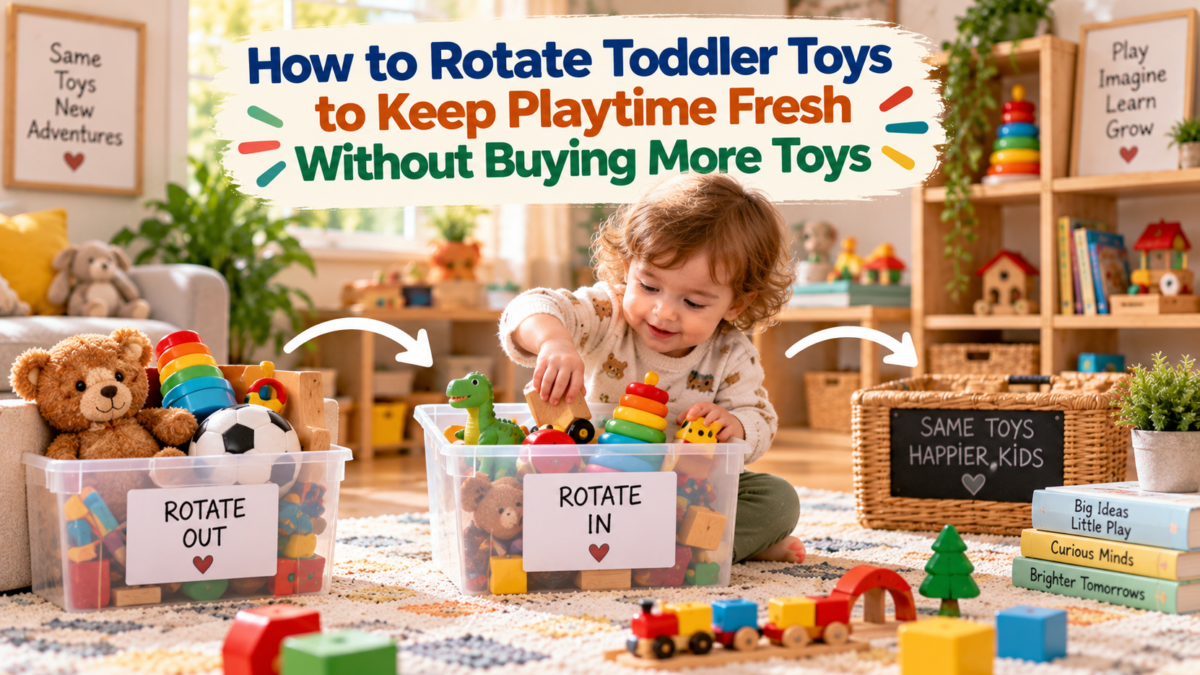
Each evening, in living rooms across the world, an all-too-familiar and disheartening scene is played out. In the middle of a room stands a toddler, surrounded by an enormous sea of plastic cars, wooden blocks, puzzle boards and soft dolls. Toys are all around strewed on rugs, hiding under chairs, falling out of overflowing canvas bins but the child complains, wanders aimlessly, knocks another bin to the floor and says with genuine despair that they have “nothing to play with.”
To a tired parent, this behavior is puzzling, if not ungrateful. It’s natural to think the child has outgrown their collection and then spend late nights online searching for the next new gadget or developmental toy that might finally hold their attention. But pediatric psychology and occupational therapy tell us that the problem is not a lack of toys but too much visual noise.
Faced with an avalanche of unstructured choices, a toddler’s developing nervous system is profoundly overwhelmed, both sensorially and cognitively. With fifty stimuli competing for visual attention, the prefrontal cortex struggles to select a single goal, sequence a plan of action or achieve a state of sustained focus. The child is driven to manic surface sampling, hopping from thing to thing, dumping bins for a cheap dopamine hit and then leaving each object seconds later. Toy abundance actively sabotages play, rather than enhancing it.
We at CozyParents believe in “intentional play,” meaning the physical environment should be a quiet collaborator in your child’s emotional regulation and creative autonomy. The basic architecture of this philosophy is toy rotation. You can get rid of choice paralysis and double attention spans, and bring back calm to your home by displaying a small, visible selection of purposeful items on open low shelves, while hiding the rest out of sight. Best of all, rotating toys requires no financial investment. Here’s how to humanize the text: “In this comprehensive guide, we explain the cognitive science behind toy rotation, provide an actionable, step-by-step process for auditing and categorizing your existing collection, explain five tried and true rotation schedules and provide practical strategies for making old toys feel brand-new season after season.”
Cognitive Foundations: Why Less Toys Equals More Deep Play
To understand how rotating toys turns a household from chaos to calm we need to understand how an early childhood brain processes physical space, visual clutter and intrinsic motivation.
1. Choice Architecture and the Eradication of Cognitive Friction
The “Paradox of Choice” is working overtime in kids’ development. A 2018 study by developmental scientists at the University of Toledo tested toddlers playing in two different environments: one that had 4 toys and another that had 16 toys. The results were astounding. In the 4-toy setting, children played with each toy for significantly longer, came up with four times as many creative uses for each item and demonstrated significantly deeper, more focused play schemes.
There is no barrier to engagement from a shelf with four deliberately spaced toys. For each option, the child’s visual cortex can register it immediately, and without visual clutter. An adult does not need to dig to the bottom of a bin to find a missing piece. The child, with well defined physical boundaries, moves smoothly from observing to doing and experiences the psychological calm of a clear horizon.
2. Deep Flow and Intrinsic Motivation The Mechanics
Psychologist Mihaly Csikszentmihalyi defined “flow” as the state of complete immersion in an activity where time seems to stop and outside distractions disappear. We see it in the two-year-old who will spend twenty solid minutes lining up wooden train cars or balancing stones along a seam in a rug. Children are born with the capacity for deep flow.
But flow needs low ambient friction and sustained intrinsic motivation. The flow is constantly interrupted in a room full of noisy, half-broken, or mismatched toys. Every time a child sees another flashing gadget across the room that has nothing to do with them, the delicate thread of their internal narrative is broken. You remove the excess and offer just a few complete, high-quality materials, and in doing so you create a protective perimeter around their attention span, giving their nascent executive function the quiet space it needs to blossom.
3. The Dopamine Reset: Reclaiming Novelty
The human brain is programd to desire novelty. In today’s consumer economy, toy makers tap into this biological drive, convincing parents to constantly purchase new products. Toy rotation taps into the very same neurological process and costs you exactly nothing.
If a toy is kept in an opaque bin in a dark closet for four to six weeks, the child’s brain resets its baseline familiarity with that item. When the toy finally reappears on a clean, open wooden shelf, the child welcomes it back with the heightened excitement, wonder and intense curiosity that is usually reserved for a brand-new holiday gift. You actually increase the play value and functional lifespan of every toy you already own by controlling its availability.
The Great Purge: How to Audit Your Existing Collection in 4 Steps
Before you can develop a successful rotation system, you have to deal with the clutter that is currently occupying space in your home. Pick a quiet evening or weekend afternoon when your toddler is napping or otherwise engaged away from home with a partner and do a full toy audit.
Step 1: The Floor Solidification Ceremony
Go around your house and gather up all the children’s toys and put them all into one room. Dump the bins on a big blanket on the floor, empty the baskets in the bedroom, gather up the plastic cars from under the sofa and gather the stuffed animals from the corner of the nursery. The psychological reality check of seeing the sheer, overwhelming volume of accumulated possessions in a single pile is essential it makes the necessity of intentional editing immediately obvious.
Step 2: The Eliminator of Ruthlessness
Go through the pile with four non-negotiable elimination questions. Have four sturdy cardboard boxes or large trash bags handy:
The Trash Bag (Broken & Incomplete): Toys with cracked plastic, broken wooden joints, missing essential puzzle pieces, or shredded cardstock go straight in the trash or recycling. Broken toys frustrate and teach children that material goods are cheap and disposable.
Donate Box (Outgrown & Passive Novelties): Make sure items are appropriate for your child’s current developmental stage. Have they outgrown simple rings that rattle or infant rolling balls? Do you have battery operated novelties that give you the whole play script, flashing LED’s and loud electronic voices? Think about donating these gently used items to a local community preschool, day care or family shelter.
The “Sentimental” Archive (Small Keepsakes): A child doesn’t need 20 sentimental heirlooms on the floor. Choose three to five of your favorite items (a handmade quilt, a wooden name puzzle or a special heirloom doll) and place them in an archival memory bin, stored safely in the top of the closet.
The Active Rotation Roster (The Core Collection): The rest of the items should be durable, multi-purpose, complete and age appropriate to your child’s current age. This curated core is what will become your rotating library.
Step 3. Organize by Play Schema and Developmental Function
Divide the rest of your active collection into 5 functional groups. If you strike a balance between these categories, each rotation cycle draws on a broad spectrum of gross-motor, fine-motor and imaginative faculties:
Fine-Motor and Problem-Solving Wooden puzzles, shape sorters, pegboards, lacing beads, threading cards, nesting cups, mechanical latches boards.
Open Ended Construction: Solid unit blocks, magnetic tiles, wood stacking arches, building planks and interlocking bricks.
Symbolic and Dramatic Role-Play: Play food and kitchen tools, child-sized cleaning implements, dress-up silks, animal figures, baby dolls and doctor kits.
Active Movement and Gross-Motor: Balance boards, indoor stepping stones, crawl tunnels, soft bowling pins, jumping spots, push-pull rolling toys.
Creative and Sensory Resources: Chunky beeswax crayons, sensory bin bases (dried beans or oats), play dough with wooden stamps, picture books.
Step 4: The Closed Storage Tank
Choose an area in your house that is completely out of reach and out of sight for your toddler like the top shelf of a master bedroom closet, a tall storage cabinet in the hallway or opaque latching totes stacked in the basement. Use stackable storage bins with labels to store most of your sorted categories. The toys that are not out need to be out of sight. If a child can see twenty storage bins piled in a corner, they will ask to open those bins and the system falls apart.
5 Toy Rotation Frameworks That Work
There is no one “right” schedule for rotating toys. The best rhythm is influenced by your child’s temperament, your storage space and your family’s routine. Here are 5 proven rotation frameworks used by intentional parents and Montessori educators:
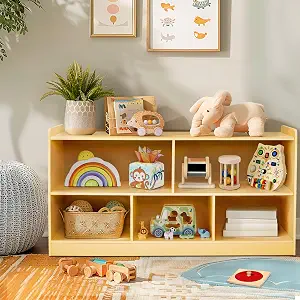
1. The Montessori Low-Shelf Method (Ideal for Toddlers 12-36 Months)
The Setup: A simple, low two-tier open wooden shelf that can hold a total of 6 to 8 items, each displayed in a dedicated wooden tray, a shallow canvas basket or a freestanding space with generous margins around it.
Why It Works: Toddlers love predictability and spatial order (a concept Maria Montessori referred to as the “Sensitive Period for Order”). If you change all the toys on your shelf overnight, an eighteen month old might feel disoriented and anxious. You keep your psychological security but you also bring in a little current of fresh discovery by just rotating two or three items, holding familiar anchors in place.
2. The Weekly Complete Reset (Best for 3-5 year old preschoolers with lots of energy)
The Setup: A select play station with 5 to 7 toys that represent the core developmental categories (i.e. one puzzle, one building set, one dramatic play kit, one gross-motor tool and one art tray).
The Cadence: Each Sunday nite, empty the shelf completely, refill it with a new selection of 5 to 7 items from your closet stock.
The reason it works: Preschoolers have a longer attention span and can handle a whole change of environment with enthusiasm. Every Monday morning we wake up to a completely different playroom, which makes for a fun rhythm to our week and sets the tone for the next few days to be calm and focused.
3. The Deep Explore “Schema-Focused” (For the Really Deep Explorers)
The Setup: Build the shelf around a particular developmental “schema” a pattern of repetitive behavior your child is currently displaying in everyday life.
The Cadence: During the time the schema is in progress (typically 2 to 4 weeks).
The Reason It Works: If your toddler is into the “Enclosing Schema” (building walls, hiding inside boxes, wrapping toys in cloths) your rotation might include empty wooden crates, silk scarves, nesting bowls, and animal figures. If they are in the “Trajectory Schema” (throwing, rolling, tracking movement), your shelf may include ball runs, ramps, rolling chime cylinders and soft beanbags. Match your rotation to their natural neurological schema, and you get hours of uninterrupted joyful focus.
4. “Daily Special” Floating Tray (Ideal for Small Apartments)
The Setup: If your family lives in the city and doesn’t have a lot of floor space or a room big enough for a large shelf keep a permanent collection of only 3 anchor toys on a small mat, along with one “Daily Special” in a shallow wooden tray on a low coffee table.
The Cadence: Change the “Daily Special” tray every morning when you make breakfast.
Why It Works: A new tray with three animal figures in a bowl of dried chickpeas, or a wooden lacing sheep with a single lace, will pull a toddler right into morning independent play, giving parents twenty minutes of uninterrupted time to make coffee and prepare breakfast in peace.
5. The “Toy Library” Check-Out Model (Best for Older Preschoolers who can be Independent)
The Setup: The child has full visual access to the storage closet (or a binder with pictures of available toy sets) but there are only four parking spots marked with tape on the shelf in the family room.
The Rhythm: Entirely child-initiated, on demand.
Why it works: The wooden train set can only be taken out when the child puts the building blocks back in the closet bin and puts the new toy in the empty spot. This system teaches basic lessons in resource management, physical accountability and delayed gratification, turning cleanup into a self-contained ritual.
4 Rules for Show Designing a Powerful Prepared Environment
How it is displayed on the shelf is as important as the toy itself. If you toss a beautiful set of wooden blocks into a deep, opaque plastic bucket and shove it in a corner, your child will likely walk past it without a second thought. Use these four display principles to encourage spontaneous exploration:
1. The Two Inch Breathing Space Principle
Don’t cram toys together on a shelf like books in a busy university library. Each toy should have two to three inches of empty negative space around it on all sides. Negative space is a child’s eyes that highlight the physical beauty of each object and allow small, clumsy toddler hands to lift an item off the shelf without knocking over neighboring toys.
2. Disassemble for Display
Never set an assembled toy on a rotation shelf. When you show a wooden puzzle with all the pieces perfectly formed into their slots, or a shape sorter with its lid closed and all blocks inside, the toy announces that the work is already done. Instead, put the empty puzzle board up on the shelf with the loose pieces all neatly arranged in a little shallow basket right next to it. The presentation of materials in an unfinished form is an open psychological invitation for the child to complete the task.
3. “Parts-to-Whole” Scatter
Explore the philosophy of “strewing”: the art of casually leaving an open-ended scene set up on a low table or rug, to spark curiosity. Instead of just leaving a basket of magnetic tiles on the shelf, build a simple three-sided arch on a play mat and place four extra loose tiles and two toy animals right in front of it. Who lives in this barn? As soon as your toddler enters the room, his brain instantly picks up on a story already in progress. Can I end the roof? Strewing fills the gap between passive storage and active play.
4. Eye Level Height and Natural Lighting
Put your rotating shelves on walls that get lots of natural light, well below adult eye level. When you’re standing in a room, a toddler’s eyeline is somewhere between your knees and your hips. Get on your stomach on your living room floor and see the room from your child’s point of view. Can you see the toys? is the shelf corner safe? Is the space open, inviting and grounded? When designing from the child’s perspective, the environment speaks to them directly.
The Art of the Cross-Pollination: Bringing Old Toys Back to Life
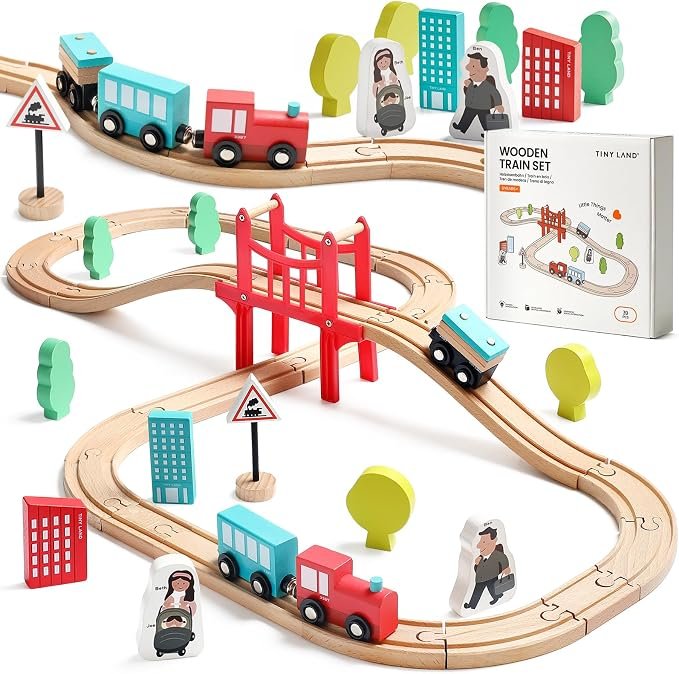
The real magic of an intentional toy rotation system lies in “cross-pollination” the intentional pairing of two familiar, unrelated toys from different categories to spark entirely new cognitive play schemas. When kids combine different materials, they move from functional manipulation to complex symbolic world-building:

Wooden Train Tracks + Silk Play Cloths: Add a blue silk scarf and a green silk cloth to a classic wooden railroad. The train track is suddenly no longer a simple wooden loop. It crosses a rushing river and winds through an emerald valley, inspiring rich narrative vocabulary and geographic storytelling.
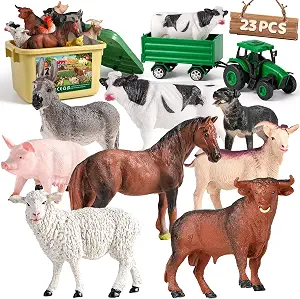
Magnetic Tiles + Farm Animal Figurines: Rather than just displaying magnetic tiles, add a small basket of realistic farm animals nearby. Geometric prisms become stables, feeding troughs, and animal hospitals. You have to figure out, spatially, how to build pens large enough to enclose the horses and cows.
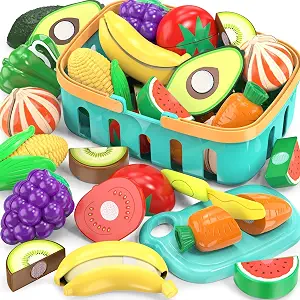
Play Food + Sensory Base Grains: Place a wooden cutting carrot and a toy soup pot in a shallow tray with two cups of dried brown lentils. What was once a simple pretend-cooking set is transformed into a high-resistance sensory laboratory where children scoop, bury, stir, and sift tactile grains.
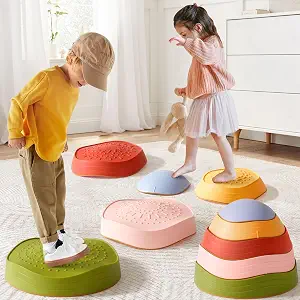
Balance Stepping Stones + Stuffed Animals: Place indoor balance stones on a wool rug and put three favorite stuffed animals at the far end of the room, along with a small wooden doctor kit. The simple motor exercise of crossing the room becomes a veterinary rescue mission across a fiery volcanic mountain, sustaining energetic play for forty-five minutes.
Troubleshooting the Rotation: Common Pitfalls and Solutions
Even the best thought-out toy rotation systems encounter practical bumps in the road. Here’s how to fix the most common problems around the house:
My Toddler Wants A Toy That’s Put Away
It’s pretty normal for a child to suddenly remember a favorite wooden fire truck that was put into closet storage two days ago. When this happens, affirm their memory with warmth and enthusiasm, “You are remembering your red fire truck! You love rolling that across the rug.”
Don’t hurry to the closet straight away to get the item out. That breaks down the system boundaries and teaches the child that the closet is an open vending machine. Instead, offer empathetic scaffolding: “The fire truck is resting in the high cabinet right now. It will be back on your shelf next Sunday! Would you like to build a fire station with your wooden blocks right now, or roll the wooden bus?” If the child remains fixated on the item for several consecutive days, make a mental note to include it in the very next rotation cycle.
My Kid Just Knocks Shelf Stuff Off Without Even Playing
Toy dumping is not a malicious act of defiance but a clear physical signal of either exploration of developmental schemas or visual overwhelm. If your child pushes his arm across the shelf and drops everything on the rug, do these two things immediately:
Reduce the Shelf Count: If you have eight items on the shelf, cut it in half to four. Dumping is often a nervous system response to having too many options.
Channel the Dumping Schema The child’s brain may be needing the physical sensation of emptying containers. Set up a purposeful dumping station: a big canvas basket full of light wooden spools of yarn, silk scarves, or soft foam blocks, and an empty bucket. Let them dump that particular basket as many times as they like.
“Plastic Novelties Family Members Keep Buying That Clog the System”
Gift giving is often the way well-intentioned grandparents and extended family show their love, showing up with giant plastic play sets or loud battery-operated gadgets out of sync with your purposeful home. Managing this dynamic takes proactive, gracious boundaries:
Create a “Experience-First” Wish List: Assist generous relatives in finding gift memberships to local children’s museums, botanical gardens, zoos, gymnastics open gyms, or swimming lessons.
The “One Special Toy at Grandma’s House” Strategy: When a relative gives you a giant, loud plastic playset, politely suggest that the toy stay at their house: “Amelia loves this so much! Let’s keep this at Grandma’s house so she has a special, exciting surprise waiting for her every time she comes to visit you.” This keeps your living room calm while respecting the grandparent’s relationship with the child.
Growing Contentment in an Age of Plenty
Setting up a toy rotation system is more than a neat organizational trick to keep living room rugs free of clutter. It is an act of profound responsibility for the environment and psychotherapeutic care. In a world of hyper-commercialism that constantly whispers to our children that happiness, satisfaction and fun are always found in the next purchase, toy rotation teaches a counter-cultural truth: that deep joy, boundless creativity and sustained wonder are found by looking more closely at what we already have.
When you sit quietly on the floor of your living room looking at a neat wooden shelf with four simple, beautiful materials and watch your toddler spend an hour building an intricate world with a dozen unit blocks and two silk cloths, you are seeing far more than play. You are witnessing a young human being learning the rare, fundamental skills of focus, inner joy and creative independence.
We believe that each and every item in your home should serve a clear purpose, foster genuine human connection and promote household serenity. You don’t have to buy another toy this season to unlock your child’s brilliance; you just have to clear the noise, step back and give their remarkable imagination the quiet space it needs to soar.
We invite you to explore more CozyParents for mindful parenting examples, expert-backed gear reviews, and intentional approaches designed for your expanding family. Are you currently rotating toys weekly or monthly in your home? Or are you getting ready to do your very first whole-house toy audit this weekend? We’d love to hear your experiences and thoughts in the comments below what are your tips for creating peaceful, intentional spaces in your home?