
Go into almost any house with a young child and you will see a common domestic scene: overstuffed canvas bins in the corner, brightly colored plastic things peeking out from under the living room sofa and a floor littered with puzzle pieces, wheeled cars and half-dressed dolls. In our consumer culture, toys accumulate at an astonishing speed. Well-meaning grandparents stack up big boxed playsets, birthday parties shower toddlers with dozens of plastic novelties, and targeted social media ads persuade exhausted parents that the next sensory gadget will yield twenty minutes of uninterrupted independent play.
But as the toy bins overflow, parents witness a baffling, counterintuitive paradox: the more toys a toddler has, the less they actually play.
If you give a two-year-old a sea of options, they don’t spend hours happily exploring on their own. They wander from bin to bin knocking over bins with a clattering racket. They pick up an object and play with it for ten frantic seconds and then cling to a caregiver’s leg whining that there is “nothing to do.
This behavior is frustrating to a tired parent. But developmental psychology says that the child is not ungrateful; they are simply cognitively overwhelmed. In this all-encompassing guide, we examine the developmental neuroscience of toy volume, tackle the specific question of how many toys a toddler really requires on their shelves, offer specific developmental quotas for each age group between 12 and 36 months, and share practical ideas to get your house out of toy excess for good.
The Neurological Argument For Fewer Toys
To understand why the plethora of toys stymies early childhood play, we need to look at the biological architecture of a toddler’s brain. The brain is rapidly synaptogenizing , making millions of new neural connections every single day between 1 and 3 years old . This neuroplasticity enables toddlers to learn language and physical mechanics at breakneck speed, but their prefrontal cortex the control center that governs executive function, impulse control, selective attention and emotional regulation is still in its earliest infancy.
1. Visual Overload and the Breakdown of Selective Attention
An adult can easily walk into a cluttered room and filter out the peripheral objects to focus on a laptop screen or a book. A toddler can’t. In early childhood, the visual cortex has an open aperture; every bright color, blinking LED and scattered part competes equally for attention.
A child who looks at a shelf crowded with thirty unrelated objects has its attentional filters instantly flooded. The brain cannot sequence a play schema. It cannot decide to build a tower or feed a doll or push a train. The child is driven to frantic “surface sampling,” darting quickly from toy to toy, looking for a quick dopamine hit but never settling into the focused mental state that is necessary for deep learning.
2. The landmark study from the University of Toledo
The idea that “less toys = better play” is not just the mantra of a minimalist lifestyle, it’s borne out by clinical research. In a groundbreaking 2018 study published in the journal Infant Behavior and Development, developmental researchers at the University of Toledo put toddlers in two different play environments:
Group A: played in a room with 4 toys.
Group B: played in a room with 16 toys.
The differences were stark. When there were 4 toys, toddlers played with each item for a significantly longer period of time. More interestingly, they investigated much more creative, varied ways to interact with each toy (what the researchers called “play schemas”). Children did not simply spin wheels or press buttons. They used objects symbolically, incorporated them into imaginary narratives and sustained focused concentration.
The researchers found that toyless environments encourage greater engagement, more advanced motor planning and longer attention spans.
3. Cultivating Intrinsic Resourcefulness
If a child is given a never ending supply of single purpose toys like an electronic kitchen that makes sizzling sounds or a plastic car that drives itself they don’t have to use their own imagination. The toy does something, the child looks.
When you reduce the excess and offer a small choice of open-ended materials, you ask the child to be the author of the experience. A wooden arch can be a bridge, a cradle, a barn for animals, a telephone. Boredom is no longer a crisis that calls for a new gadget; it’s the fertile ground in which real creativity, problem-solving, and resilience grow.
The Core Number: How Many Toys Should Exist?
The question of how many toys a toddler needs needs to be distinguished between total owned inventory and accessible shelf inventory.
A household might have 30 to 40 high quality toys, stored in closed closet repositories or basements (more on this later). But the number of toys within reach of your toddler on their active play shelves at any one time should be astoundingly small.
As a general principle, in accordance with Montessori principles and standards of occupational therapy:
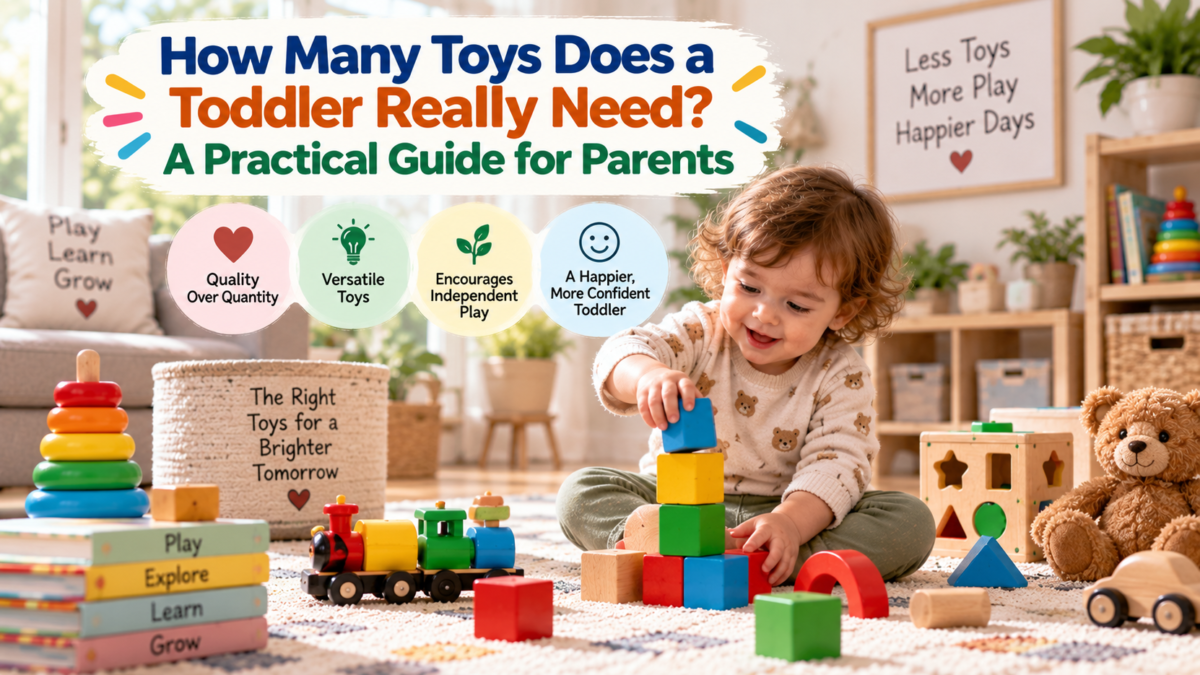
A purpose-driven toddler play space should have 4-8 toys available at any given time.
When 4-8 purposeful items are displayed on a low, open shelf, there is plenty of space between each object, creating a calm and inviting environment where a child can see his or her options clearly, initiate play independently and clean up his or her materials with minimal help.
Developmental Profiles & Age-by-Age Toy Quotas
A toddler’s mental capability, motor skill and play endurance change dramatically between their first and third birthdays. Tailoring the number of toys to their developmental stage ensures that their play space is stimulating yet not too overwhelming.
12 to 18 Months The Emerging Explorer
Developmental Focus: Cause and effect reasoning, basic object permanence, gross-motor pulling to stand, early fine-motor pincer grasp.
Accessible Shelf Target: 4-6 toys total.
At this stage, pre-walkers and budding toddlers are easily overwhelmed by visual complexity. They manipulate the physical world mainly through sensorimotor schemas like dropping, banging, mouthing and rolling. Too many items on an open shelf can lead to indiscriminate shelf clearing and dumping.
The Perfect 5-Item Shelf Setup:
One Object Permanence Toy: Simple wooden ball drop box or coin box
One Stacking or Nesting Set: Solid wood stacking rings with a flexible dowel, or nesting cups.
One Kinetic/Rolling Toy: A push-along wooden car with easy-grip cutouts or a rolling chime cylinder
One Fine-Motor Challenge: One single-shape puzzle (such as a large wooden knob circle puzzle) or an oversized pegboard.
A Gross-Motor Anchor: a low balance board laid flat on a play mat or indoor stepping stones.
18 to 24 Months: The Kinetic Builder
Focus on Development: Bilateral coordination, rotational wrist mechanics, early symbolic imitation, taxonomic sorting.
Shelf Goal: 6-7 toys total. Reachable.
This is the time when toddlers have a boom in physical autonomy and verbal understanding. They begin to imitate everyday household rituals and to investigate spatial relationships between objects.
The Perfect 6-Item Shelf Arrangement:
- One Open-Ended Building Set. A shallow basket holding 12 to 16 solid hardwood unit blocks.
- One Slicing or Fastening Toy A child-safe wooden knife wooden fruit set for cutting.
- One Geometric Sorter: A wooden shape-sorting box with 3 or 4 classic shapes (circle, square, triangle).
- One early small-world set: 3 to 4 chunky wooden farm animals in a shallow tray.
- One Practical Life/Fine-Motor Tool: simple latches board, screw top wooden barrels, peg pounding bench.
- One Sensory/Tactile Resource: A small tray with a wooden scoop and large wool felt balls.
24 To 36 Months The Storyteller
Developmental focus: Complex spatial construction, symbolic role-play, narrative vocabulary, emotional projection.
Shelf Target: 7-8 toys total, accessible.
Toddlers and young three-year-olds have a longer attention span and can follow multi-step play sequences. They externalize internal stories with physical toys, negotiate emotional boundaries, and master fine-motor precision.
The Perfect Shelf Layout in 8 Items:
- One Construction System: A collection of magnetic tiles (16-20 pieces) or interlocking wooden building planks.
- One multi-piece puzzle: wooden jigsaw puzzle 4-8 pieces with empty board and pieces in small tray.
- One domestic role-play set: small wooden tea set or crate of play food including two cups and a pot.
- One Transit/Kinetic Set Simple wooden train track loop with engine and two magnetic cars.
- One Dexterity Game: Wooden animal with cotton lace and a stiff tip.
5 Functional Categories Every Playroom Must Have
Intentional parents don’t count their stuff, or go out and buy random things, they build their home around functional developmental categories. When picking out a shelf for your toddler, try to include one item from each of these five basic pillars:
1. Fine Motor and Problem Solving Materials
Purpose: Improves isolated finger manipulation, wrist rotation, pincer strength and hand-eye coordination required for later writing and self-dressing.
Examples: Puzzles, shape sorters, pegboards, lacing cards, wooden nuts and bolts to put together, latches boards.
2. Open-Ended Construction Systems
Purpose: Teaches physical physics (gravity, balance, friction, cantilever mechanics) and develops spatial imagination and divergent thinking.
Solid hardwood unit blocks, magnetic tiles, wooden stacking arches and interlocking foam or wooden bricks.
3. Dramatic and symbolic role-play props
Purpose: Allows children to practice real world domestic and community roles and so develop Theory of Mind, empathy, emotional self-regulation and pragmatic language.
Examples: include pretend food and kitchen tools, child-sized cleaning brushes, baby dolls with a swaddle blanket, doctor kits and realistic animal figurines.
4. Gross Motor and Vestibular Anchors
Purpose: Provides proprioceptive “heavy work” and vestibular input for central nervous system stabilization and core postural tone development.
Examples: Curved wooden balance boards, indoor stepping stones, low climbing arches, floor balance beams and push-pull rolling toys.
5. Creative & Sensory Resources
Purpose: To promote tactile desensitization, bilateral use of tools and slow emotional expression through open-ended materials.
Examples: Sensory trays (dry oats, lentils or river stones), chunky beeswax block crayons, non-toxic modeling clay with wooden rollers, picture books.
5 Steps to Declutter Toys This Weekend
Do you want to create a peaceful, focused play space in your home? This weekend, find two calm hours when your toddler is napping or out with a partner at the park and use this five-step decluttering framework:
Step 1: The Big Floor Consolidation
Gather up all the toys from everyplace in your home, under the beds, in nursery baskets, under the sofas and in the car, and lay them out on a large blanket in the living room. Seeing the physical bulk of your current collection in one pile provides the emotional clarity to edit ruthlessly.
Step 2. The Merciless Purge
Separate the stack into three distinct bins:
Recycle/Trash Bin: Broken plastic items, dried up markers, toys with missing crucial puzzle pieces, broken wooden objects. Broken toys teach kids that physical possessions are cheap and disposable and it creates frustration.
Donation Box: Duplicates, promotional plastic junk, outgrown baby gear, singing and flashing battery-operated novelties with minimal child agency. Donate these gently used items to a local shelter, nursery school or charity shop.
The Active Collection: Robust, versatile, complete and developmentally engaging toys your child loves actively or will soon grow into.
Step 3: Create the 8-Toy Shelf Baseline
Select 6-8 items from your active collection that represent a balance of the five core functional categories: fine motor, open-ended construction, dramatic role-play, gross motor, and sensory/art. Put them on a low, open shelf, with 2 to 3 inches of empty negative space around each toy.
Step 4: Store the rest in opaque totes
Put the other 20 to 25 items from your active collection into two or three opaque, stackable storage bins. Label the bins by category or rotation number (e.g., “Rotation Set A,” “Rotation Set B”) and store them in high closet storage, completely out of your toddler’s sight.
Step 5: Politely Turning Down Future Donations
The other half is keeping it from becoming a toy magnet again, which requires some proactive communication with well-meaning friends and family members. Clearing out your playroom is half the battle.
Make a “Experience-First” Wishlist: Point generous grandparents toward memberships to local children’s museums, botanical gardens, community pools or gymnastics classes.
The “One Toy at Grandma’s House” Script: When relatives give big, loud plastic playsets, say with a smile, “Amelia enjoyed having fun with this! Let’s keep this special set at your house so she has an exciting surprise waiting for her every time she visits you.”
The Stagger Protocol: When you receive multiple gifts at holidays or birthdays open them gratefully, allow your child to explore them for an afternoon, then quietly transfer 75% of the new items directly into your closed closet reservoir, adding them at a rate of one every couple of months over the next few months.
The Peace of Sufficiency
The question of how many toys your toddler really needs isn’t a matter of adhering to some ascetic, joyless doctrine of minimalism. It is an act of deep environmentalism, cognitive stewardship and parental peace.
Removing the visual noise from the living room and giving your child four to eight beautiful, purposefully chosen materials to work with is a way to open space for something magical to happen in a way that is not part of the frantic cycle of consumer toy accumulation. You give your toddler the quiet they need to get into a deep flow, develop authentic resourcefulness, and discover the endless wonders of their own imagination.
At CozyParents we think it’s better to have fewer objects in your home that serve a purpose, foster family connection and promote household serenity. You don’t have to make your living room a toy store to give your kid a magical childhood. Just a few thoughtful tools, an open horizon, and a quiet space to let them play.
We invite you to continue your journey with CozyParents, where you can find mindful parenting frameworks, expert-backed gear roundups and intentional strategies created for your growing family. How many toys are you currently displaying in your home? Are you planning to tidy up your play shelves this week? We’d love to hear your thoughts and experiences in the comments below what are your ways of creating peaceful, intentional spaces in your home?