
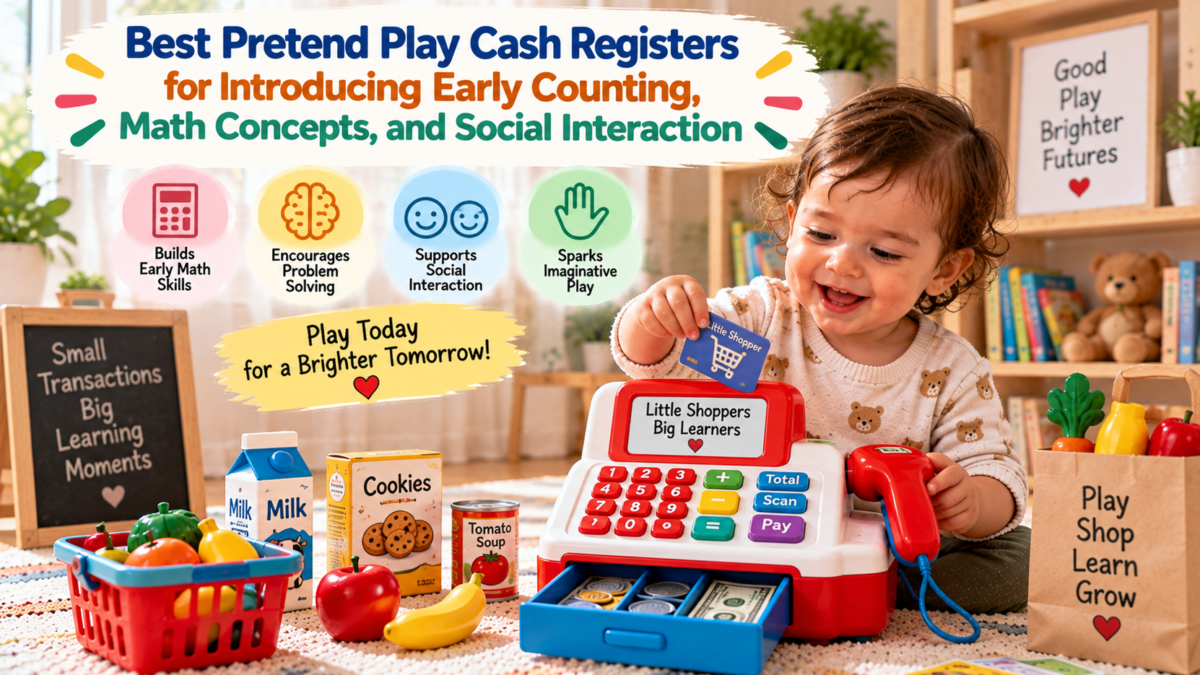
The instant a three-year-old slides behind a wooden counter, yanks a cash drawer open and peers out over the living-room rug, there is an earnest grown-up gravity that descends on him. They stiffen, their eyes glint in greeting and they ask the eternal question that they have heard adults ask a hundred times: “Can I help you find something today?” You hand them a wooden apple. They examine it dramatically, tap three touch-sensitive buttons on the register, run a wooden card through a slotted channel and with utter certainty declare: “That will be four dollars, please.”
In that slow exchange, a regular living room floor becomes a thriving neighborhood marketplace. The child is not just mimicking a task; they are practicing a sophisticated form of human social contracts, mathematical equivalence and pragmatic communication.
However, if you were to visit a commercial toy superstore today, you would be faced with a dizzying array of plastic, battery operated supermarket consoles. These electronic behemoths are equipped with flashing neon bar codes, automatic digital scanners that project screeching red lasers and synthetic robotic voices screaming pre-recorded prices at the top of their lungs. Press a button and the mechanical voice booms: “Thank you for shopping! Credit approved!” and twenty seconds of tinny celebratory music. The child doesn’t have to calculate, negotiate, count physical tokens or even speak. The electronic console dominates the story, turning a potentially rich dialog of social reciprocity into solitary, passive button-mashing.
At CozyParents, we believe in the power of “intentional play” that the toys in our homes should be peaceful, lasting partners in our children’s cognitive and social development. Child-powered cash registers are a perfect example of this philosophy. They depend on honest physical mechanics sliding drawers, tactile wooden keys, physical cash, face-to-face conversation and offer deep mathematical and linguistic foundations without the acoustic clutter of motorized novelties. In this deep dive, we’ll explore the neurology and social dynamics of make-believe trade, outline pragmatic structures for adding a play store to a peaceful home, and provide a list of 7 tried-and-true cash registers on Amazon US that give your kid the respect of a competent, chatty apprentice in everyday life.
Developmental Foundations The Counter’s Bodily and Cognitive Mechanics
To appreciate the lasting educational and therapeutic power of child-powered cash registers, we must consider how early numeracy, hand mechanics, and social perspective-taking coalesce in pretend commerce. Pediatric occupational therapy, speech-language pathology and developmental psychology all agree: Running a pretend storefront is a whole-brain workout.
1. Cardinality, Concrete Value and One-to-One Correspondence
Children are not ready for abstract arithmetic worksheets until they have built up mental models of quantity based on physical matter. A cash register makes concrete objects out of abstract mathematics.
One-to-One Correspondence: The exchange of three wooden coins for three felt carrots illustrates to children that each physical count is for a single object at a time.
Cardinality: When a toddler says “One, two, three” they are learning that the last number they say tells them how many there are in total.
Value Conservation: Trading one paper bill for several small wooden coins introduces early ideas about equivalence of currency, building the neural infrastructure for addition, subtraction and algebraic thinking.
2. Pragmatic language, conversation scripts and social empathy
Above all, language is a tool of human connection. Speech therapists say playing store requires “pragmatic language,” the rules of communication for the context, the social rules of communication.
Conversational Turn-Taking: A transaction is an organic script. The cashier says something (“Hello!”). Waits. Waits for the customer to respond. Hears an order. Says a prompt (“That’s two coins”). This structured back-and-forth format teaches verbal impulse control and active listening.
Theory of Mind and Perspective-Taking: Children Need to Adopt a Divergent Psychological Perspective in Pretend Store Play. The child has to guess what the customer may want, negotiate if an item is “out of stock” and learn proper social etiquette (“Thank you, have a nice day”). This rehearsal encourages empathy and decreases social anxiety in real life public spaces.
3. Two-Handed Tool Use and Pincer Precision in Fine-Motor Skills
Working with a cash drawer is a small hands intensive occupational therapy clinic:
- It requires a fine three-finger pincer grasp and sharp visual-motor targeting to place a thin wooden or plastic coin into a narrow drop slot.
- To swipe a play credit card through a narrow channel, you need wrist stabilization and a graded arm speed too fast and you tilt the register; too slow and you jam the card.
- Paper bills are sorted into a flat register drawer by denomination . This is an example of bilateral integration as one hand stabilizes the drawer while the other hand flattens and separates currency .
The Product Roundup: 7 Purposeful Pretend Cash Registers
Choosing a cash register that can withstand the heavy-duty business of everyday life while blending into a peaceful family living space means favoring sustainable hardwoods, non-toxic water-based finishes, smooth mechanical latches and sturdy currency. Here are 7 highly rated and tried and true options on Amazon US that fit the CozyParents philosophy.
1. Melissa & Doug Spin and Swipe Cash Register
Classic, heirloom quality wooden play till with spinning number wheels, built-in play cash drawer with real bell chime, wooden coins that drop through color-matched top slots and felt play credit card with swiping slot.
Why it works for Child and Home: Melissa & Doug took all the electronics out for brilliant mechanical cause-and-effect. Designed for toddlers and preschoolers (ages 2 to 5), children turn tactile wooden dials to match colors and numbers, drop chunky wooden coins that fall straight into the interior drawer, and push a wooden lever that opens the till with a satisfying, gentle mechanical ding. The solid wood construction is built to last through thousands of enthusiastic transactions and the coins store safely in the closed drawer, keeping your playroom floor free of clutter.
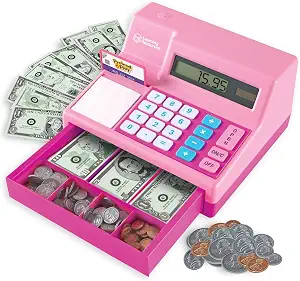
2. Learning Resources Cash Register Cash Calculator Pretend & Play (73 Pieces)
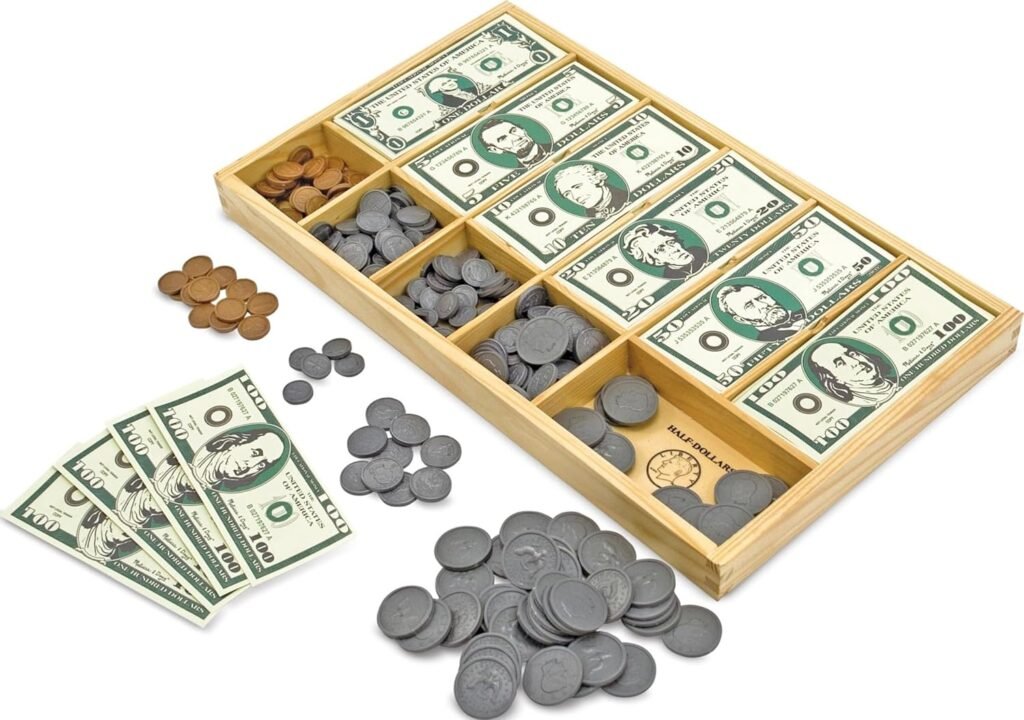
Description: Iconic educational classic featuring a large solar powered LCD calculator screen, oversized tactile rubber buttons, a spring loaded mechanical cash drawer with a bell chime, life size play currency (bills and coins) and a pretend plastic credit card.
Why It Works for Child and Home: This register is a beloved fixture of kindergarten classrooms everyplace for one very important reason: it employs a solar-powered, real working calculator. No batteries are needed. Press 2 + 2 = on your preschooler and the solar screen gives you the right answer of 4. Now you’re really connecting the early toddler button-pressing with real elementary school arithmetic. The cash drawer is big enough for bills to be laid flat without crumpling and the realistic US play currency gives children authentic exposure to quarters, dimes, nickels and dollar bills.
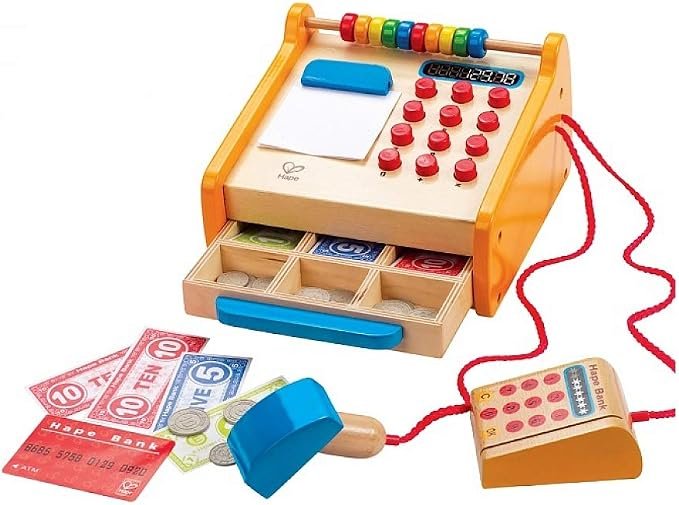
3. Hape Checkout Register Pretend Play Set
Details: This beautifully designed wooden cash register is made out of FSC certified birch and maple plywood. It features a working wooden abacus bead counter, soft touch push button keyboard, handheld wooden barcode scanner on a cotton cord, card swiper and a roll of paper receipts.
Why it works for Child and Home: Hape brings European minimalism with developmental tools that are thoughtfully designed. Children can tally groceries up instead of using electronic screens, sliding counting beads back and forth on the built-in mini abacus. Older preschoolers can practice early writing strokes and scribble prices on the paper receipt roll. The warm satin smooth wood and the soft gray and white accents blend seamlessly into modern living rooms without visual noise.
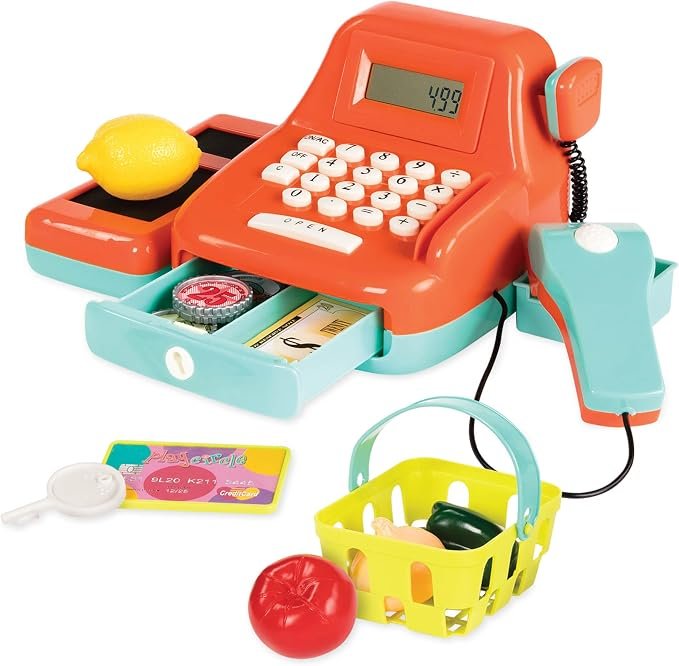
4. Battat Kids Cash Register with Scanner & Sounds, 26-Piece Set Pretend Play
Description: This eco-friendly cash register is made without plastic and is made in Thailand from sustainable chemical-free kiln-dried rubberwood and non-toxic waterborne pigments. The keys are soft pushable rubberwood buttons, there is a credit card slot, a mechanical till drawer and a slot for paper receipt tape.
Why It Works for Child and Home: For families who are committed to 100% natural, plastic-free living, there’s nothing like PlanToys. The buttons are blocks of smooth-sanded rubberwood, that yield to finger pressure, and provide a rich proprioceptive feedback. The drawer opens effortlessly, free from the harsh mechanical springs, and its gentle curved edges make it remarkably safe for households with younger, mouthing siblings. Its muted earth tones look like a boutique decor piece on an open shelf.
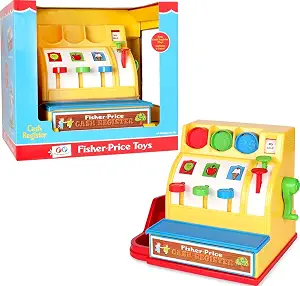
5. Basic Fun Fisher-Price Classics Retro Cash Register (Reissue 1974)
Description: Authentic reproduction of the legendary 1974 classic toy cash register with ergonomic side-turn hand crank, three color-and-size-matched coin slots, spring-loaded drawer, ringing mechanical bell chime, and six durable, oversized plastic coins .
Why It Works for Child and Home: For younger toddlers (18 months to 3 years) who aren’t ready for paper money or complex buttons, this mechanical marvel is pure developmental perfection. The child drops a coin into the slot of the corresponding color, turns the giant hand cranks, and watches the coin drop into the drawer as a bell rings. Rotating the side crank works rotational wrist supination and shoulder stabilization. You push the front lever and the drawer pops open and the coins roll down the side ramp. It’s battery-free, almost indestructible and endless cause-and-effect fun.
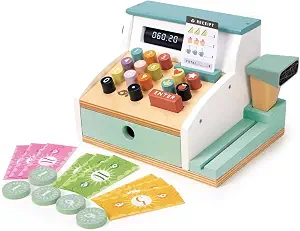
6. Tender Leaf Toys Wooden General Store Cash Register
Description: This is a vintage style wooden cash register made from sustainable rubberwood and non-toxic paints. It includes a pop-up printed wooden display screen, wooden buttons on internal springs, a barcode reader, a wooden card swiper and 5 printed wooden bills with coins.
Why It Works for Child and Home Tender Leaf Toys adds artisanal storybook charm to childhood play. The register shows illustrated wooden currency that never tears or gets wrinkled like cheap paper money. The spring-loaded buttons have a tactile feel, offering a crisp and bouncy resistance when pressed, and the retro general store esthetic is designed to spark imaginative stories, turning an afternoon into a home-baked bakery, a seaside flower shop or a warm post office.
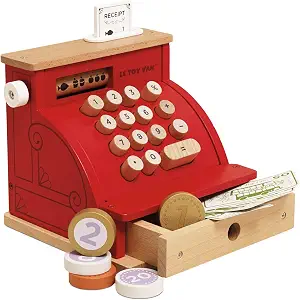
7. Le Toy Van Honeybake Wooden Cash Register
Wooden till painted in soft retro red and natural timber, designed in Britain. Squishy silicone push buttons. Bell on spring loaded wooden cash drawer. Wooden till receipt roll. Wooden credit card with play money.
Why It Works for Child and Home: Le Toy Van is excellent at multi-sensory ergonomics. The keypad is made of flexible silicone buttons, providing a uniquely satisfying squishy tactile contrast against the solid hardwood frame. The spring loaded cash drawer pops open with an authentic mechanical bell chime that never requires batteries. Its compact footprint easily fits on small sideboards in the nursery or low coffee tables, making it the perfect option for urban homes with limited play space.
Rituals to Soothe the Daily Rhythms of the Storefront
A pretend cash register is a great tool for behavior management and daily transitions. Here are four easy ways to add pretend commerce to your family life:
1. Farmers Market ‘Snack Depot’
Turn the afternoon snack time into an engaging cognitive game. Place small bowls of fresh fruit, cucumber slices and crackers on the kitchen island. Put a cash register on the counter and give your toddler three wooden tokens. Invite them to “buy” their afternoon snack: “Strawberries are one coin; crackers are two coins.” This makes eating an autonomous, math-filled ritual that takes the whining out of afternoon mealtimes and encourages adventurous eating.
2. The Library Book Checkout Errand
Set up the cash register on the nursery rug as the “Community Library Desk” before the quiet time in the afternoon or the reading before bed. Have your toddler pick three picture books from their shelf and bring them to the counter to “scan” with their wooden barcode scanner. Press the register keys, stamp a pretend date in the book and hand them their loan. This well-known, silent role-play turns boisterous gross motor play into a tranquil literary state.
3. The Toy Rental Clean-Up Market
Just don’t have cleanup battles with commerce if you’ve got a living room rug littered with scattered building blocks. Play the part of the “Toy Inspector.” Tell your child, “The warehouse is accepting blue blocks! For every three blocks you drop in the cash drawer, I’ll give you a play dollar.” Toddlers will enjoy running around the room, grouping things into threes and dropping them in the storage bin to earn their coins, making cleanup a fun game of spatial sorting.
4. Bedtime “Closing the Till” Wind-Down
A closed play store is a strong signal that the day’s activities are winding down. Before you go to the bath, sit down with your child and “close the shop.” Count the day’s coins together, smooth out the paper bills into the drawer, turn the key to lock the till, and flip the sign to “CLOSED.” Whisper goodnight to the cash register. A simple ritual that gives a predictable neurological shift from commerce to rest.
A Tribute to the Able Apprentice
Selecting a well-made, realistic-looking pretend cash register is an investment in your child’s mathematical confidence, linguistic agency, and love of learning that will last a lifetime. By providing simple, well engineered tools that respond to physical mechanics and human imagination, instead of electronic microchips, you are creating a calm sanctuary where childhood milestones unfold with joy and grace.
At CozyParents we believe that everything in your home should have a clear developmental purpose, invite mindful connection and facilitate household serenity. But when you sit on the floor, stretch out your palm and trade a wooden coin for a pretend flower you see so much more than play. You see a young human learn the beautiful art of community.
Continue browsing CozyParents for mindful parenting frameworks, expert-backed gear roundups, and intentional strategies for your growing family. Does your child love to run a pretend grocery store, or are you setting up your first low-shelf checkout station this week? We would love to hear how you create peaceful and intentional spaces in your home in the comments below.