

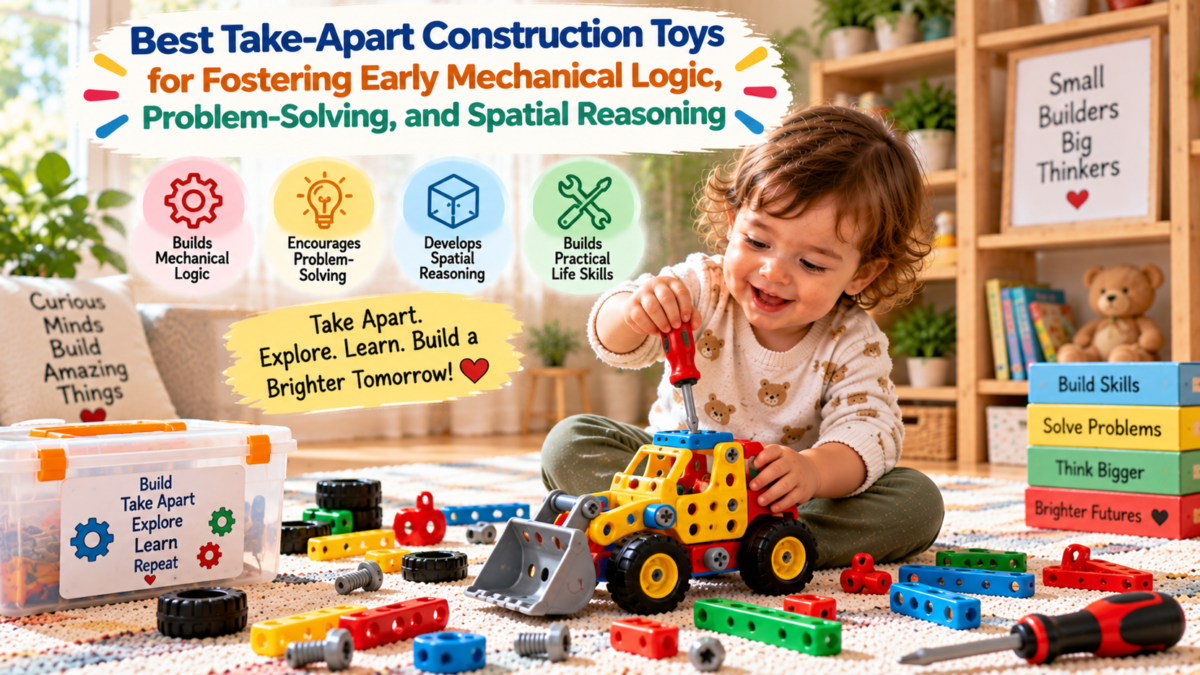
The first time a three-year-old places a child-sized wrench over a hexagonal plastic bolt, braces the chassis of a toy vehicle against their chest and turns their wrist with deliberate force, there is a breathless, laser-focused stillness. They lean in, trying to hear the tiny internal click of unspooled thread. Their stance stiffens with quiet pride as the bolt spins free and falls into the open palm. They don’t immediately grab to put it back together, but instead look at the helical spiral of the screw, peer into the empty cylindrical bore, test if their index finger can push all the way through to the axle below.
In this unhurried moment of taking apart the child is not mindlessly destroying. They’re doing a mechanical autopsy hands-on. They are learning that physical objects are not magical, monolithic solids that exist by accident; they are systems of interconnected sub-assemblies brought together through human engineering, friction, and geometry.
But walk down any aisle of a modern toy superstore and you’ll see construction play dominated by throwaway, sonic-welded plastic vehicles. These single-mold toys hide their inner workings beneath opaque, glued shells, festooned with flashing LEDs and sound chips that emit pre-recorded revving noises at the touch of a button. If a wheel breaks it can’t be unbolted or repaired, it just snaps off at a stress point, and the whole vehicle is useless trash. The child is denied the chance to probe the workings of things and becomes a passive consumer, dragging a fixed shell over the carpet.
At CozyParents we believe in “intentional play” the idea that the physical objects in our homes should be peaceful, empowering partners in our children’s cognitive and neuromuscular development. Take-apart construction toys are the perfect example of this philosophy. Children invite children to disassemble, analyze, troubleshoot and rebuild vehicles and machines with real mechanical fasteners. Without the acoustic chaos of motorized novelties, children build the bridge between abstract spatial reasoning and tactile physics. In this comprehensive guide, we dive into the evolution of deconstructive play, provide practical frameworks for managing loose nuts and bolts in a harmonious home and review seven vetted, top-rated take-apart toys available on Amazon US, positioning your child as an able, inquisitive mechanical apprentice.
Developmental Foundations: The Physical and Cognitive Mechanics of Dismantling
If we examine the intersection of early tool use, three-dimensional mental rotation, and physical frustration tolerance, we can start to understand why take-apart toys are so enduringly valuable for development. Studies in pediatric occupational therapy, spatial development, and developmental psychology show that taking apart and putting back together physical machines provides a multi-sensory cognitive workout that cannot be had with static toys.
1. Forearm Pronation-Supination and Rotational Wrist Kinematics
Operating mechanical fasteners requires complex neuromuscular motor planning that is very different from simple block stacking:
Forearm pronation and supination: The two bones of the forearm (radius and ulna) cross and uncross rhythmically as you turn a screwdriver or wrench. The spinning is physically demanding for toddlers since motor control is mostly concentrated on the shoulder and the elbow.
Graded Pressure and Axis Alignment: A child must exert axial forward pressure while generating rotational torque to prevent a tool from slipping off a screw head. This dual vector motor challenge strengthens the intrinsic muscles of the palm and trains finger isolation, the exact physical coordination needed to use scissors, grip a pencil with a mature tripod grasp and open child-proof container lids.
Spatial Directionality: Clockwise motion makes a connection, counter-clockwise breaks it (” righty-tighty, lefty-loosey “). This is a visceral, intuitive anchor for initial ideas of direction.
2. Mental Rotation, Reverse-Engineering, Topological Geometry
Before a child can bolt four wheels onto a vehicle chassis their brain has to perform some complex mental modeling:
Parts-to-Whole Synthesis: Deconstruction requires a child to assess the spatial hierarchy of an object. They find out that the wheel can not be tightened until the axle rod is in place. The cab can not be bolted until the engine block is in place.
Topological Reversibility: Jean Piaget found that the cognitive construct of “reversibility,” or the understanding that an action can be mentally and physically reversed, is a monumental milestone of early childhood. Disassembling a machine and then carefully undoing each step to reassemble it teaches working memory, executive function sequencing, and spatial orientation.
Geometric Alignment: Seating a threaded bolt into a recessed bore is a fine visual-motor calibration. If the screw is entered at an angle it will cross thread and jam the bolt. The physical resistance teaches real world tolerance and geometric clearance.
3. Schema Redirects and Destruction Productive
Many children between two and four years of age go through intense physical play schemas, including taking things apart, pulling off cabinet knobs, peeling stickers, and testing structural seams (the ‘Connection and Disconnection Schema’). Scolding to suppress this biological urge only creates unnecessary household friction. The urge to deconstruct is real , and dissecting toys is a productive and legitimate outlet. By providing toys that are meant to be torn apart, you foster the child’s innate analytical curiosity and protect household furniture and electronics.
The Product Roundup: 7 Purposeful Take-Apart Construction Toys
Chunky non-slip fasteners, smooth hardware threads and contained storage architecture should be top priorities in addition to durable materials. A take-apart toy capable of withstanding vigorous wrenching and repetitive threading, while fitting into a peaceful living space, Here are 7 curated, highly-rated options available on Amazon US, in the spirit of the CozyParents philosophy.

1. Battat Take-Apart Airplane (Working Battery-Powered and Manual Tools)
Description: Classic 21-piece heavy-duty plastic aircraft with 4 large wheels, spinning propeller, wings, cockpit, child safe mechanical drill with interchangeable bits, and manual screwdriver handle.
Why It Works for Child and Home: Battat is the gold standard for entry-level take-apart vehicles. The oversized octagonal bolts are sized for children three years and older with deep slip-resistant sockets to keep the tool bits from camming out. The included motorized drill runs at a slow, calculated RPM and has an internal slip-clutch that safely clicks when fully tightened to prevent stripped threads and protect small wrists from sudden rotational torque. The plastic has a satin, matte finish that resists scratching, and the major pieces are big enough that you can’t lose them behind the chair in the living room.
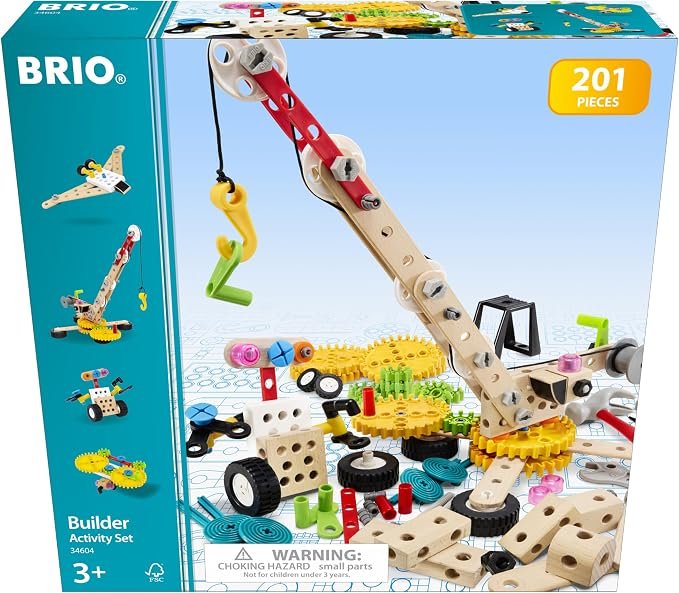
An heirloom grade construction system made from FSC certified European Beech wood components and durable, non-toxic polymer fasteners including, wooden beams, wheels, threaded bolts, nuts, a wooden spanner and play pliers.
Why It’s Good for Child and Home: BRIO combines the tactile warmth of natural hardwoods with the precision mechanics of nuts and bolts. This kit is open-ended, not vehicle-specific. Kids can build a crane, a race car, a robot figure or abstract geometric machines. The marriage of a wooden wrench and pliers requires a real two-handed bilateral integration – one hand holds the nut with the wrench, the other hand tightens the bolt from the opposite side. It has a clean Scandinavian esthetic that looks beautiful on an open shelf, and the parts store flat in a canvas bin.
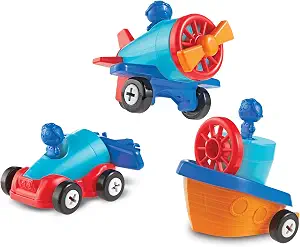
3. Learning Resources Build It! 123 15 Piece Car-Plane-Boat Set
Early development take-apart set made for younger toddlers (2+ years old). Chunky snap and screw aerodynamic pieces that can be configured into a rolling car, airplane or a buoyant boat. Comes with a toddler-friendly screwdriver.
Why It Works for Child and Home: This set is developmental perfection for toddlers who want to take things apart, but lack the fine-motor dexterity to deal with narrow threaded bolts. The pieces are over-sized and light and connect with broad low-resistance twisting joints and big slotted screws. Each vehicle takes less than two minutes to assemble and disassemble, giving kids instant cause-and-effect satisfaction without frustration meltdowns. The adaptable pieces wash clean easily, making the boat configuration a stellar companion for purposeful bath or sensory water play.
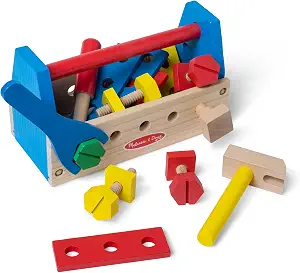
4. Melissa & Doug Take-Along Tool Kit, 24 Pieces
Wooden construction box with 24 parts. Includes wooden nails, threaded screws, nuts, washers, connecting boards with predrilled holes, child-safe wooden hammer, a wrench, and a slotted screwdriver.
Why It Works for Child and Home: Melissa & Doug eschews all plastics in favor of solid pine and birch construction. Toddlers can screw wooden bolts right into the pre-tapped holes along the side of the wooden toolbox itself to turn the storage caddy into an active workbench. Tapping nails with the wooden hammer improves visual-motor targeting and tightening nuts onto wooden planks reinforces spatial geometry. The compact toolbox has a sturdy wooden handle that encourages toddlers to haul their own gear, making cleanup an autonomous ritual.
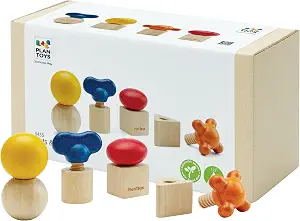
5. PlanToys Eco-friendly Wooden Nuts and Bolts Set
A minimalist, eco-conscious developmental hardware set handcrafted in Thailand from chemical-free kiln-dried rubberwood and non-toxic waterborne pigments, with four oversized tactile wooden bolts and four matching geometric nuts in assorted shapes (square, triangle, hexagon, circle).
Why It Works for Child and Home: For families looking for 100% natural, plastic-free sensory tools, PlanToys is second to none. This set reduces mechanical physics to its barest essentials: matching shapes and sewing threads. Each nut has a unique geometric perimeter, making it difficult for small fingers to grip the different contours as they twist. Sanded wood grain is silky, grounding for toddler hands. Threads interlock with an organic frictionless smoothness that makes mechanical alignment intuitive and soothing.

6. Educational Insights Design & Drill Bolt-It Bucket Toy
Description: Large, super-interactive mechanical play bucket with 52 colorful bolts, ergonomically designed child-sized toy power drill and heavy-duty bucket base with clear lid that serves as a threaded activity pegboard and storage container.
Why It Works for Child and Home: The Bolt-It Bucket’s signature engineering is the storage-and-play lid. Children drill bolts directly into the threaded grid on the bucket lid, making colorful mosaic patterns, mechanical tracks, and geometric letters. When playtime is done, all 52 bolts and drill pack flush inside the bucket, and lid snaps securely into place, with integrated carrying handle. It eliminates floor scatter completely and is a must-have for calm travel, dining at restaurants, or focused tabletop work.
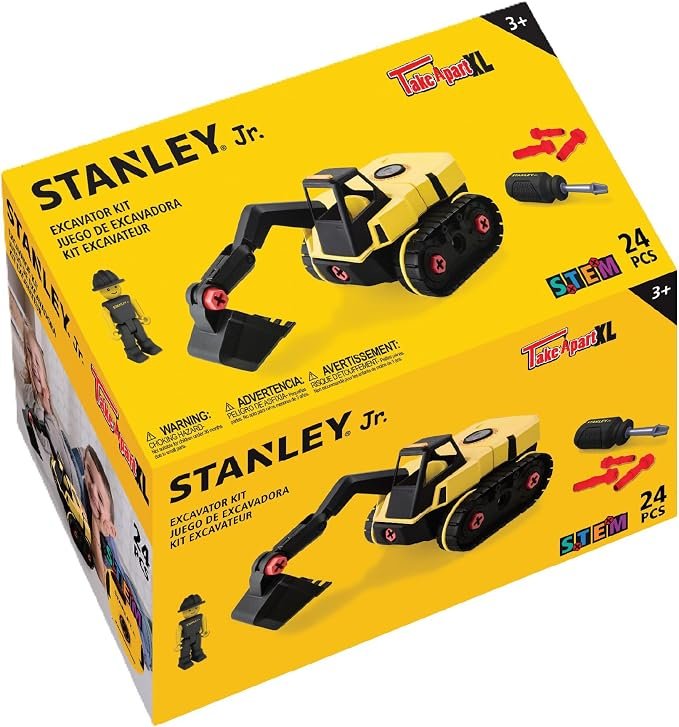
7. Junior Stanley Take Apart Dump Truck Kit
Description: Realistic licensed take apart vehicle construction set with moving dump bed, rubber tread tires that roll, child safe plastic screwdriver, play figurine and 20 modular assembly pieces.
Why It Works for Child and Home: Stanley Jr. is the sweet spot for older preschoolers (ages 3 to 6) with an appetite for authentic real-world mechanical simulation. The vehicle mimics real industrial construction machinery with working pivot hinges and realistic assembly layers. Disassembling the cabin, wheel assemblies and dump mechanism requires a methodical diagnostic approach: bolts need to be unscrewed in a particular sequence to unlock structural layers. The screwdriver included has an ergonomic bi-material grip modeled after real adult tools, giving young builders a deep sense of physical confidence.
The Plastic Disposable Novelty
Picture an impulse-bought, brightly colored plastic fire truck. It’s got shiny chrome decals, batteries installed, and buttons that blast compressed sirens. Its components are assembled in the factory using ultrasonic welding and hidden glue seams.
Looks pretty solid. But in the home practice it is a developmental dead end. The child cannot investigate its workings. Should the ladder jam, the parent cannot open the housing to realign the plastic gears without breaking the casing. And the inevitable step on the vehicle or the launching of it from a sofa results in a plastic wheel clip snapped off. The toy was designed to be assembled quickly, not for serviceability, so it cannot be repaired. The child learns that things when broken are immediately useless which reinforces a disposable consumer mentality.
Workshop: Mindful Disassembly
Now imagine a deliberate take-apart vehicle made of heavy-gauge, non-toxic polymers or solid beech wood, fastened with chunky hexagonal bolts and smooth-threaded nuts. The living room is silent. The child kneels on a low play rug, holding a wooden screwdriver in hand.
A wobbling wheel is not a catastrophic failure; it is an open invitation for diagnostic reasoning. The child looks at the wheel hub, sees the bolt has worked itself out two turns, picks up their wrench from the wooden tray, tightens it down until it sits flush against the chassis. Every joint has been put together with their own hands and they understand the structural anatomy of the vehicle. No flashing lights, no dead batteries, no mystery. The child does not see the physical world as an opaque black box; he sees it as a realm of mechanisms, accessible, waiting to be understood, to be maintained, to be mastered.
Calming Mechanical Rituals for Daily Cycles
Take apart toys naturally help to ground high energy children during difficult transitions in the household. Here are four easy ways to incorporate mechanical play into your family’s routine:
1. The afternoon “pit stop” to re-center
If the witching hour hits in the late afternoon and your toddler is restless, irritable or overstimulated, skip the screens. Lay out a low-pile wool rug, place a single take-apart vehicle and its disassembly tray in the center, and dim the overhead lights in the room. Sit next to them without speaking. Pass them the wrench, and loosen the first bolt a half turn, to lower the barrier to entry. The repetitive rhythmic rotation of the wrist and the quiet tactile focus will naturally bring down their heart rate, slow their breathing and help ground an overstimulated nervous system.
2. The Errand of the “Community Service Repair Shop”
Turn mechanical play into a directed, collaborative narrative. Place two stuffed animals next to a “wrecked” vehicle missing two wheels on the rug. Say: “The rabbit’s delivery truck broke an axle on the mountain road! Can the mechanic help get the wheels back on so they can deliver their groceries?” This adds a layer of technical spatial assembly with tender empathy and real world helpfulness, expanding your child’s narrative vocabulary while working fine-motor precision.
3. The Market for Hardware Sorting and Sizing
Turn the loose parts into a taxonomic sorting game before reassembling a vehicle. Draw three chalk circles on a small wooden tray, marked Small, Medium and Large, or group by color. Before starting the build, have your child sort the washers, short bolts and long chassis pins into their matching circles. This simple ritual hones visual discrimination, reinforces early math concepts of sizing and prevents frantic searching for parts in the midst of assembly.
4. The Bedtime “Tools Down” Closing Routine
The cessation of mechanical play is a concrete cue that industriousness is ending for the day. Before you go to the bath, sit down with your child and “close the repair shop.” Put the screwdriver and wrench in their proper places on the wooden box or bucket lid, check that all the bolts are tight, park the finished vehicle in its “overnight garage” on a low shelf, and say, “Tools are resting, the machines are parked.” This regular ritual establishes a satisfying neurological boundary between the work of the day and the rest of the evening.
Honoring the Expert Mechanic
When you choose a well-made, thoughtfully designed take-apart construction toy, you are making a commitment to your child’s mechanical literacy, physical agency, and long-lasting problem-solving resilience. You provide tools that honor the honest physics of threads, leverage and structural geometry, not disposable digital novelties. You create a calm refuge, where childhood milestones unfold with confidence and grace.
At CozyParents, we believe that every object in your home should have a clear developmental purpose, invite mindful connection and support household serenity. Sitting on the floor next to your child, watching those small hands as they carefully place a wrench on a bolt, and seeing the face light up as a wheel spins free, is not just play you are witnessing; it is a young human being discovering that they can comprehend, fix and mold the physical world around them.
Continue reading CozyParents for mindful parenting frameworks, expert-backed gear roundups, and intentional strategies for your growing family. Does your kid love taking things apart with a screwdriver? Are you about to set up your first low shelf mechanical workbench this week? Tell us about your experiences in the comments below how do you make peaceful intentional spaces in your home?