

Few activities for play bring together the pure fun of play and serious scientific investigation quite like putting a ball on an elevated track and watching it make its way down by gravity. The clickety-clack of the wood or plastic, the quick drop down a steep slide, the tantalizing stop in a swirling funnel: a natural feedback loop of interest for toddlers. Kids learn abstract physical principles such as potential energy, kinetic friction, centrifugal force and structural center of mass in a hands-on practical way long before they are introduced to formal physics equations in a classroom.
But marble runs often come into an intentional home environment with practical friction. The toy marketplace is packed with brittle, paper-thin plastic tower kits with loose joints that collapse with the smallest bump of an elbow, leaving kids disheartened and distraught. Other sets come with hundreds of identical, uncalibrated tubes that don’t maintain the required slope angles, leaving marbles stuck halfway through each run. Worse, a jumbled mess of little rolling balls poses instant household storage dilemmas and dire safety risks for younger siblings.
A good marble run is an open-ended physics lab that fosters fruitful trial and error and doesn’t require an adult to come in and fix it every five minutes. At Cozy Parents, we look at kids’ building toys through the lens of cognitive problem-solving, structural stability, non-toxic material integrity and clutter-conscious living. We think STEM gear should challenge a child’s engineering instincts, hold up to active play and fit easily in a quiet, well-ordered family room.
Cozy Parents is here to provide grounded tools for tranquil daily family living, with expert buying frameworks, practical routines, minimalist gadget reviews and all the support you need to construct an intentional, fulfilling play area.
What Building a Track Teaches About Spatial Physics and Cognitive Scaffolding
A marble run is essentially an engineering problem with iterations. The difference between that and static blocks of wood is that the towers just have to resist gravity pulling down . A marble track is dynamic. You have to balance the vertical loads and control the horizontal kinetic momentum of the moving mass .
STEM educators and developmental specialists seek four main learning mechanisms to judge if a marble run has real educational and developmental depth:
1. The Iterative Hypothesis – Testing Cycle
The greatest cognitive worth of a marble run is not in the success of the run but in the failure. If a marble jumps off a curve or suddenly stops inside a flat tube, a kid can’t blame software or adjust an app option. They have to step back, visually assess the physical failure, generate a mechanical hypothesis (“the ramp is too flat” or “the marble has too much speed entering this 90-degree turn”), change the structure and test again. This cycle develops emotional frustration tolerance and systematic problem-solving practices that are the basis of scientific thinking.
2 Spatial Mental Mapping and Foresight
A child has to think back from the exit point to the launch pad to build a working track or schedule successive drops ahead of time. The youngster should visually perceive in his mind the trajectory of the 3D velocity in horizontal, vertical and diagonal planes. This visual-spatial mapping task builds mental rotation abilities, which are a central cognitive predictor of future ability in arithmetic, architecture and structural engineering.
3 Kinetic Acceleration and Frictional Deceleration
Children rapidly learn that steeper drops provide greater velocity but too much speed will cause a marble to leap the rails or a top-heavy column to tumble. Children learn a concrete, direct sense of conservation of energy, resistance of friction and centrifugal force through experimentation with spiraling chutes, rough braking surfaces, switchbacks and broad banked bends.
4. Torsional Foundation Joint Tolerance and Stability
A rising run needs a solid structural basis to survive. Marbles rolling down shake loose connectors due to flimsy connections caused by dynamic vibrations. Quality systems have tight friction joints, interlocking foundation plates or weighted footings that illustrate basic principles of structure: wide bases for support, low centers of gravity and balanced vertical loads.
Best STEM Marble Runs for Building Dynamically
To assist you choose a stable, developmentally appropriate and long-lasting marble run, we researched seven notable systems now on the market at Amazon US.
Each pick has great connection integrity, instructional variety, and durable material craftsmanship.
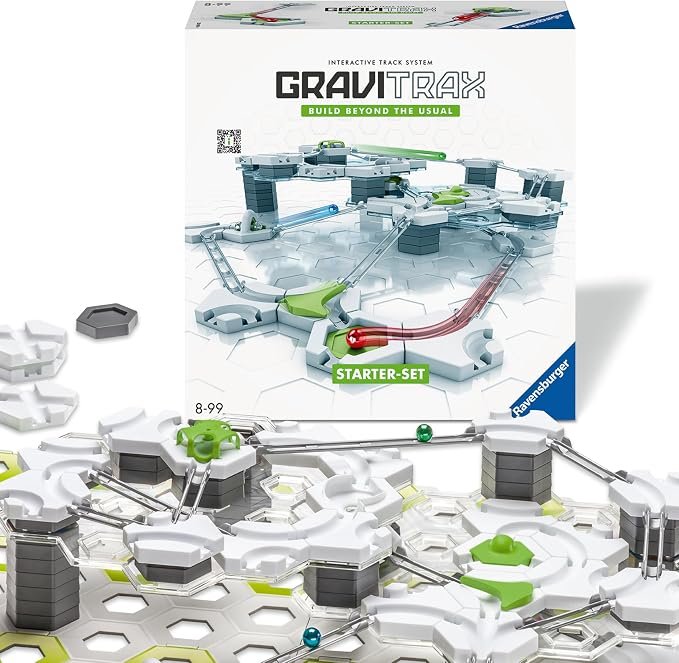
1. Ravensburger GraviTrax Starter Set (8+ years old)
Recognized as the definitive contemporary gold standard for interactive physics, Ravensburger’s GraviTrax reimagines the marble run as a modular, open-ended gravity track. GraviTrax is a break from the usual vertical stacking tubes and uses instead a modular hexagonal baseplate system where youngsters lay tracks, height tiles and action accessories across multi-level horizontal terraces.
Specialist kinetic elements are included such as magnetic cannons that fire steel balls up inclines, free-fall drop holes and curving track rails to challenge older children to calibrate velocity and momentum. The track is made of open steel rails instead of enclosed plastic tubes, so youngsters can see rolling friction and gravity in action. With limitless expansion options and an app-assisted track builder to sketch out blueprints, it offers advanced, screen-free engineering for school age builders.
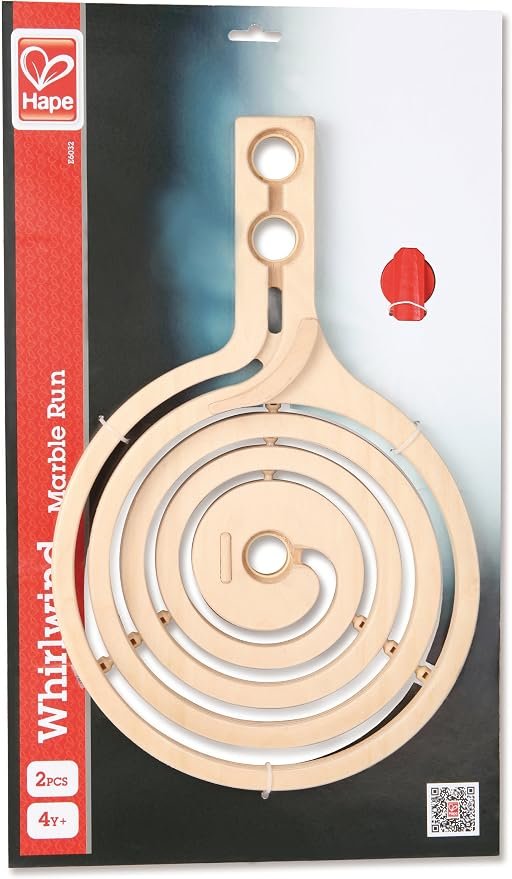
2. Hape Quadrilla Vertigo Wooden Marble Run (4+)
Hape Quadrilla Vertigo is a great wooden construction set for families who like natural, durable-to-the-touch timber of heirloom quality. Using precision milled wooden tracks, swirling drop funnels and color-coded distributor blocks, the system is crafted from sustainable, beautifully grained birch and rubberwood, with non-toxic, water-based coatings.
Quadrilla’s genius resides in its engineering logic: every colored wooden block includes a distinctive internal routing channel (straight drop, angled chute or dual-exit diverter). Kids need to learn the how the internal block channels direct the marble’s route, promoting strong logical thinking and spatial imagery. The thick wooden bits provide you great stability on the floor, so you don’t have the annoying wobbles you get with thin plastic towers.
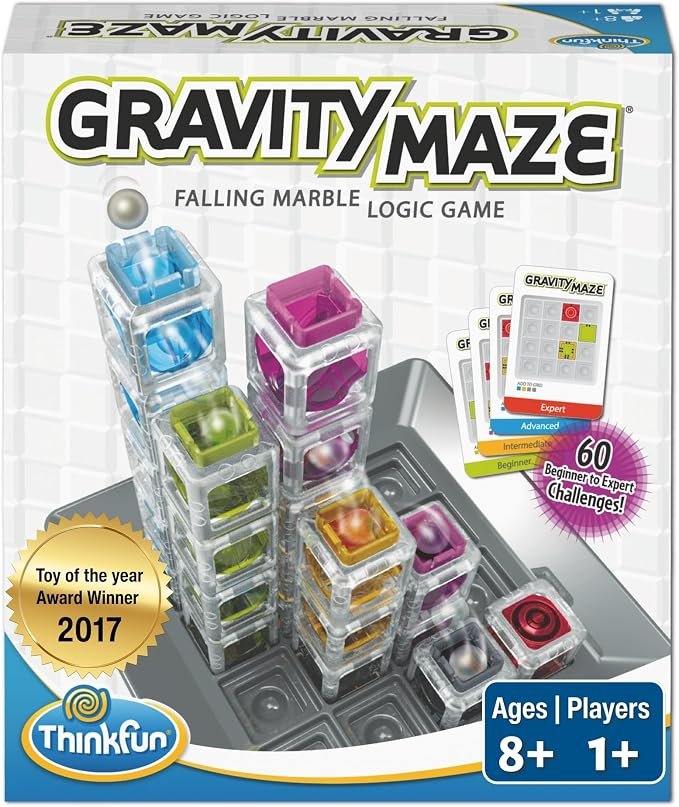
3. ThinkFun Gravity Maze Marble Run Logic Game (For 8+)
If you’re interested in the spatial problem solving of a marble run in a little compact single player tabletop puzzle ThinkFun Gravity Maze is a fantastic mix. The set features a solid four-by-four grid board and translucent, multi-colored towers of different heights and interior slide channels.
Players select one of sixty escalating challenge cards (from beginner to expert) that define the starting position and objective finish. The youngster has to learn to select the right precise tower blocks to be placed in the grid so that a continuous path is built for the marble to fall to the goal. The tactile joy of a marble run, with the discipline of spatial logic and logical thinking, it’s a great choice for small living areas and concentrated solo play.
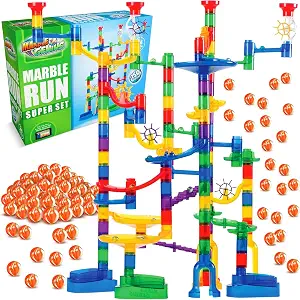
4. Marble Genius Super Set Marble Run (Ages 4 to 9)
If you’re looking for a large, classic tubular marble run that lets kids build towers that reach for the sky, the Marble Genius Super Set offers great mechanical reliability. Made from high-density, shatter-resistant translucent ABS plastic, its transparent tubes let children follow the marble’s journey through every loop, drop and twist.
The set features heavy-duty wide-stance foundation platforms, designed to combat the infamous tipping problem of budget sets, keeping towering structures stable even against knocks from the floor. There are plenty of active parts like dual-exit splitters, loop-de-loops and spinning paddle wheels, and solid glass marbles that have a gratifying kinetic weight. Its friction joints are close and easy to push together, so young children may build and alter tracks on their own without help from adults.
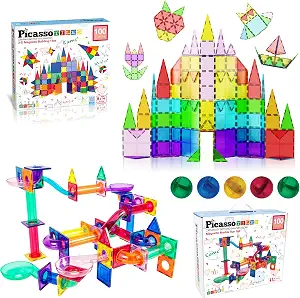
5. PicassoTiles Marble Run Magnetic Building Blocks Set, 100 Pieces (Age 3+)
PicassoTiles Magnetic Marble Run is designed as a bridge between 2D magnetic tiles and 3D kinetic tracks and provides a simple way for novice builders to begin their careers. The system consists of translucent plastic track tubes, drips and funnels that interlock with clear square magnetic tiles with apertures in the center.
Kids who haven’t developed the fine motor strength to push tight friction-fit tubes together together can simply snap parts together using the built-in magnetic edges. The equipment contains weighted, flashing LED balls, as well as normal wooden spheres, lighting the run as they whizz through see-through tunnels. It works perfectly with ordinary magnetic tile sets and fits right into open-ended construction games.
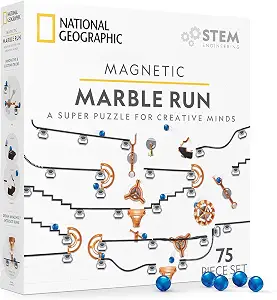
6. National Geographic Magnetic Marble Run (Ages 6 and up)
The National Geographic Magnetic Marble Run moves the entire building canvas to a vertical wall for families who want to completely avoid floor sprawl. Heavy-duty imbedded magnets in each rail piece, drop tunnel and curved chute attach strongly to any ferrous metal surface including refrigerators, metal doors or magnetic dry-erase whiteboards.
If you build against a vertical wall the engineering physics are different. Gravity is constant and the wall makes the tracks stable. So no more towers falling over. The kids can create meandering multi-path courses out of track segments and trick components and test slope angles and kinetic drop pathways without cluttering up the playroom floors. The kit folds flat into a storage box and provides an outstanding small-footprint STEM station.
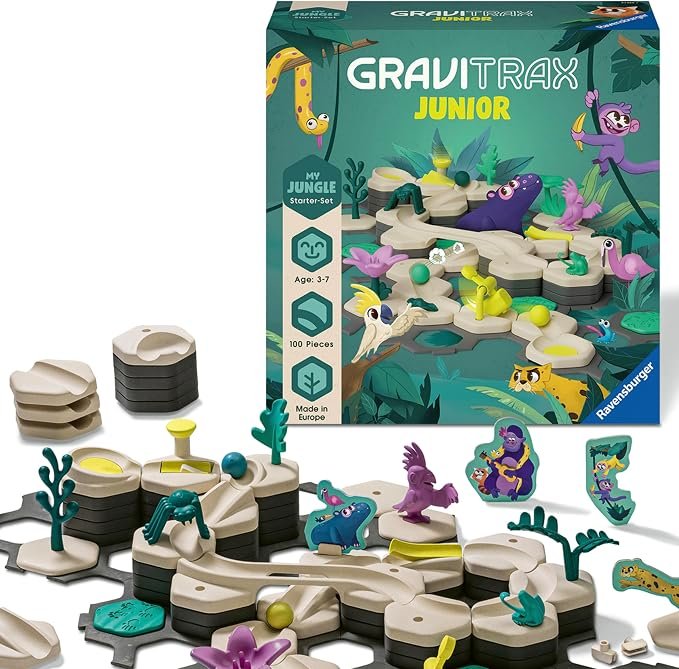
7. Ravensburger GraviTrax Junior Starter Set (Ages 3 – 7)
GraviTrax Junior is all about introducing young toddlers to the excitement of creating tracks, taking the advanced engineering of the original line and making it into a safe, chunky system. The tracks and connector blocks are made from a bio-based wood-plastic combination and are wide, smooth and easy for small hands to hold.
The set replaces small hazardous glass marbles with oversized lightweight wooden balls that lessen choking dangers but are still easy to monitor visually. And then, the tiles snap together loosely but firmly on huge baseplates and children can design bridges, tunnels and animal-themed obstacles on their own. It’s a soft, screen-free way to introduce kids to gravity and velocity and a great way to prepare them for more complex construction sets as they become older.
Home Planning: Controlling Track Systems Without Floor Sprawl
Marble runs are big, modular construction toys that can rapidly take over common living areas if storage methods and building parameters are not maintained.
Four simple habits that make dynamic construction more fun, safer and visually organized:
1. Anchor to a Low-Pile Rug or Framed Tray
Don’t let the kids build their towering marble runs on thick, high-pile carpet. Plush pile creates an inconsistent, mushy basis that wobbles towers, causing joints to twist and fall apart under dynamic weight. Play directly on a hard floor, low pile braided rug or framed wooden play table. For smaller tabletop sets, building inside a lipped tray collects any escaping marbles before they get scattered under furniture.
2. Develop the “Contained Sphere Vault” Habit
Lost marbles rolling across hardwood floors are a slip hazard for adults and a choke hazard for crawling newborns. Establish a firm rule: marbles are to be kept only in a special zipped canvas pouch or a screw-top silicone jar. No marbles are removed until the entire track structure is constructed, tested and ready for launch.
3. Modular, Shallow Bins For Keep Track Parts
Don’t keep a complete 150-piece marble run in a vast toy chest. Looking for a certain base joint or curved chute at the bottom of a deep bin can be noisy and frustrating. Sort components by kind (baseplates, straight tracks, connections, special action parts) and keep in shallow, transparent, stackable latching bins. Good sight enables children to efficiently plan their buildings.
4. Cheers to the Engineering Magazine
Encourage older children to record their track layouts before they dismantle them. A simple graph-paper notebook next to the building bin allows kids to sketch out top-down designs, time the rolls with a stopwatch and keep track of which angles led to the fastest runs. Keeping playtime as a real-world engineering journal keeps them engaged and acknowledges their hard work before putting the parts away.
Growing Resilience & Mechanical Intuition
More than a fun diversion, a marble run is an open-ended workshop where children struggle with real-world physics, learn to accept design errors and enjoy the quiet thrill of seeing a complex idea come together. The appropriate set will respect your child’s spatial development, hold up to hard hands-on testing, and offer a lasting, screen-free foundation in physical mechanics.
Choosing systems with strong connections, solid bases, clear sightlines and safe, non-toxic materials gives your child a fundamental STEM tool that teaches patience, problem-solving and creative confidence for years to come.
This week clear a big flat building zone on your floor, investigate track pathways together and appreciate the shared excitement as gravity and curiosity lead the way.
You don’t have to work out early childhood equipment or playroom organization by yourself. Cozy Parents is your best source for honest product reviews, developmental frameworks and minimalist home solutions to deliberate, grounded parenting.