
Learning the alphabet is one of the most famous milestones of early life. Long before a child writes their first complete sentence or deciphers a full storybook, learning to identify letters and associate them with their corresponding phonetic sounds lays the essential foundation for early reading readiness.
When a child can distinguish a capital A on a sign or recognise the first letter of his own name he is taking his first confident steps into the realm of symbolic communication.
However, many well-meaning parents feel overwhelmed by the sheer volume of high-tech “educational” ABC gadgets jostling for attention these days. Bright, flashing electronic letter boards, automatic sound-chip posters and tablet-based phonics software promise quick learning but they can turn children into passive button-pressers.
Sensory-overloading digital inputs take away the tactile, hands-on experience that young brains need to truly understand spatial letter shapes and phonemic relationships.
Young children should be taught to build real literacy skills through tactile multi modal exploration. Tracing the unique curves of a 3D wooden letter with a finger, snapping together matching letter pairs or finding a hidden object inside an alphabet acorn activates motor pathways that consolidate letter recognition far more rapidly than tapping a flat computer screen.
By surrounding your kid with mindfully designed, screen-free alphabet toys, you transform early reading preparation into an enjoyable, self-directed play experience that increases spatial memory, language confidence and fine motor coordination.
At Cozy Parents, we assess early childhood equipment through a demanding lens of spatial clarity, physical health, developmental utility and clutter-controlled minimalism. We believe your house should operate as a calm sanctuary where your child’s intrinsic curiosity can thrive without unneeded digital noise.
For more therapist-backed frameworks, house organising strategies and professional gear reviews for developing families, visit cozy parents can hook you up with pragmatic resources for intentional daily life.
Biomechanics & Cognitive Foundations
To grasp why screen-based apps fall short compared to tactile alphabet assistance, it’s useful to consider how the developing paediatric nervous system acquires visual symbols and motor actions in its earliest years.
The brain has to learn to transform abstract visual shapes (graphemes) into discrete spoken sounds (phonemes) in order to learn to read . A letter to a toddler is not a symbol but rather a complex shape of vertical lines, horizontal bars and curved angles.
Hands-on alphabet play utilises three critical developmental mechanisms:
1. Orientation & Spatial Discrimination in Vision
To a tiny child a chair is a chair whether it’s turned left, right or upside down. Letters on the other hand, are the exception that proves the rule: Turn a lowercase “b” upside down and you get a “d.” Turn it sideways and you get a “p” or a “q.”
Playing with real , three-dimensional letters gives infants spatial feedback that helps them realise that orientation matters for identifying written symbols .
2. Tactile-Kinesthetic M
When a child feels a physical letter block or follows a carved-out wooden letter groove, the hand muscles send sensory input straight to the brain’s motor cortex.
This tactile kinesthetic input creates muscle memory for letter creation making the final transfer to holding a pencil and drawing letters on paper much easier.
3. Phonics Multi-Sensory Integration
It’s called multimodal integration, a combination of seeing, touching and hearing.
When a youngster connects an uppercase alligator head to its lowercase tail and says the “A” sound out loud, three distinct sensory pathways light up at the same time, cementing the letter into long-term memory.
Best Toys for Learning the Alphabet
So to assist you choose great, durable literacy tools for your home, let’s check out 7 different top-rated goods, that are currently live and easily found on Amazon US.
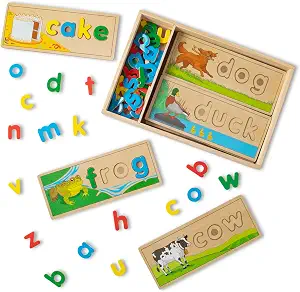
1. Melissa & Doug Educational Toy Wood See Spell
This traditional wooden spelling game sets the standard for heirloom quality for early training to read. The set consists of eight double-sided wooden puzzle boards with 16 short, everyday words and colourful pictures and 64 sturdy wooden lowercase letters.
Children select a word board and arrange the wooden letters in the cutouts to make the word.
The toy is self correcting in that the wooden letters are securely fitted into the recessed cuts in the board and if a kid choose the inappropriate letter shape it won’t sit flush in the slot.
The design encourages sight-reading vocabulary, increases letter-sound awareness and develops fine motor control as young fingers manipulate each wooden letter into place.
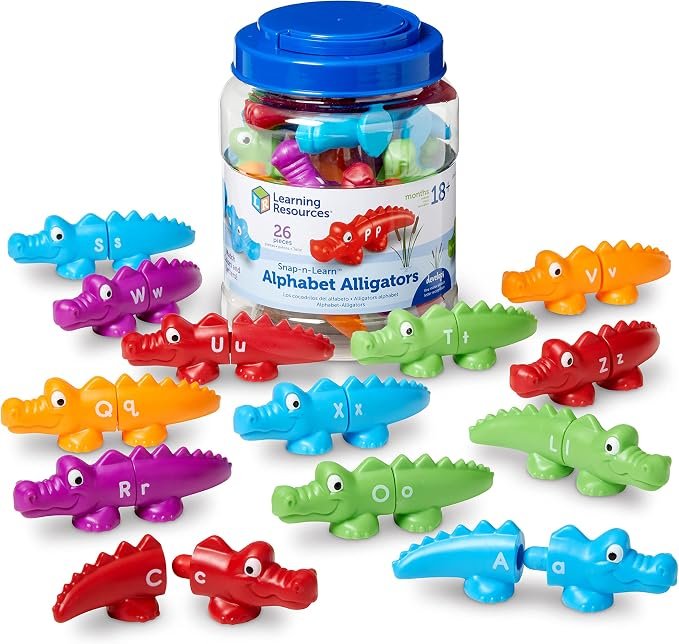
2. Snap-n-Learn Alphabet Alligators Learning Resources
This vibrant 13-piece alligator set is specifically created for toddlers and preschoolers and puts hands-on alphabet matching directly into their hands. Each two sided alligator divides in half. The capital letter is on the head half, the lower case letter on the tail half .
Matching higher case to lower case or matching head and tail colour promotes independent problem solving skills.
grip and release the sturdy plastic alligator pieces, building grasp and bilateral hand coordination, essential motor skills for early writing and scissor use.
The whole set wipes clean easily with a damp towel and stores neatly within the supplied bucket.
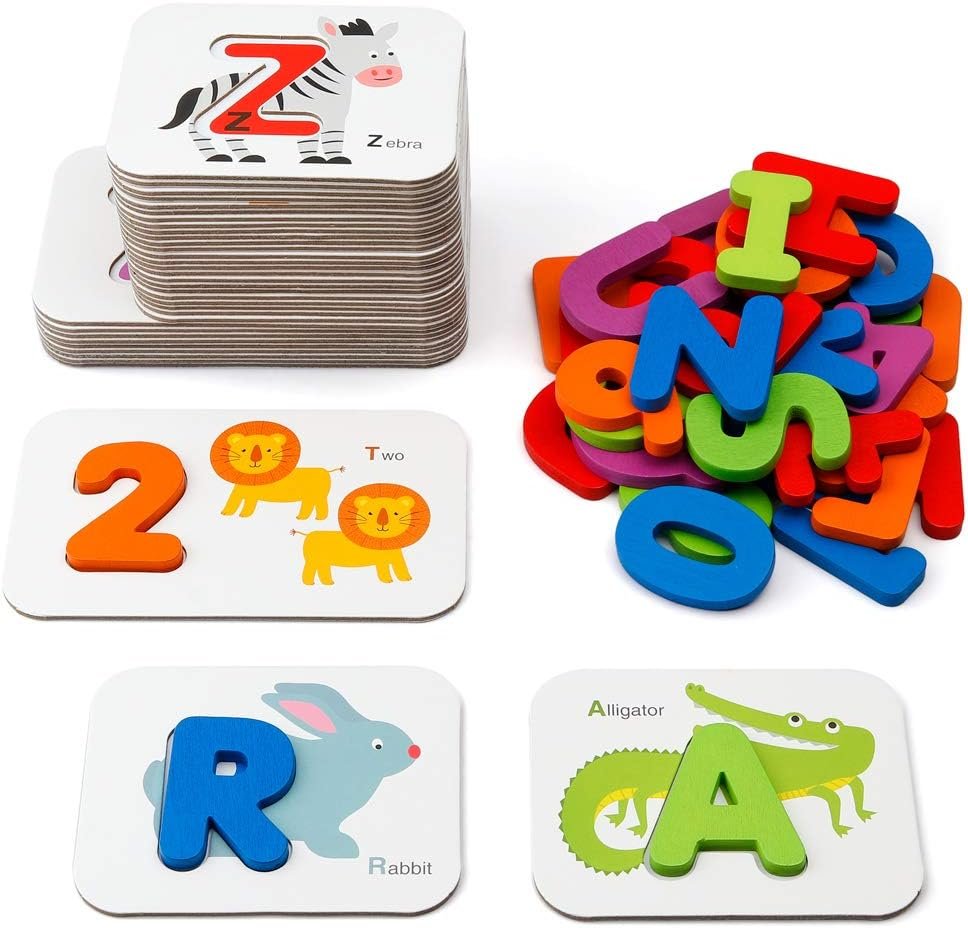
3. Coogam Wooden Numbers and Alphabets Flash Cards Kit
This beautifully designed multi-sensory learning set includes 26 bright wooden alphabet blocks and 26 heavy-duty double sided cardboard flash cards. Inside each flashcard is a cutout the size and shape of a wooden letter block with cute animal characters and their matching names.
The toddler will see the picture of the animal, then choose the right wooden letter and insert it in the cutout in the card.
The hardwood blocks are sturdy and smooth-sanded to fit a child’s hand and the flashcards have a matte, waterproof coating that avoids bending and leakage.
There is a small storage box so it’s a perfect tool for quiet desktop learning or for tidy playroom storage.
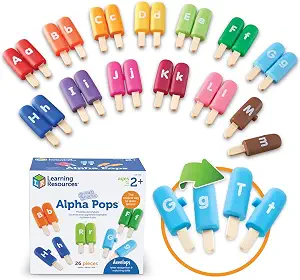
4. Alpha Puffs Smart Snacks Learning Resources
An inventive kit that combines pretend play with early literacy, the set includes 13 colourful, double-sided plastic popsicles that click together to show matching uppercase and lowercase letters. Kids pop off the outer pop to see the matching lowercase letter underneath for a terrific surprise play pattern.
The click together mechanism requires pulling and pushing with two hands which gives very good resistive muscle input for development of intrinsic muscles of the hand.
Popsicles contains 26 complete upper case and lower case letter pairs in vivid colours to assist parents to introduce letter matching, colour sorting and imaginative ice cream shop play in one robust, simple to clean arrangement.
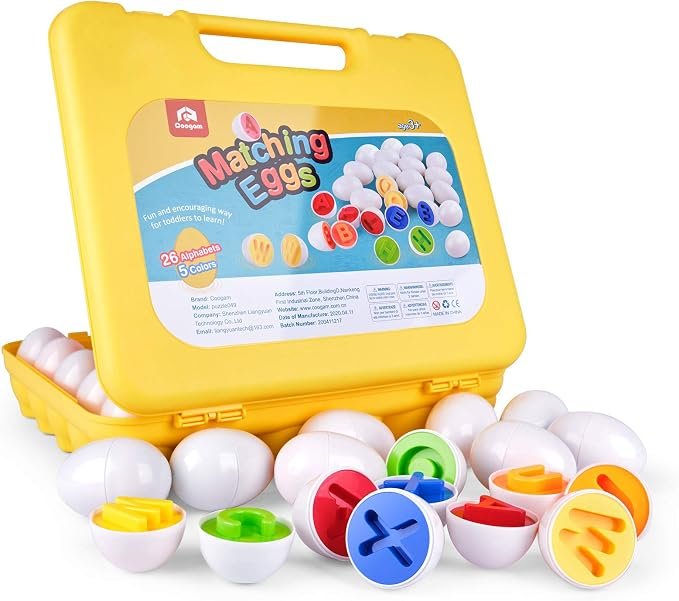
5. Coogam 26 Piece Letter Matching Egg Set
This egg matching set in a real plastic egg carton is a fun sensory exploration game to learn letters. The hard white plastic eggs crack apart to expose a vibrant inside with 26 upper case letters and matching inner yolk shapes.
Toddlers open the eggs and shake them and match the letters inside by shape, colour and letter name and then snap the eggs together.
The egg shapes are rounded and smooth (so no little choking hazards) and toddler-sized.
The genuine egg carton container helps children develop autonomous cleanup skills and this durable educational aid progresses from basic colour sorting to sophisticated letter recognition.
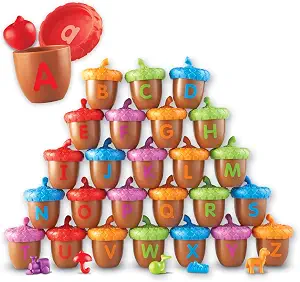
6. Learning Resources Alphabet Acorns Activity Pack
A fun squirrel-away twist on classic matching games, this complete 78-piece kit features 26 two-piece plastic acorns and 26 color-coded surprise counters. The uppercase letter is on the outside of each acorn with the matching lowercase letter on the removable cap.
Each acorn contains a small colour co-ordinated toy counter whose name starts with the appropriate letter sound, e.g. an apple in the “A” acorn or a car in the “C” acorn.
This surprise-inside method encourages phonemic awareness and helps toddlers to link letter symbols with their spoken beginning sounds immediately.
Children can stack the acorns, match the upper case caps to the lower case bodies or sort the mini-counters by colour and initial sound.
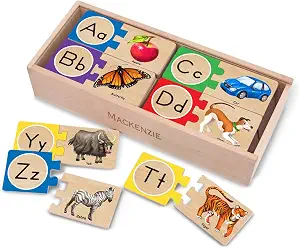
7. Melissa & Doug Self-Correcting Alphabet Wooden Puzzle
Made from solid wood this 52 piece puzzle set consists of 26 different two piece letter puzzles. Packaged in a compartmentalised storage box. Each of the self-correcting puzzle pairs contains a capital and lower case letter and a clear and familiar pictorial depiction, such as Aa with an apple or Bb with a ball.
Puzzle pieces are designed with self-correcting die-cut joints that will only accept the matching letter piece to fit into its matching image mate.
This self-correcting design helps toddlers work independently, since they get rapid physical feedback if they try to pair incompatible letters.
This is a great quiet-time, tabletop activity to develop visual discrimination, problem-solving confidence and sight vocabulary without adult interference.
How to Create a Quiet Literacy Corner Without Screens
Verified tactile alphabet toys are a terrific place to start, but the daily play remains focused and meaningful only when you build an organised, low-friction learning environment. A room with overcrowded toy bins might be visually distracting, resulting in youngsters with short attention spans and scattered pieces.
1. Place Literacy Tools on Low, Open Shelves
Put alphabet puzzles, eggs to match and letter flashcards in shallow woven baskets or flat wooden trays on low wooden shelves. With tools at eye level, your kid may choose learning activities independently and will know where everything goes when it’s time to put play time away.
2. Practice for Rotation of Play
Don’t put all 7 letter sets in your play space at one time. Provide 2 or 3 different letter activities at a time (ex. the Alphabet Alligators on a rug and the See & Spell board resting on a table). You rotate the choices every two weeks. This maintains the interest level, but also keeps the look of your home visually peaceful.
3. Link Letters using Tactile Tracing
Use real letters made of plastic or wooden. Place dry play sand, salt or cornmeal in a shallow dish. Let your preschooler choose a wooden letter block, say the sound it makes and trace the shape of the letter with his index finger in the sand pan. This tactile extension aids muscle memory and pre-writing readiness.
4. Blend Phonics into Daily Routines
Don’t make a set drill of letter-writing. Instead, integrate natural phonics questions in everyday life: “Can you find the letter acorn that makes the ‘mmmm’ sound like milk?” or “Let’s find the alligator that matches the first letter of your name!” Play based interactions Bring Joy and No Stress to Reading Readiness.
Tactile Alphabet Toys Versus Electronic ABC Apps
Examining early literacy tools reveals considerable differences in the impacts of tactile materials and automated digital technology on a growing child:
Sensory Interaction: 3D touch, weight, spatial orientation and physical feedback are engaged with tactile alphabet toys. The electronic ABC apps have flat glass screens and offer the same touch screen resistance to whatever letter that appears.
Motor Development: Working with snaps, puzzles, and physically matching letters develops intrinsic hand muscles, finger isolation, and bilateral coordination. Swiping and tapping an app doesn’t take much physical exertion and doesn’t provide much fine motor exercise.
Self-Correction Mechanics: Good wooden puzzles and matching games have physical self-correction built into them if you have the wrong pieces, they just won’t fit together. Chime noises, flashing lights or digital animations from electronics apps might be a distraction when studying.
Focus and Attention Span: Screen-free tactile tools encourage sustained attention, quiet exploration and deep immersion in play. Sometimes the noise of toys with buttons and the fast pace of digital games can cause sensory overload and quick fatigue.
Parent/Child Interaction: Physical alphabet toys promote parent-child communication, collaborative storytelling and problem solving.Automated electronic toys tend to foster isolated passive button pushing.
Building Reading Confidence through Play
You don’t need high tech displays and flashing lights to prepare your child to read early. With carefully selected wooden letter puzzles, tactile snapping toys and surprise matching sets, you’re offering your child rich, multimodal tools that make letter identification feel natural, engaging, and very fulfilling.
Take a few minutes today to check out your child’s learning environment! Turn off all button operated digital sound toys Put some hands-on alphabet items on a shelf that your child can easily reach and then just sit back and watch your youngster discover the fun of letters with his or her hands. You’ll never have to wonder what early childhood equipment choices to make or what house setup aspects to keep in mind. Save Cozy Parents for a constant flow of practical growth frameworks, minimalist home organisation ideas and sincere product reviews.Added to your favourite digital resource.