
A toddler who succeeds in fitting a wooden triangle into the right slot has a quiet, hypnotic concentration on his face. For an adult, putting a cylinder into a hole is a trivial geometrical task. But it’s a huge win for a baby or toddler in spatial reasoning, trial-and-error problem-solving and fine motor precision. But when parents enter the nursery toy market, they’re faced with a dizzying array of plastic sorters that flash and blare loud electronic reward jingles, and assault the senses with neon colors. These gimmicky gadgets claim to accelerate learning but often hijack the child’s attention, turning what should be a peaceful meditative exercise in tactile discovery into a frantic search for the next digital button.
At CozyParents we believe that a playroom is a place for independent, focused thought for a child. We believe in “intentional play” selecting durable, tactile, well-designed resources that honor a child’s developing nervous system as well as a home’s visual harmony. In this comprehensive guide, we will go over the developmental milestones that shape sorters trigger, how to create a low-friction play ecosystem and review 7 stellar shape sorting products available on Amazon US that respect your child’s expanding mind while maintaining your home’s esthetic peace.
Developmental Foundations Psychology of Geometry and Motor Control
To understand the continuing educational power of shape sorters we need to understand how a young brain makes sense of the physical world. Sorting is not a static academic drill, according to the principles of occupational therapy and child development. It’s a multisensory, dynamic experience that is grounded in motor planning and spatial awareness.
1. Geometric Discrimination and Spatial Reasoning
Children learn to understand the world through tactile spatial exploration long before they learn formal geometry in school. When a baby or toddler manipulates a 3D object tracing its edges, rotating it in the palm of the hand, matching its face to a corresponding aperture they are creating a mental map of physical space. This haptic feedback teaches concepts of orientation, symmetry and scale. They learn that a square peg will not fit into a round hole, not because some electronic voice tells them so but because their own hands and eyes feel the physical laws of the universe. This trial and error experimentation provides the basis for later mathematical and engineering problem solving.
2. Bilateral Integration and Wrist Rotation
Shape sorters require complex fine motor control for manipulation. The child must stabilize the sorter box with one hand (bilateral coordination) and then use the other hand to rotate, pitch and thrust the shape into the correct angle for entry. This demands a high level of wrist rotation and pincer precision. As babies grow from infants to toddlers they move from a clumsy palmar grasp to a precise, intentional grasp. A good quality shape sorter will offer just the right amount of physical resistance and tactile feedback to build these little hand muscles without being a frustration.
3. Learning Without Errors and Executive Function
The greatest psychological advantage of a traditional shape sorter is that it has a built-in feedback loop. A shape sorter provides ‘error-free learning’ or instant self-correction feedback. If it doesn’t fit, the child instantly knows to try a different angle or different block. This builds emotional resilience, patience and executive function. They learn to trust their own analytical skills instead of depending on a parent or an electronic device to correct them. This type of experience fosters deep self-reliance and emotional regulation during problem solving tasks.
The Product Roundup
Look for shape sorters that are made of natural non-toxic materials and simple designs that evolve with your child’s cognitive and physical abilities. Here are seven of the best CozyParents-approved options on Amazon US:
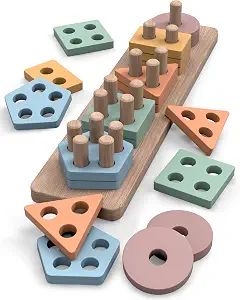
1. Solid Wood Shape Sorter Toy
Description: This sustainably made Rubberwood box features smooth, rounded edges and bold, green water-based color accents, as well as chunky geometric shapes that are easy for small hands to grasp.
Benefits: This is a minimalist essential. The piece is made from natural rubberwood, providing rich proprioceptive feedback to a toddler’s fingertips, while the subtle color palette avoids sensory overload. The sliding lid makes it easy to find their shapes and encourages independent clean up and spatial organization for little ones.
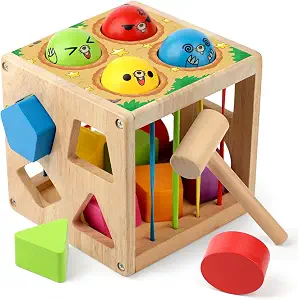
Description: This heirloom shape sorter is made of North American hardwoods, with geometric blocks finished with a clear, zero-VOC natural lacquer to bring out the organic wood grain.
Benefits: This wooden sorter without artificial paints is uncompromised and offers a pure, grounding sensory connection to nature. Thanks to its classic design, it’s a beautiful decorative object on an open nursery shelf when the fun is over and heavy so it won’t get tossed around in rambunctious play.
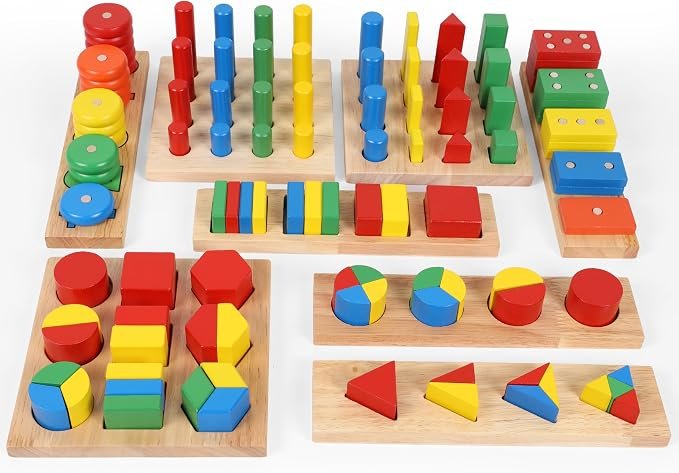
3. Wooden Geometric Stacking & Sorting House
Waldorf toy made of solid Linden wood. Open-ended and world-renowned. Non-toxic, water-based color stains that allow the natural wood grain to come through.
Benefits: This goes beyond the typical box sorter. The house structure and geometric blocks are taken apart, stacked, sorted, and incorporated into larger imaginative block play. It grows with your child with no effort, from a simple sorting activity for infants to an architectural feature in a toddler’s town.
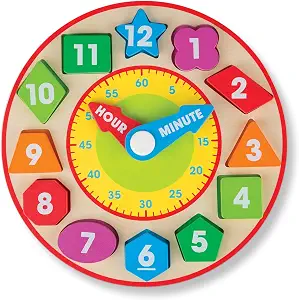
4. Melissa & Doug Wooden Clock Shape Sorting Set
Classic wooden clock, made in an ecological way. The blocks are placed in the recessed wells of the clock and are color coded. Moving minute and hour hands for early cognition engagement.
Benefits: This toy aids in the transition from basic shape sorting to the introduction of early abstract concepts. The smooth wooden blocks are super durable and the bright friendly color coding helps with visual tracking without the need for flashing lights or digital noises. It sits flat on a bookshelf and takes up nearly no floor space.
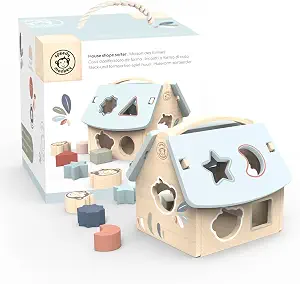
5. Raduga Grez Wooden Sort House and Shapes Set
Description: These house shaped sorting pieces in minimalist geometric shapes are made of solid linden wood and finished only with natural flaxseed oil, no chemical paints or varnishes.
Benefits: No artificial colors = soothing, naturalistic play environment; organic wood smell = grounding sensory connection indoors. The irregular, unique shapes present advanced spatial challenges which require a finer motor calculation than the standard, uniform cubes.
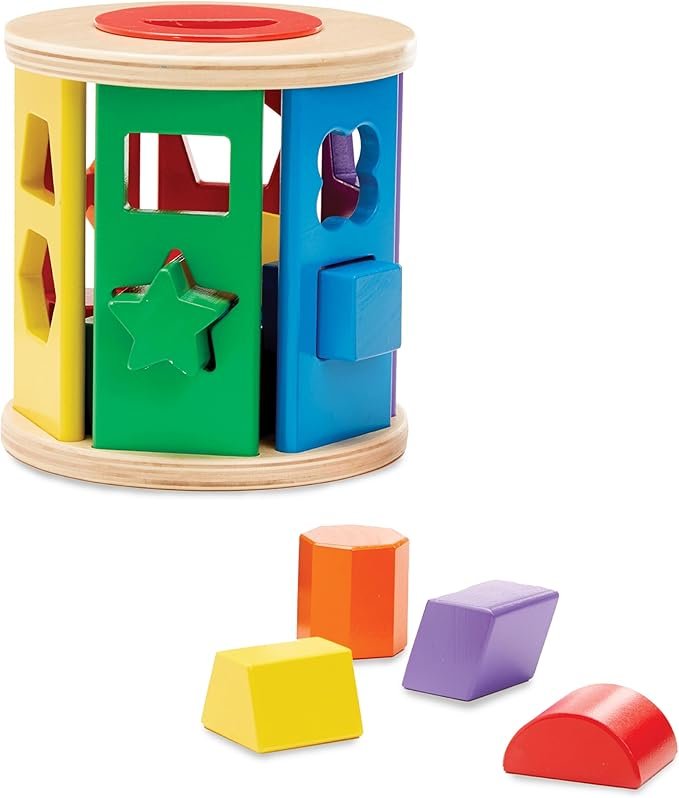
6. Melissa & Doug Match and Roll Shape Sorter – Classic Wooden Toy
A multi-use wooden bench made from Baltic birch and finished with child-safe, water-based paints, this toy combines a traditional shape sorter with a gentle pounding action.
Benefits: great for toddlers 18 to 36 months old, works on multiple developmental areas at once, hand-eye coordination, cause & effect reasoning and gross motor energy release. It’s solid wood so it can take the beating of an enthusiastic toddler with a hammer and it’s screen-free and quiet for play.
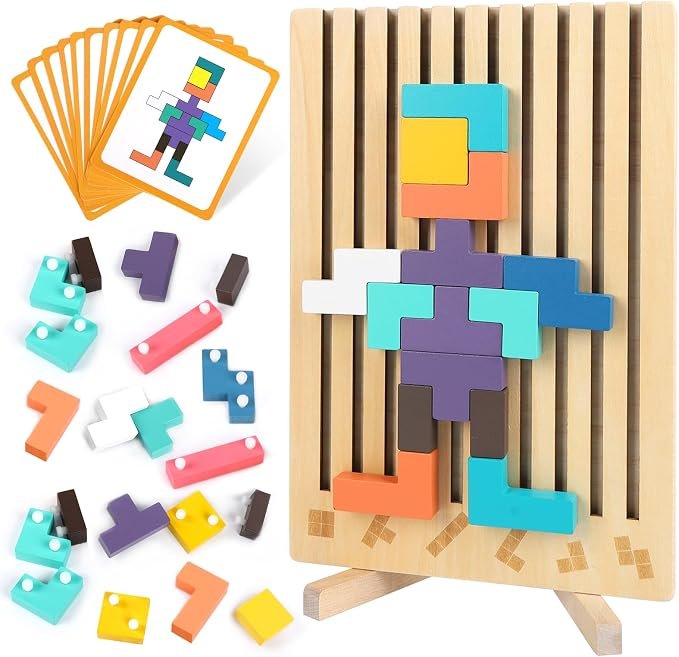
7. Wooden Stacking Puzzle Board, Montessori Brain Blocks for Kids Ages 3-8
This puzzle is uniquely designed, can be used for spatial matching and sorting challenges on a metal surface or in geometric constraints.
Benefits: These blocks combine the static shape sorting with the dynamic 3D spatial engineering. Thanks to the hidden magnets there is a magical ‘click’ that is incredibly satisfying to touch and helps you stay focused for longer. They fit into a small felt pouch so they are a travel-friendly companion for on-the-go screen-free fun.
Building a Low-Friction Shape-Sorting Ecosystem
But the battle with shape sorters isn’t just about collecting them, it’s how you administer them and present them in your home that makes your home peaceful or not.
1. The Incremental Complexity Method
A complicated 12-hole shape sorter can be confusing and frustrating for a ten-month-old infant. Instead, practice progressive reduction. Begin with a simple box that has only one round hole and one round block for the youngest infants. Once your child can do that easily, add a square or triangle. This builds their confidence, protects their attention span and prevents frustration while promoting steady growth of their cognitive skills.
2. Low-Shelf Access & Categorized Placement
Instead of storing your child’s shape sorters in deep toy chests or high closets, keep them on low, open wooden shelves. If the toys are in view and at the child’s eye level and within reach, they can choose what they want to work with independently and, most important, where to put it back when they are finished. It increases executive functioning, develops a strong sense of personal autonomy and encourages respect for the home environment.
3. Implement the “Less is More” Rotation Strategy
But if you give them too many sorting toys at once, they can be overwhelmed by the choices and lose interest. Rotate one shape sorter out and put the others away in a closet or storage bin. Change selection every 4 weeks. A month later your long-lost favorite toy is back, and the same intense curiosity is re-ignited as with a brand-new discovery, and the toy is thereby extended in life without adding to the clutter in your living space.
Play with Intent: The Lasting Value
Choosing shape sorters for your baby and toddler is an act of deep environmental and psychological stewardship. By selecting items that celebrate your child’s present stage of development, you are providing them with the ideal tools to develop sharp spatial reasoning, sound fine motor skills, and mental clarity without the distracting noise of modern commercialism.
At CozyParents we believe everything in your home should have a purpose, contribute to growth or inspire a moment of peace. When you curate a thoughtful, sustainable collection of developmental toys, you’re not just cleaning your living room. You’re teaching your child how to focus, how to wonder and how to be present with the world around them.
We’re excited to keep you in the loop on all things minimalist parenting, expert curated gear roundups, and intentional approaches to help restore calm to your family’s everyday flow. Are you rotating toys at home now or thinking of doing a play space purge this week for your child? We love to hear how you create peaceful, intentional spaces for your growing family.