
The first time the toddler walks the narrow wooden plank it’s a nail biting, breath-holding experience, gingerly stepping with arms outstretched like a tiny tightrope walker. If you’ve ever seen a two year old cautiously tiptoe across the edge of a low garden curb or try to balance on one foot while putting on their shoes, you’ve seen the raw, unrefined instinct of human vestibular development. In today’s marketplace, replete with flashing plastic ride-on toys, motorized cars, and gadgets that do the physical work for the child, it is easy to assume that entertainment must come with battery-powered motion. But these noisy novelties often fail to provide the deep neurological and muscular engagement required for true physical autonomy.
Parents, searching for ways to help kids burn off this boundless physical energy, often find themselves staring down massive, primary colored plastic slides and bulky indoor gyms that take over the living room and clash with the home decor. These products may claim to help with gross motor skills, but they often interfere with the esthetic harmony of a room and do not provide the kind of subtle, graded proprioceptive challenges that a developing child needs to master balance and coordination.
At CozyParents we believe that the children’s playroom should be a sanctuary for focused and purposeful movement and independent physical mastery. The notion of “intentional play” is at the core of our philosophy to choose the most durable, tactile and well-designed resources that honor the child’s developing nervous system and the visual harmony of the home. In this ultimate guide we’ll explore the complex developmental milestones that toddler balance toys promote, discuss how to establish a low friction gross motor ecosystem and look at 7 awesome balance products on Amazon US that respect your child’s developing body while preserving your home’s esthetic peace.
Developmental Foundations: Gross motor mechanics of balance control
To understand the enduring educational and therapeutic value of balance toys, we have to think about how a young brain and body learns to control physical balance. Pediatric occupational therapy and child development principles hold that balance, body control and spatial orientation are not static traits but rather dynamic, multi-sensory skills, based on vestibular integration, core proprioception and neurological regulation.
1. Spatial Orientation and Vestibular Function
The vestibular system, found in the inner ear, is the master regulator of human balance, spatial awareness and gravitational security. Children are bombarding their vestibular receptors with important sensory information as they walk on a bumpy stone path, balance on a teetering board or walk on low balancing beams. This constant flow of information helps the brain make sense of the head’s position relative to gravity. This deep sensory work is so grounding and organizing for the brain. It provides a natural reset for the nervous system, calming overstimulated, anxious or hyperactive children and developing the physical confidence to safely explore their environment.
2. Fundamental Postural Stability and Muscle Synergies
To achieve balance, the deep postural muscles, the abdominals, the spinal erectors and the pelvic stabilizers that support the spine must all work in harmony. Active balance toys require the child’s core and lower extremities to make micro-adjustments continuously, compared to stationary seating or passive riding toys. When toddlers lean into a tilt or a narrow surface, they are exercising the very muscle groups needed for standing up tall, running, jumping and preparing them for school. This constant physical feedback loop creates a really good sense of body awareness and muscular endurance.
3. Motor Planning, Risk Evaluation & Resilience
One of the most remarkable psychological benefits of traditional balance equipment is the careful motor planning and risk assessment that it requires. So, if a child is coming to a balance beam or a stepping stone, they need to look at it so they know how far it is, they know where their center of gravity is and they’re moving their body in a specific way with intention. If they screw up, they have to get right back on track. It builds the higher level executive function, emotional strength, frustration tolerance. Children learn to trust their own physical abilities, develop a deep sense of self-reliance and emotional regulation when faced with difficult tasks rather than trusting an electronic device or adult to stabilize them.
The Product Roundup
Choose balance toys that are durable, made from natural non-toxic materials and have a minimalist design so they can grow with a child’s developing physical skills.
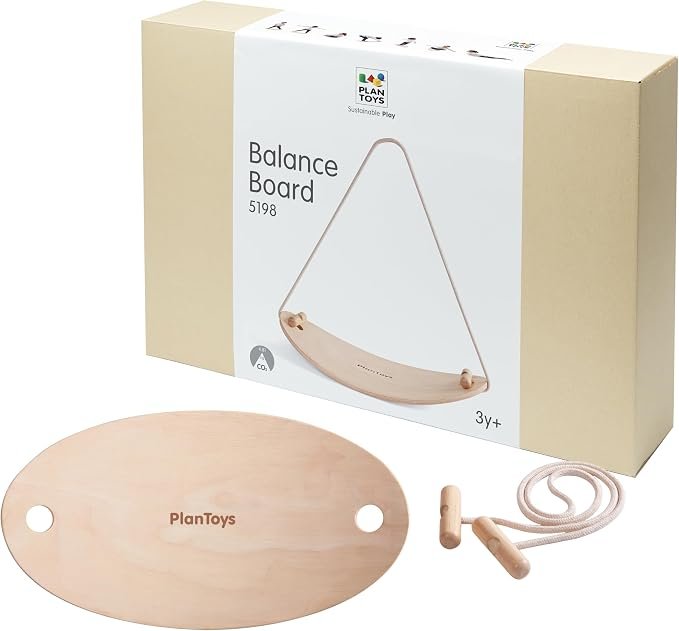
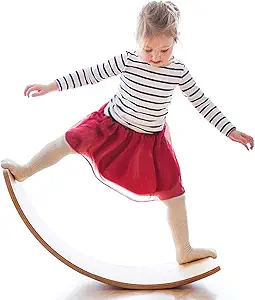
Description: A curved balance board sustainably made from rubberwood with smooth rounded edges and non-toxic, water-based finishes. Ergonomic curve, designed for early rocking and standing and core stabilization exercises.
Benefits: This classic wooden board is an exact match to the developing toddler’s need for vestibular stimulation taking the guess work out of age appropriate gross motor presentation. The nursery esthetic is grounded in natural rubberwood construction, while the minimalist design keeps sensory overload at bay. Its small footprint means it can sit flush against a wall or underneath a low shelf, keeping clutter off the floor.
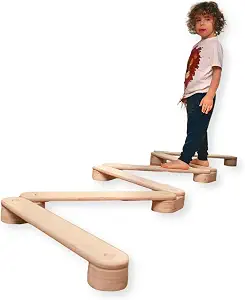
2. Piccalio Wooden Balance Beam Set Montessori
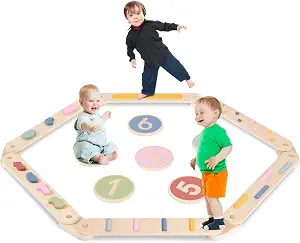
The modular balance beam set is beautifully designed with FSC-certified birch plywood, with interlocking wooden planks and stable stepping pods finished with a clear, zero-VOC natural lacquer.
Benefits: All artificial neon plastics are removed, pure grounding connection to nature with an uncompromised wooden balancing system. Its modular concept allows parents and children to build custom paths like straight lines, zig-zags or squares and to change the physical challenge as the child’s balance develops. When playtime is over its timeless wood esthetic makes it a beautiful decorative object.
3. Lily & River Little Climber & Balance Beam Combo
Hand crafted from North American hardwoods, this heirloom quality gross motor station features precision milled wooden beams finished with only natural, non-toxic oils and no chemical paints or varnishes.
Benefits: No artificial colors, a calming, naturalistic play environment, and the organic wood aroma provides a grounding sensory connection indoors. Its flexible beam format lends itself to endless configurations, offering hours of independent balance exploration and gross motor mastery.
4. Riverstones Balance Set by Gonge
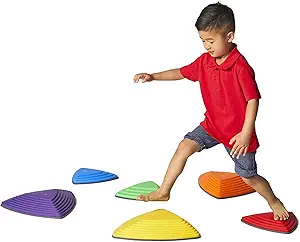
Description: A classic of Occupational Therapy known internationally. Strong asymmetric plastic stones of different heights and steepness. Has a strong anti-slip rubber rim that sticks well to the floor.
Benefits: These stones serve as a bridge between structured gymnastics and free-form active play. The asymmetric slope means children are constantly adjusting ankle pronation and core posture. They fit neatly into one stack and are the perfect companion for screen free enjoyment respecting the spatial harmony of the home.
5. ComfyBumpy Balance Board for Kids with Cork Roller
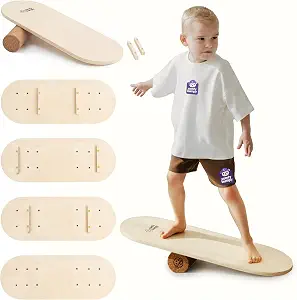
Description: This heirloom rocker is made from solid American maple wood and finished with a blend of organic linseed oil and beeswax that enhances the rich, organic grain of the timber. Handcrafted.
Benefits: Great for toddlers 18-48 months as it works on all areas of development at once. Vestibular integration, core strength & creative open ended play. Solid enough to survive enthusiastic everyday use, yet offering a screen-free, quiet and visually soothing play environment made of solid wood.
6. Sprout Kids Low Profile Wooden Balance Beam
A sleek, low-profile wooden balance beam crafted from Baltic birch and finished with child-safe, water-based finishes for exceptional stability.
Benefits: Ideal for families who want to promote gross motor control without adding an unsafe height to the living area. Its low profile design means a slip is just a soft step onto the rug and the clean, minimalist silhouette blends into modern home decor.
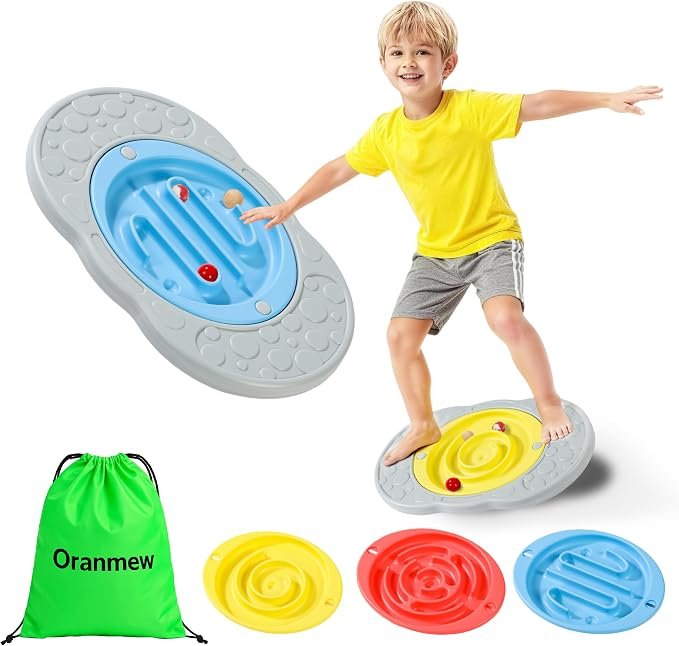
7. Kids Maze Balance Board with Bag, 2-in-1 Sensory Training Toy, Ages 3-12
Well designed, wooden wobble board with convex hemispherical base and textured wooden top disk for rotational stability and multi-directional balance.
Benefits: This artistic wooden balance trainer is free from plastic overstimulation, it is a gentle engaging introduction to rotational equilibrium and ankle stabilization. This multi-ply wood is strong enough to stand up to active use over and over again, and is a soothing companion for indoor gross motor development.
Practical advice on building a low friction balanced ecosystem
Choosing balance toys is only half the war. And the way you arrange and present them in your living space will determine the amount of peacefulness and orderliness your home will retain.
1. Landing and Boundary Approach
But when a toddler has no spatial boundaries, the addition of gross motor equipment can easily turn your living room into a chaotic gymnasium. Always use a low-pile wool rug or anti-slip play mat under your balance beams or rocking boards. It gives a physical boundary for active play, lets children know where the play space starts and allows for easy, independent clean up.
2. Stacking and Low-Shelf Attain
Keep your child’s balance boards and modular beams on low, open wooden shelving, or upright in a shallow basket against a wall. When physical tools are in sight and accessible children are able to make their own decisions about when they want to push their bodies to their extremes and most importantly where to put them back when they are done. It encourages the development of executive functions, teaches respect for the home environment and promotes autonomy.
3. Implement the “Less is More” Gross Motor Rotation Strategy
The paradox is that having too many big motor toys available at one time can stifle involvement. Having too many choices and a cluttered room can be overwhelming. Change one main balance tool such as the curved rocking board for two weeks and then the modular balance beams for the next month and put the other tools in a closet or storage nook. A month from a known balance tool, and when it returns, it is met with the intense curiosity of a new discovery. Extend the life of the toy without taking up space in your living area.
Comparative Study: Premium Intentional Balance Toys and Mass Market Toys
Many parents face a dilemma when choosing balance toys for their toddlers. Should they go for expensive, eco-friendly, high quality items or cheaper, mass-produced plastic options? Here’s a look at some of these options along some axs that explain why intentional gear is an important investment for your family.
Premium sustainable wooden balance boards and reinforced beams are built to last for multiple generations and easily withstand the heavy stepping, jumping and active manipulation of early childhood. By contrast, mass-market plastic balance toys tend to crack, warp under weight and fade, ending up broken and discarded in landfills within months.
Intentional toys are designed with minimalist spatial harmony in mind in terms of functional storage and home integration, with flat profiles, stackable components and neutral esthetics that blend seamlessly into home décor. These cheap plastic substitutes have awkward, bulky shapes and chaotic primary color schemes that overwhelm sightlines in a room, making for unavoidable clutter in the visual sense.
Premium balance equipment is made with non-toxic water-based finishes, secure anti-slip rubber pads, and smooth, rounded edges to address ergonomics and safety concerns for a child’s sensitive skin and developing immune system. Often mass-market knock-offs will use untested chemical plasticizers or brittle plastics that dangerously slip on hard flooring under pressure.
Natural wood and matte finishes ground with organic textures and natural scent profiles that calm a child’s nervous system on a sensory level. Synthetic plastics and electronic novelty toys with cold slick surfaces and loud high frequency artificial sounds can over-stimulate sensory processing capacities of young children.
Intentional balance tools are often open-ended in developmental and therapeutic value, developing creatively as the child develops from a toddler exploring basic standing stability to a preschooler exploring complex imaginative obstacle courses. Cheap novelty toys are pre-programmed to give a hit of dopamine that is short-lived and that the child soon loses interest in.
The Lasting Importance of Play on Purpose
Selecting a balance toy or gross motor station for your toddler is an act of profound environmental and psychological stewardship. In choosing items that celebrate where your child is developmentally, you’re giving them just the tools they need to develop strong core stability, strong spatial awareness and physical confidence all without the jarring noise of modern commercialism.
At CozyParents we believe everything in your home should have a purpose, help you grow or spark a moment of peace. A well-chosen, sustainable selection of developmental gear does more than tidy your living room. It teaches your child to focus, to balance, and to engage deeply in the physical world around them.
We’d love to have you back on CozyParents for more minimalist parenting ideas, expert-approved gear round-ups, and intentional ways to bring calm back into your family’s daily rhythm. Do you have a gross motor rotation system at home or are you curating your child’s play space this week? Let us know in the comments, we love hearing how you create peaceful intentional spaces for your growing family.