
The most effective strategy to broaden a child’s world view, to develop their spatial intelligence and to begin cultivating an early sense of global awareness is to introduce young children to geography. Long before a youngster learns about borders in political geography or memorizes capital cities in the classroom, they absorb spatial concepts through hands-on experience. As the child runs her finger across the curved surface of a spherical globe or snaps a continent piece into the floor puzzle, she is translating abstract land masses into physical concepts .
But many parents equate teaching geography with complicated memorization, or high-tech computer screens with flashing lights and automated sound clips. Digital maps and screen-based apps show flat, two-dimensional images that don’t adequately convey physical scale, curvature or geographic relationships to a developing mind.
In contrast, tactile geography aids such as raised-relief globes, Montessori continent puzzles, interactive floor maps and nesting nesting-block maps engage motor and spatial pathways. Young toddlers can physically manipulate and conceptualize the Earth as a three dimensional sphere in space with land and sea.
By outfitting your house with screen-free, tactile geography tools, you transform global learning into an engaging, self-directed play experience that encourages spatial thinking, cultural curiosity and fine motor precision.
At Cozy Parents we assess early children equipment via a rigorous filter of spatial clarity, physical health, developmental utility, and clutter-controlled minimalism. We believe your house should act as a tranquil sanctuary where your child’s innate curiosity can grow without needless digital noise.
If you are eager to discover more therapist-backed frameworks, house organizing tactics, and professional gear reviews for developing families, visiting Cozy Parents can connect you with practical resources created for deliberate daily life.
How Young Minds Learn Geography
To select the most effective geography products for your house, it helps to understand how the pediatric brain acquires spatial awareness and geographic comprehension. Early childhood educators and Montessori practitioners define early geographic reasoning into three key pillars:
1. Three Dimensional Space Curvature
For a young child living on flat ground the idea that the Earth is a curving sphere suspended in space is a significant cognitive leap. Physical, three-dimensional globes provide immediate tactile feedback for kids, letting them rotate the planet, look at the equator and understand that if they go in one direction, they’ll eventually get back to where they started.
2. Discrimination based on land, water & continent
Before youngsters can tell the countries or wave flags, they must divide the face of the Earth into its two great physical habitats, land and sea. High-contrast, tactile globes and color-coded continent maps assist children to visually distinguish between oceans and landmasses, laying the groundwork for future geographic studies.
3. Orientation in space relationships between parts & whole
Floor maps and map puzzles help children understand where tiny pieces of geography fit into the bigger whole of the world. Placing South America just below North America or placing Antarctica at the bottom of the globe trains visual discrimination, spatial rotation and hand-eye coordination.
Best Globe And Map Toys
Below are 7 different best rated goods that are still available and active on Amazon US to assist you choose durable, quality geography manipulatives for your home.
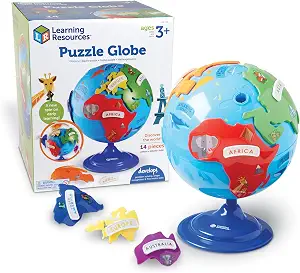
1. Puzzle Globe Learning Resources
Designed exclusively for babies and preschoolers, this 3D interactive puzzle globe converts early world geography into a hands-on manipulation game. The set includes a strong, smooth-spinning globe base and seven large, color-coded continent parts with unique post and hole shapes.
Each part of a continent slots into one correct area on the globe and gives self-correcting tactile feedback if a youngster attempts to place a landmass in the wrong hemisphere.
The continent pieces are embossed with contoured pictures of native animals and iconic locations so that non-readers can recognize landmasses by sight.
The globe is made from non-toxic plastic and is durable. It’s also the right size for little hands. Young children will learn the spherical shape of the Earth while developing pincer grips and skills of spatial rotation.
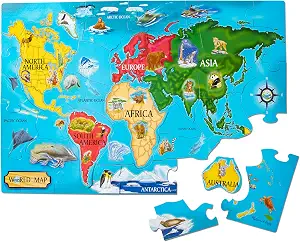
2. Melissa & Doug World Map Floor Puzzle (33 pcs.)
This giant 33-piece cardboard floor puzzle is an extra thick visual examination of world geography. The puzzle measures over two feet wide when assembled and has a surface that is easy to clean and can stand up to frequent play on playroom floors.
Each puzzle piece is individually designed to depict continents, oceans and regional landmark representations, allowing youngsters to relate physical puzzle assembly and spatial geography.
Whole-body movement is required to assemble a floor puzzle, which means toddlers have to reach, bend and rotate pieces which fosters gross motor planning and bilateral integration.
The high contrast colors clearly identify continents and it’s a great quiet time tabletop or floor game that promotes spatial problem solving confidence.
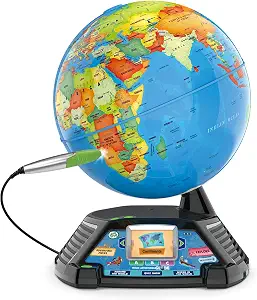
3. LeapFrog Magic Adventures Globe
For older toddlers ready to transition from tactile play to aural discovery, this interactive globe provides an exciting, child-safe teaching platform. The interactive smart pen included allows kids to tap anywhere around the globe to hear about capitals, national anthems, populations, languages and natural fauna.
The globe boasts a smooth rotating axis, clear geopolitical contours and age-appropriate audio content intended exclusively for young learners.
While flat digital screen tablets do not, the SmartGlobe holds onto the basic three-dimensional globe format and employs auditory prompts to spur on self-directed global research.
It features built-in games and comparison modes where youngsters can search for certain countries or compare the size of different geographical masses.
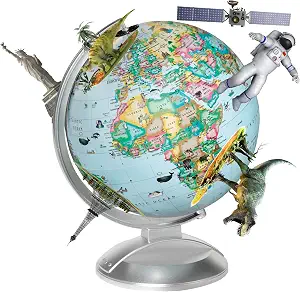
4. Globe 4 Kids Educational Insights
This vibrant 12-inch desk globe is an approachable, non-electronic introductory globe for young children with clear, strong labeling and simple color categorization. The globe features over 125 illustrated animals, landmarks and maritime boats, giving natural visual anchor points for young children who are not yet reading full text.
The smooth-spinning mounting base enables children to turn the globe easily with one hand without toppling the gadget over.
Its simple visual design avoids cluttered overwhelm, making it easy for children to find major oceans, the equator and their own home continent.
Made from tough, wipe-clean plastic, it fits nicely on a low bedroom shelf or play table for everyday exploration.
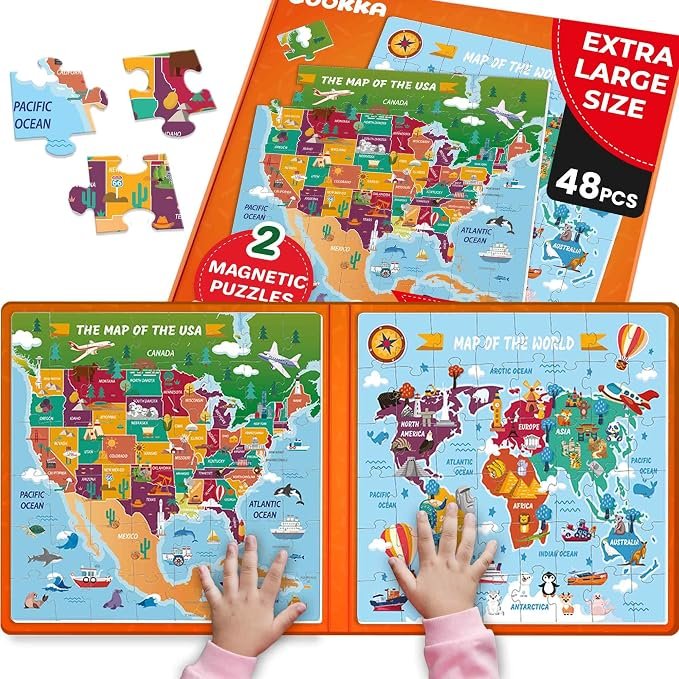
5. Magnetic Puzzle World Map Janod
This heirloom-quality wooden wall puzzle mixes creative design with magnetic geography learning. The set is made of solid wood and comprises a huge globe map board to hang on your wall and 92 magnetic wooden puzzle pieces of specific countries and regions.
Each magnetic piece includes a photograph of the country’s name and capital plus a picture of local culture, flora or fauna.
Children arrange the magnetic pieces on the color-coded continents printed directly on the hardwood board, giving visual cues of where to position the pieces.
Hanging the board vertically on a wall or easel forces youngsters to work on a vertical plane, promoting wrist extension, shoulder stability and spatial tracking while keeping floor space free from visual clutter.
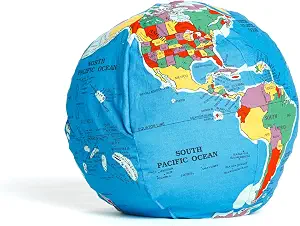
6. Hugg-A-Planet Soft Plush Globe
This special sensory approach to geography makes world geography a soft huggable toy. This 600-color cotton plush globe. The plush sphere is stuffed with soft, non-toxic stuffing and is printed with over 600 clearly identified destinations, oceans and landmasses in bright water-based dyes.
Toddlers may squeeze, throw and catch and hug the globe combining spatial learning with physical play.
Soft and light enough to be perfectly safe for toss games indoors. Parents can toss the globe to a youngster and see if they can name the continent closest to their thumb when they catch it.
The entire plush globe is machine washable, making it a hygienic, long-lasting addition to a toddler’s snug reading corner or bedroom shelf.
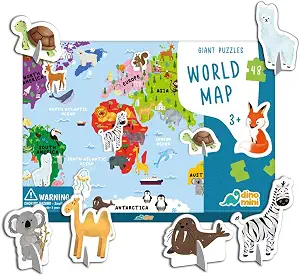
7. Learning Resources: Canvas Map of the World
This sturdy canvas world map is great for flexible floor play, wall display or travel and offers a soft non-skid surface for geography sorting games. Bold contours of continents Labeling of oceans Colorful illustrations of important habitats around the world and iconic sites.
Kids can place the canvas on a rug and place their own toy animals, wooden automobiles or continent blocks directly on their own home regions.
The fabric design folds up compactly into an included canvas storage tube for easy storage in tiny playrooms or for carrying on family holidays.
No fiddly plastic parts, no batteries, and an open base for imaginative play, story telling and geography talks.
How to Create a Peaceful No-Screen Geography Corner
Investing in verified, tactile globes and map toys is a great beginning point but building an organized, low-friction learning environment is what keeps everyday play focused and meaningful. A room full of overflowing toy bins can visually distract children, leading to short attention spans and scattered toys.
Here are four practical ideas to create a clutter-free welcoming geography environment at home:
1. Position globes at eye level
Place globes and map puzzles on low wooden shelves or tiny side tables so your youngster can reach up and spin them without the help of an adult. Physically being present for learning tools encourages self-directed exploration and independent curiosity.
2. Map Rotation Exercise
Instead of having all 7 geography sets out at once in your play area, display 1 globe and 1 map puzzle at a time. Rotating the selection every two weeks keeps the interest strong, and also maintains a visual tranquility in your home.
3. Combine Maps with Animal Figures
A flat world map or puzzle globe, containing a little basket of realistic miniature animal figures Get your youngster to connect the polar bear to the Arctic, the kangaroo to Australia or the elephant to Africa. This practical combination anchors abstract map schematics in recognizable biological ideas.
4. Encourage Story Telling, Not Testing
Don’t quiz your child with rapid-fire queries such as, “Where is Europe?” “Let’s go to the coldest place on earth that has penguins!” or “If we traveled on a boat across this blue ocean, what country would we first reach?” Playing is a fun, low stress way to get geography.
Important Differences: Tactile Globes & Maps vs. Maps in a Digital App
Evaluating early geography tools clearly shows that tactile materials and automated digital gadgets have different impacts on a developing child:
Sensory Engagement: Tactile globes and maps provide a rich 3D feel, weight, volume and physical curve. Digital map apps depend on flat glass panels that compress 3D landmasses into 2D pixels.
Motor Development: Intrinsic hand muscles, finger isolation and bilateral coordination are exercised through physical puzzle building, magnetic component placement and globe spinning. All that swiping and pinching on an app is not much of a fine motor workout.
Spatial Comprehension: Three dimensional globes show spherical scale and continuous ocean paths accurately. Flat digital screens misrepresent the size of landmasses and do not reflect the continual rotation of the Earth as it is.
Focus and Attention Span: Tactile, screen-free instruments promote sustained focus, quiet exploration and deep play flow. Fast moving digital map apps and pop-up films often cause sensory overload and rapid exhaustion.
Parent-kid Interaction: Physical globes enable shared storytelling, journey planning and natural discussion between parent and kid. Automated electronic apps mean passive, solitary screen tapping.
Broadening Perspectives Through Hands-On Play
You don’t need dazzling lights, batteries or computer screens to introduce your child to international geography. By selecting well-designed 3D puzzle globes, magnetic wooden wall maps, and plush soft globes, you provide your child rich, multisensory tools that make global discovery natural, entertaining and deeply satisfying.
Take a few minutes today to check out your child’s learning place. Bypass the button-activated computerized noise-makers, put a tactile globe on a shelf within reach and let your child explore the universe with his own hands.
You don’t have to do it alone when it comes to deciding what early childhood equipment to purchase or how to set up your home. For a constant stream of realistic developmental frameworks, minimalist home organization suggestions and honest product reviews stay tuned to our website.