

The floor of the living room isn’t just a floor. It’s a massive, unexplored terrain for physical and cognitive exploration in the beautiful, chaotic and fast-paced journey of early childhood. As toddlers transition from unsteady, tentative first steps to the confident, leaping and bounding energy of the preschool years, they are constantly testing their boundaries both physical and psychological. We strive to keep our homes clean, attractive and safe.
Nor is it defiance or just a way to burn energy, this compulsive urge to move, to balance and to jump. It is an essential brain function. In the young child’s brain, the body is being continuously and actively mapped on physical space. This developmental need doesn’t just stop when the weather gets rough or when we are confined to smaller indoor footprints. Without appropriate and safe outlets for this energy children often develop emotional dysregulation, frustration and the dreaded “indoor fatigue.”
Here at Cozy Parents, we are huge believers in the philosophy of creating “yes” environments for children. A “yes” space is a well-considered space where a child’s innate drive to climb, jump and balance is supported by intentionally crafted, quality equipment, not constant adult redirection or the prohibition of furniture use. We believe that a peaceful, minimalist home can still include active play, but it should be done thoughtfully.
Developmental Foundations
Buying open-ended gross motor equipment is a lot more than just keeping a child busy on a rainy afternoon. Within pediatric occupational therapy and child psychology, stepping stones are a treasure trove of developmental benefits. This is how a good set of indoor stepping stones supports foundational growth:
1. Enhanced Vestibular and Proprioceptive Input
The body’s internal GPS is the vestibular system, found in the inner ear. It helps us maintain our balance, know where we are in space and control our emotional states. The proprioceptive system, meanwhile, provides us with feedback from our joints and muscles, informing the brain where the body is in space without the need to see it. Stepping stones offer a controlled uneven surface that requires the brain to process the distribution of weight and gravity in real time. If overstimulated, anxious or hyperactive, it can act as a natural nervous system reset and some parents report that their children’s focus and emotional regulation during quieter activities later in the day are dramatically improved.
2. Motor Strategic Planning and Executive Functioning
What does it mean to walk a path of stepping stones? It is not just a physical action. It is a deeply complex mental exercise in problem solving. Before a child even lifts their foot they have to look at the distance between the current stone and the next, calculate the height and width, assess their own physical capabilities and decide exactly where to place their foot to avoid falling. This is called “motor planning.” These purposeful repetitive movements children engage in are actually practice and improvement of their executive function. They are learning to plot a sequence, implement the strategy and change their body movements on the fly if they start to wobble.
3. Bilateral Coordination and Crossing Midline
They have to switch feet, change their center of gravity from left to right and often, reach across their body to maintain their balance, like a child jumping from stone to stone. This means the left and right halves of the brain need to talk to each other quickly and well a skill called bilateral coordination. Also, when a child steadies themselves on an uneven stone by crossing an arm or leg over the center of their body they are “crossing the midline” which is a significant developmental milestone closely associated with the development of reading, writing and higher level cognitive processing.
7 Best Indoor Stepping Stones
You must select the right stepping stones for your minimalist home with the utmost care, so that you can find the perfect intersection of developmental utility, safety and aesthetic harmony. We’ve picked seven of the top-rated and best options on Amazon US that fit with the CozyParents philosophy.
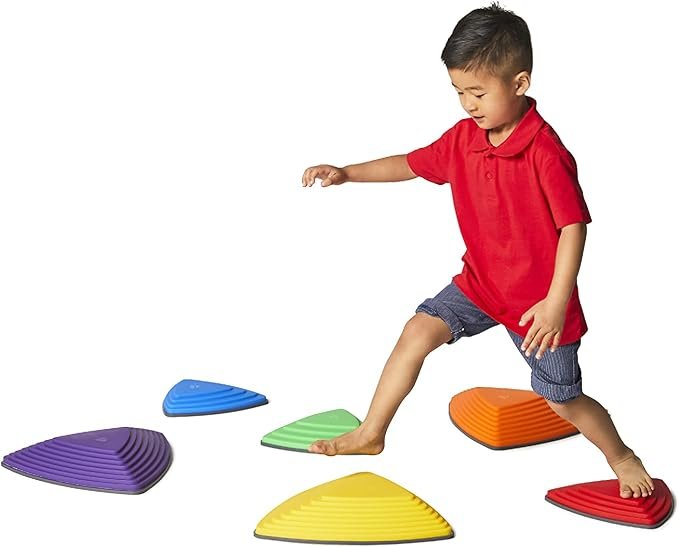
1. Gonge Riverstones indoor/outdoor play
The Gonge Riverstones are a staple in pediatric occupational therapy clinics around the world. This set consists of six durable, asymmetrical plastic stones in various sizes and steepness. They feature a heavy-duty, non-slip rubber rim that grips tightly to hard floors and carpets.
Benefits for the Child and the Home: These stones boast a brilliant asymmetry that mimics the natural, unpredictable shape of real river rocks, requiring the child to constantly adjust their ankle position and balance. They’re plastic but built to heirloom-quality standards and can support an adult’s weight, so parents can join in the play. As far as storage, the stones are fully hollowed on the bottom so they can nest and stack into one neat, compact tower to be tucked into a wardrobe corner, saving your home’s visual peace.
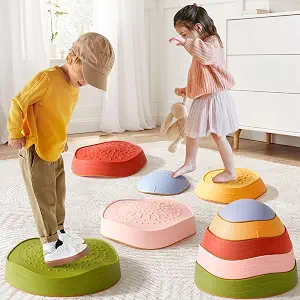
Made in the USA from durable, sustainably harvested Birch hardwood, the Lily & River Little Steps are high-end wooden stepping stones that will bring the best of minimalist and Montessori-inspired home design. They have a smooth non-toxic clear finish and are backed by a thick felt pad for protection to prevent slipping and scratching of floors.
Child and Home Benefits: These stones are a veritable triumph of aesthetic design. The natural wood grain lends a warm, grounding, organic feel to the playroom that integrates seamlessly with modern interiors. They are flat and low to the ground, making them the perfect starter set for younger toddlers (18 months to 3 years) who are just learning to master their balance but aren’t ready for steep angles. The flat surfaces also double as beautiful display pedestals for wooden toys or tiny toddler seats for reading time, maximizing their functional value in a clutter-free home.
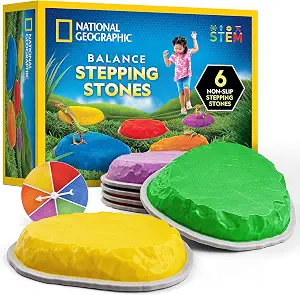
3. Balance Footsteps National Geographic
This colorful set contains ten soft, light weight high density EVA foam stones. The top features a textured non-slip surface that softly grips little feet and the flat, secure base sticks well to indoor flooring.
Benefits for Child and Home: If you have a very young toddler or live in a flat where noise reduction is a priority, these foam stones are a great option. The EVA foam is completely silent when dropped, stepped on or thrown so you can enjoy all the active indoor play without the loud clatter. The foam has a little give to it, which presents a special proprioceptive problem in that the child has to keep their core stable on a surface that is not perfectly rigid. Feather-light, they allow a two year old to exercise their autonomy by carrying and arranging the obstacle course all on their own.
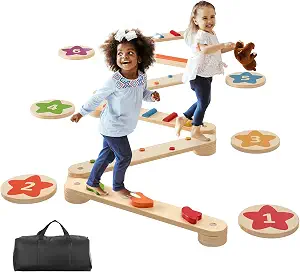
4. Piccalio Wooden Step Stones
Piccalio stones are made from FSC certified pine and birch wood, set of 6, beautifully muted, earth-toned, non-toxic painted tops (or natural wood options). All stones feature a full coverage rubber base for maximum anti-slip safety.
Child and Home Benefits: Piccalio does a nice job of making gear that looks like high-end furniture instead of kids’ toys. The soft, earthy colours respect a child’s visual environment by avoiding the sensory overload often created by neon plastics. The solid wood construction gives a wonderful, substantial tactile feedback, grounding the child’s energy as they step. Also, their uniform, circular shape and flat design make it easy to stack them into a visually pleasing column when playtime is over, easily stored on an open Montessori shelf without looking like clutter.
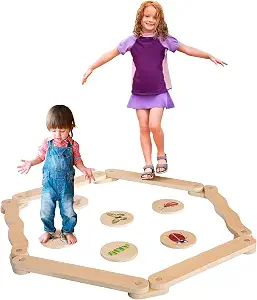
5. Bunny Hopkins Wooden Step Stones
This set of six stones is hand made by artisans in the USA from natural maple wood. The wood is treated with a natural, child safe blend of linseed oil and beeswax, inspired by Waldorf educational philosophies, making the beautiful, unique grain of the maple fully visible.
Benefits for Child and Home: These are the stones for the purist. Bunny Hopkins eschews paints and lacquers for a deeply sensory experience. Children can feel the subtle warmth and texture of natural wood underfoot, helping them to connect with the natural world even when playing indoors. They are super tough and since they don’t have bright colors or predefined shapes they are the perfect open-ended toy. Today they are stepping stones, tomorrow plates for a mud kitchen, the next day lily pads for a stuffed frog.
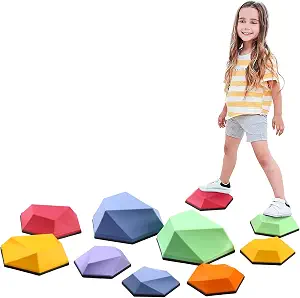
6. Stepping Stones Textured Balance Special Supplies
These bright, heavy duty plastic stones are designed with sensory integration in mind. Each stone in the set features a highly tactile, raised-bump surface designed to stimulate the nerve endings in the soles of the feet. They have rubberized grips on the bottom so they don’t slip on hardwood or tile.
Child and Home Benefits: These stones are a dual purpose tool: gross motor development and tactile sensory therapy. The textured bumps give intense sensory feedback, which is great for sensory seeking children or children who need a little extra help waking up their nervous system in the morning. They are more colorful than wooden alternatives but the therapeutic value makes them a must-consider. They fit together perfectly, so that when it’s time to clean up, a big and difficult obstacle course can be reduced to the size of one stone.
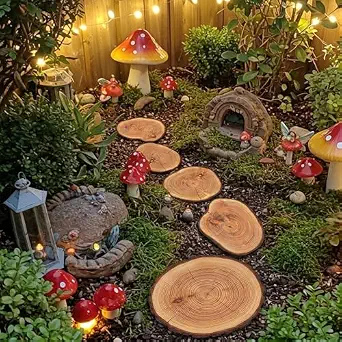
7. Sprouting Wooden Stepping Stones
Sprout’s stepping stones are milled of very strong Baltic Birch plywood, and have a clever, interlocking design that requires no hardware. They have a minimalist, natural aesthetic and are finished with a zero-VOC, non-toxic finish.
Benefits for Children and Homes: Sprout is known for its clean lines and functional design. These stones have a slightly larger surface area making them very approachable for cautious children who might feel intimidated by smaller targets. The wide base means they will never fall over, providing the most safety during energetic play. Their sleek, unpainted wooden design brings peace and visual quiet to a minimalist playroom, honoring the child’s space with simplicity and grace.
Practical Advisory
These are beautiful tools to be a source of joy, growth and connection, not yet another source of scattered clutter in your home. It’s essential to incorporate them into your home with a few simple, intentional habits to keep it that way.
The “On-Demand” Obstacle Course Approach
Make your stepping stones a “on-demand” activity rather than a permanent fixture in your living room floor. Store them neatly nested in a special low-profile woven basket or on a bottom shelf. If you sense your child’s energy building or they ask for ‘gross motor work’, have them take out the stones and build the path themselves. This means that the setting up and breaking down of the obstacle course becomes part of the play itself, and teaches responsibility, spatial planning and respect for the home environment.
Implement the Barefeet Play Policies
Encourage your child to use their indoor stepping stones, completely barefoot, whenever the weather allows. The soles of the feet are filled with thousands of nerve endings that read the terrain and send rapid messages to the brain about balance and posture. Socks (even those with grippy bottoms) and shoes dull this important sensory feedback. Letting your child feel the cool smoothness of wood, the slight give of foam or the therapeutic bumps of a textured stone enhances proprioceptive feedback, deepens their connection to their physical body and greatly improves safety and grip.
Integration of Narrative and Open Ended
Combine the stones with other minimalist tools you have around the house to nurture your child’s natural creativity. Place a wooden balance board at the end of the stone path to serve as a wobbly ‘finish line’. Hang a play silk over two stones to create a ‘river’ to jump over. The stones can be part of a bigger story (maybe a dangerous journey through a dark forest or a quest to cross a volcano full of lava), which adds more psychology to the play, and motivates the child to keep their attention for a longer, uninterrupted time.
Novelty through rotational strewing
If you discover the stepping stones have remained unused in their basket for a week, you can use the Montessori idea of “strewing.” When your child is asleep, set out a simple, attractive trail of stones from their bedroom door to the breakfast table or to a comfortable reading corner with new books. When they wake up in this prepared environment, their intrinsic motivation to work with the tool will be immediately rekindled. Spreading is a quiet invitation to play, not the pressure of a parent directing play.
Comparative Analysis
As for choosing stepping stones to bring into your home, it’s important to look beyond the initial cost and think about the long-term impact on your child’s play and the ecosystem of your home.
Durability and Longevity
Premium stepping stones, especially those made from sustainably harvested solid hardwoods or high quality occupational therapy plastics (such as the Gonge Riverstones) are designed to last for multiple generations. They can withstand the hard, daily, high-impact force of an active preschooler and often hold the weight of adults. In stark contrast to this, cheap mass-market plastic alternatives are prone to structural fatigue, cracking under pressure and developing sharp, dangerous edges over time, inevitably ending up as landfill waste.
Storage that works and looks good.
The hallmark of a well designed, intentional toy is how it behaves when it is not in use. Good stepping stones are purposefully designed to be in harmony with the space they occupy. They have nesting features, stackable profiles and sleek shapes that can slide flush against walls or tuck away easily into storage baskets. The cheaper alternatives tend to be bulky, oddly-shaped, non-stackable and in chaotic color schemes that dominate room sightlines, creating unavoidable visual clutter and ruining the peace of a minimalist home.
Ergonomics, Safety and Stability
Safety is the most important thing in gross motor play. Premium options are developed with the help of child development experts. They are mathematically balanced with weight distribution and natural anti-tip arcs and high quality, full coverage rubber or felt bases that grip hard flooring securely without marring. Mass-market knock-offs usually use cheap, stiff plastics that slide dangerously on hardwood or tile and don’t have enough weight to stabilize the stone so it won’t flip when a kid steps on the edge.
Grounding and Sensory Quality
A toy’s sensory profile can have a powerful effect on a child’s nervous system. Sustainable wooden stones offer grounding, warm tactile feedback, the scent of natural wood, and an organic visual aesthetic that respects a child’s sensory processing limits. Premium foams and plastics even have deliberate, therapeutic textures. The cheaper options often have cold, synthetic, slippery textures and loud neon primary colors that can overstimulate spaces and take away from the grounding nature of the physical activity.
Therapeutic and Developmental Significance
Finally, premium stepping stones are naturally open-ended. They are simple, elegant and durable in design and endlessly adapt to a child’s growing imagination – serving as seating, building blocks or balance tools as the child grows. Cheaper, character-branded or poorly constructed stones tend to be rigidly pre-programmed in their functionality or break so quickly that they lose their developmental value before the child has had a chance to truly master the motor skills they were designed to teach.
Summary
There is no need to sacrifice the impossible, that between the biological need of a child for vigorous movement and the need of an adult for visual serenity and order in the home. When you decide to invest in premium indoor stepping stones you are buying much more than a toy. You are giving your child a beautiful, long lasting tool that actively contributes to their vestibular health, polishes their complex motor planning and encourages independent, creative play.
Stepping stones perfectly embody the Cozy Parents philosophy: a clear, essential developmental role, very little space needed, and endless hours of high-value, child-led engagement. We hope you’ll keep exploring Cozy Parents for more thoughtful insights, expert-backed gear reviews, and minimalist strategies to bring peace, intentionality, and joy back into your parenting journey.