

If you’ve ever said, “Five more minutes until bedtime” and gotten tears, complaints or complete indifference in return, you’re not alone. One of the most typical sources of friction in early life is moving from one activity to another putting away building blocks, turning off a show, leaving the playground or sitting down for supper.
Parents often think a child is only trying to buy some time or test the limits. Actually, young children simply don’t understand abstract time. To a four year old saying they have “five minutes” is as useless as saying they have fifty lightyears. It feels unpredictable, unjust and startling to have an activity abruptly ended because they can’t read an analogue clock and have little concept of how fast minutes go by.
A visual timer shifts this dynamic by making an invisible concept something concrete. Instead than reading numbers or hearing a grown-up’s spoken cautions, youngsters can actually watch time disappear as a coloured disc shrinks or a strip of light changes colour. It substitutes the parental nag with an objective, neutral tool that helps youngsters know what’s next and navigate through daily routines with confidence.
Here’s a guide to why visual timers are so effective, practical ways to introduce them without adding extra stress and seven reliable, parent-tested visual timers available on Amazon US to bring calm consistency to your family’s days.
Ways to Make the Most of Visual Timers
Before you stick a timer in your child’s playroom or kitchen, it helps to know how to frame it as a helpful companion and not a high-pressure countdown clock. These four rules have must be remembered:
1. The Timer isn’t the “Bad Guy” – The Timer is the Neutral Referee
When a parent says, “Time’s up, turn off the TV,” the child’s irritation naturally is directed at the parent. A visual timer turns this upside down. You can say, “Look at the red disc? When the red is gone, our screen time is up. The clock was just doing its job when the timer went off.” You’re the empathic ally who helps them through the adjustment, not the enforcer who cuts their enjoyment short.
2. Give Visual Warnings Prior to the Last Signal
Don’t wait for the alarm to tell you your time is running out. When the coloured disc is down to a small sliver about one or two minutes left give a mild, observational prompt: “Look, the blue slice is getting super thin. Soon it will be time to load up the automobiles.” This allows your child’s brain to cognitively wrap up what they are doing and prepare for the transition rather than being yanked out of deep play.
3. No loud, Shocking Buzzer Sounds
Many older kitchen timers make a loud, high-pitched mechanical buzzing noise that can provoke fight-or-flight responses in sound-sensitive or neurodivergent kids. A unexpected burst of sound jolts the adrenaline and turns a smooth transition into a sensory meltdown. Look for timers with customisable volume levels, soft chime alerts or a silent flashing light option to make the ending feel expected instead of startling.
4. Start Practicing With Low-Stakes, Fun Moments
Don’t use a visual timer during a high-stakes power conflict, such as turning off an iPad or hurrying to meet the morning school bus. Start to use it in low-key, neutral, or entertaining activities. Set it for three minutes while cookies bake, two minutes while brushing your teeth, or five minutes for a light-hearted clean-up race. When your child understands the concept of the shrinking disc and begins to trust how it works, then you can start to use it during the hard transitions of each day.
Simple Habits to Make Transitions Easier
A visible timer gives your child a clear roadmap, but how you develop daily routines around it is what matters.
1. Let Your Child Turn the Dial
Kids love to be in charge of their environment. When it’s time to set a timer, ask your child to do the actual labour. “Can you turn the knob until the big red circle is at the number 10? Making kids physically turn the dial enhances their buy-in and turns what could be an unwanted boundary into an interesting activity they helped create.
2. Link the Timer to an Action, Not Just a Termination
And always explain what occurs when the disc disappears before you start the countdown. Instead of saying “We have ten minutes”, try to think of it as an entire action loop: “We have ten minutes on the timer. When the disc is gone we put the blocks in the bin and put our shoes on.” Providing your youngster with a definite next step shrinks the blank moment where protests sometimes begin.
3. Timers for Good Things and Desirable Things
Kids will naturally learn to hate the timer if it is only brought out when it’s time to stop playing computer games, leave the playground or take a bath. Keep the relationship positive by timing things your youngster likes. Set it for ten minutes of special one-on-one playtime with mum. Twenty minutes of cosy reading time on the rug. Or a five minute goofy dance party. This teaches kids that the timer is only a method to keep track of time and not always the end of fun.
4. Acknowledge the Emotion When Time Is Short
The most vivid imagination can’t prevent a sense of real disappointment when giving up a favorite pastime. If your child looks unhappy or sighs when the timer goes off, validate how they feel: “It’s hard to stop playing with your train track when you’re making something so cool. The red’s all gone, so let’s put the train out to the depot for tomorrow. ” By holding the boundary and validating their feelings, emotional trust and resiliency develop over time.
Visual Timers For Daily Routines And Change
Here are seven highly-rated, reliable and easy-to-use visual timers from Amazon US that help children visualise time and foster independence in everyday life.
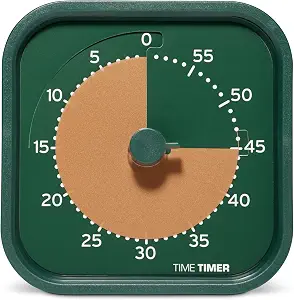
1. Home Edition Time Timer MOD
The Time Timer MOD Home Edition is the industry standard in visual time management, and was created by the firm that invented the fading coloured disc concept. This little desktop timer is about 3.5 inches square and contains a signature coloured disc that shrinks anticlockwise as time goes on, giving you a visual cue to how much time you have left.
The MOD Home Edition is protected by a soft, detachable silicone cover that protects the unit from accidental tabletop drops and features entirely silent quartz movement there is absolutely no irritating mechanical ticking while your child is working or playing. The quiet completion chime can be turned on or off with a simple button on the rear, making it a great, low-distraction anchor for study desks, reading corners and bedtime routines.
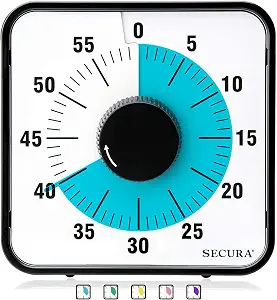
2. Secura Visual Countdown Timer – 60 Minute
The Secura 60 Minute Visual Timer is a tough, inexpensive workhorse that can take the everyday knocks and dips of a busy family household. It has a big high-contrast face with a brightly coloured disc that gradually fades away as the time goes down, along with bold, easy-to-read numbers that older siblings can keep track of at a glance.
To set the countdown, simply rotate the center dial clockwise to the appropriate length of time. On the back panel is a dual-mode alarm switch that allows parents to select a low or high aural beep or a short three-second ring or a thirty-second alert. No complex programming or tiny buttons needed so young children can easily configure it themselves under supervision to foster early ownership over their daily responsibilities.
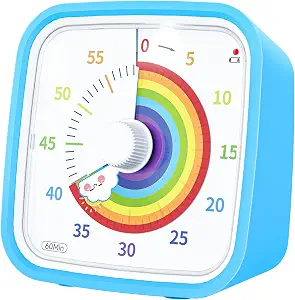
3. Yunbaoit Rainbow Kids Visual Timer
The Yunbaoit Visual Timer is made especially for younger toddlers and preschoolers and instead of one colour disc, it features a beautiful rainbow spectrum. When you twist the central knob, a bright multi-colored arc begins to form, slowly creeping toward a little cloud depiction as minutes go by.
The timer includes a fully silent sweeping motion, with no ticking sounds, which is especially helpful for youngsters with ADHD, autism or general noise sensitivities. The gadget has a large button on the top and kids may press and pause the countdown or turn off the alarm quickly when time runs out. With three volume positions: loud, quiet and totally silent with a flashing LED light, it fits effortlessly into quiet classrooms or active playrooms.
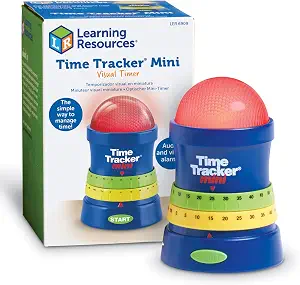
4. Time Tracker Mini Learning Materials
The Learning Resources Time Tracker Mini is unlike any circular dial clock, instead employing natural traffic-light colour psychology to help kids manage transitions. This little electrical tower is just about five inches high and has a vertical dome on top that glows green, yellow and red as time goes by.
Green light means that there is activity. Yellow light provides a visual ‘warning’ that the shift is coming. Red light means time is up . The timer can be programmed from five minutes up to two hours in five-minute increments by using simple push-button controls on the base. That early yellow warning light is essential for kids who get blindsided by sudden stops it provides an unmistakable visual heads-up to finish their game.
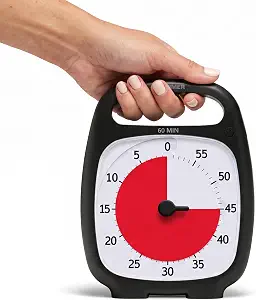
5. Time Timer PLUS 60-Minute with Handle
For families that require a timer that can easily travel from the playroom, to the bathroom counter, to the kitchen table, to outdoor play areas, the Time Timer PLUS is built for complete portability. It has a built in carrying handle moulded directly into the top so young hands may carry their personal clock where ever they go.
The face is protected by a clear, impact-resistant polycarbonate lens, keeping the characteristic red disc and delicate hands safe from curious toddler fingers. The unit has a separate volume control dial on the rear, so parents can set the alert level down to a slight whisper or up to a clear chime that can be heard across a noisy kitchen. Its sturdy structure and tip-resistant base make it a reliable partner for high-energy families.
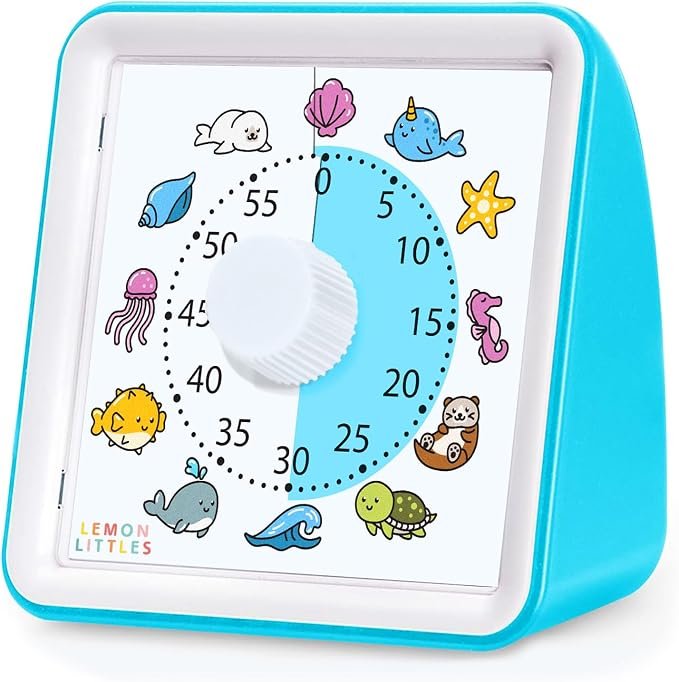
6. Twocorn Animal Visual Desk Timer
The Twocorn Animal Visual Timer is a fun, kid-friendly design that turns daily tasks into a game instead of a pain. It is designed in fun character designs such as cute bears, dinosaurs and foxes, to help soften the clinical aspect of regular clocks and offer a warm, welcoming touch to a child’s bedroom or play area.
The charming animal case hides a precision 60-minute countdown disc that runs smoothly without any ticking sound. To set the time, turn the center nose or dial, which coils the coloured disc out to your desired time. The unit has a magnetic backing and comes with an inbuilt pull-out table kickstand and wall-mounting slot, so you can stick it to the kitchen refrigerator, prop it up on a homework desk or hang it on the wall next to the foyer coat hooks.
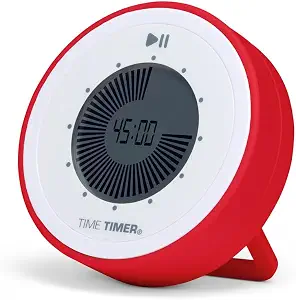
7. Time Timer TWIST Digital Timer for Countdown
For upper primary kids looking for a sleek, modern look that combines digital precision with visual tracking, the Time Timer TWIST features a unique circular design. The TWIST has a circular digital LCD screen with a surrounding revolving outer ring so you can dial in countdowns up to ninety minutes, unlike mechanical dial timers.
The timer counts down, and the digital tick markings around the edge fade away yet the precise numbers minutes and seconds stay visible in the center. The magnetic back sticks tight to whiteboards, filing cabinets and refrigerators making it a terrific tool for keeping track of homework blocks, instrument practice and screen time limits. The tiny puck shape makes it easy to tuck into a rucksack for trips or after school study sessions.
The Gift of Predictability for Children
A visual timer is not merely a handy timepiece; it is a soft bridge between a child’s inner universe of fantasy and the daily routines of family life. By making minutes of invisibility into distinct, diminishing shapes of colour, you take away the mystery and shock from everyday transitions, reduce the need for repetitive reminders and give your kid the tools they need to feel competent and in control of their day.
Selecting a quiet, easy-to-read timer, providing gentle reminders before time is up and aligning clear expectations with empathic follow-through help create a space where cooperation feels natural and routines fall into place with ease.
Spend a few minutes this week identifying the one transition that creates the most friction in your home, introducing a simple visual timer during a peaceful period and enjoying the tranquillity and predictability that clear visual time gives to your daily family rhythm.