
Early mathematical fluency is one of the most empowering periods of a child’s early development. Long before children meet formal addition equations or printed workbooks, they absorb mathematical reasoning through direct physical involvement with the world around them. When a youngster builds three wooden blocks, lines up toy cars or counts out apple slices at snack time, they are laying the groundwork for quantitative thinking.
But many parents believe that early years math is simply training a child to memorise the number sequence 1-10. Saying “one, two, three” is a great linguistic milestone but true preparedness for math involves a bigger cognitive leap understanding number sense and one-to-one correspondence. For a preschooler the abstract symbol ‘3’ refers to a certain physical quantity of objects, regardless of their size, colour or arrangement.
The fundamental knowledge does not support the button controlled screen based apps and electronic toys. We are offered flat, non-tactile representations on digital screens with no physical substance, volume and spatial weight.
In contrast, hands-on arithmetic manipulatives such as wooden counting pegs, balancing scales, connecting cubes and tactile sorting sets trigger motor pathways that reinforce mathematical concepts in a young child’s brain.
By integrating screen-free, tactile counting toys into your home, you translate abstract numerical principles into an engaging, self-directed play experience that supports spatial memory, problem-solving confidence and fine motor precision.
At Cozy Parents, we assess early childhood equipment through a demanding lens of spatial clarity, physical health, developmental utility and clutter-controlled minimalism. We believe your house should operate as a calm sanctuary where your child’s intrinsic curiosity can thrive without unneeded digital noise.
If you are eager to find more therapist-backed frameworks, home organising strategies and professional gear reviews for growing families, visiting Cozy Parents can connect you with practical tools created for deliberate daily life.
How Young Children Grasp Math Concepts
Understanding how early math thinking develops in the paediatric brain helps you to know what math tools will work best in your home. Early childhood educators and developmental psychologists have identified three basic building blocks of early math learning:
1. One to One Matching
In this basic skill the child is required to touch or move one object exactly and say one numerical name exactly in sequence. Without tactile manipulatives, youngsters can often count faster than their fingers can point, skip items or double count objects. The physical act of slipping a peg into a hole or inserting a bear into a cup, grounds the counting process in purposeful motor control.
2. Subitizing and Recognising Amounts
Subitizing is the brain’s ability to rapidly visually discern the number of items in a small group without counting them individually such as instantly knowing a die shows “3” dots without counting 1-2-3. Tactile counting toys combine objects in various geometric arrays or ten-frame grids, training the visual cortex to recognise amount patterns effortlessly.
3. Space and volume
Early math is spatial. The basis for early algebraic reasoning is concepts like “more than,” “less than,” “equal to” and “heavier than”. Balance scales and stacking towers provide physical feedback: a stack of 5 blocks is physically taller and heavier than a stack of 2 blocks, providing the kid an intuitive visual and tactile sense of comparative magnitude.
7 Top Number and Counting Toys
With the goal of helping you find good quality and durable math manipulatives for your house, let us review 7 different popular products now active and available on Amazon US.
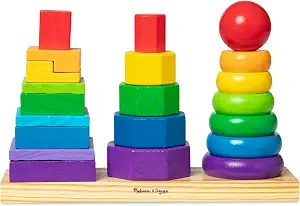
1. Melissa & Doug Shape Stacker Counting
This classic wooden stacking board is an amazing benchmark for early geometry and counting skills. The kit has a strong wooden foundation with 10 elevated pegs and 55 colourful, geometric wooden shape tiles.
In each row, a certain number from 1 to 10 is shown and the toddlers need to arrange the exact amount of colourful tiles on each numbered peg.
The wooden pegs are inserted at varying heights in a succession over the board. So the toy provides immediate self-correcting visual feedback .
Visual stair pattern becomes disrupted if a kid tries to arrange too many or too few pieces on a peg. This design fosters recognition of numerical sequences, enhances the categorisation of forms and strengthens fine motor abilities as little hands move each wooden tile into place.
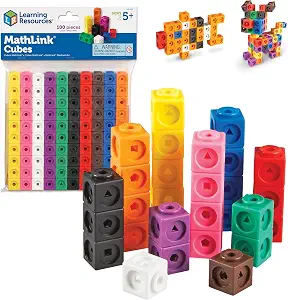
2. Learning Resources MathLink Cubes – Set of 100 Cubes
These 3/4-inch linking cubes are a staple in early childhood classrooms around the world, putting physical geometry and counting right into little hands. Kids may connect the sturdy plastic cubes of different geometric shapes vertically and horizontally since each of the six sides of the cubes has cutouts.
Connecting and pulling apart the cubes delivers resistive motor feedback that improves intrinsic hand muscles and bilateral coordination.
Preschoolers can stack cubes to make counting towers, make colour patterns or build early bar graphs to compare quantities side-by-side.
The open-ended design makes the transition from simple 1-to-10 counting tasks to early addition, subtraction and spatial patterning exercises as your kid grows, easy!
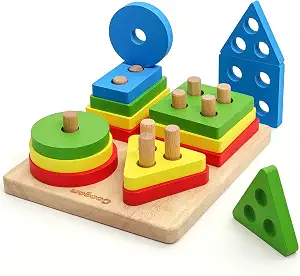
3. Coogam Matching Game Wood Counting Peg Board
Featuring a clean, wooden, minimalist Montessori-inspired design, this counting set features 10 individual wooden number tiles (1-10), 55 smooth wooden counting pegs and a handy storage bag. Each wooden tile features a visible numeral and the appropriate number of drilled peg holes right beneath it.
The toddler looks at the numeral, counts the correct amount of wooden pegs and pushes them firmly into the holes in the tile.
The experience of pegs going into holes grounds 1-to-1 association in the somatic memory of muscles .
Made from solid natural wood with smooth, rounded edges and non-toxic finishes, this compact set stores easily on low playroom shelves without adding to visual area clutter.
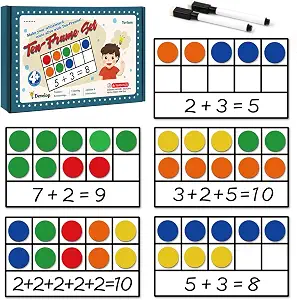
4. Froggy Ten-Frames Math Activity Set
Ten-frames are among the most effective visual tools used in today’s early math education to teach subitizing and early base-10 logic. This cute set comes with lily pad shaped double sided ten frame boards and vibrant soft plastic frog counters.
Children explore relationships between numbers in a base ten system with the frog counters on lily pad grids.
Seeing that “7” occupies one full row of five plus two extra slots helps children see number bonds and grasp how near a sum is to reaching ten.
The textured, squishy frog counters are simple for tiny hands to grasp and flip, and make the abstract skill of subitizing into a pleasurable, tactile game.
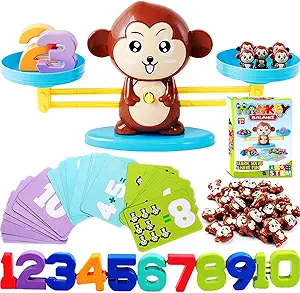
5. Coogam Monkey Balance Math Game
This popular balancing set combines fun pretend play with early physics and weight comparison, including a double-sided monkey scale, 19 weighted little monkey figures, and number blocks 1 to 10. The weights are exactly equal to the number i.e. the number “5” block is weighted exactly equal to five separate little monkey figures.
The boy places the block labelled ” 5 ” on one side of the scale and five monkeys on the other side. Balance arms are dead flat.
If the child adds too many or too few monkeys the scale leans over dramatically providing clear self-correcting feedback.
This tactile connection teaches weight comparison, quantity equality and early addition, without the need for reading or adult intervention.
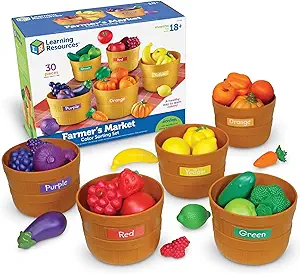
6. Farmers Market Colour Sort Teaching Resource
This 30 piece set includes 5 colourful plastic bushel baskets and 25 play food pieces with realistic detailing of fruits and vegetables for a fun grocery shop twist on early numeracy. Toddlers match actual play food to the right baskets by colour, type or specified quantities.
When you count out three red apples, two yellow bananas and four green peppers, all the elements of sorting, classifying by attributes and counting come together in imaginative pretend play.
Made from tough washable plastic the big pieces are just right for toddler sized hands and can take a hammering from everyday play.
The package also includes clear sticker labels for the baskets so that parents may modify bins with numerals or dot patterns to support early quantitative matching.
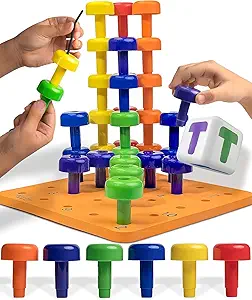
7. Skoolzy Peg Board Set with Carrying Case
This 30 piece pegboard system combines early math training with fine motor occupational therapy approaches. The set has a flexible foam pegboard grid and 30 huge plastic pegs in primary colours that stack on top of one another.
Children either press the pegs into the board or form vertical counting towers on top of each peg. They are exploring spatial height and 1-10 count sequences.
Grasping and pushing the chunky pegs aid to develop the pincer grasp and thumb web space essential for early pencil control.
The lightweight kit is easy to store in the included drawstring travel bag making it a wonderful solution for silent tabletop gaming, homeschool setups or travel.
Building a relaxing, screen-free math environment.
Investing in tactile, proven math toys is an excellent starting point, but creating an organised, low-friction learning environment is what keeps everyday play focused and interesting. Over full toy bins can be visually disruptive to a place and can lead to short attention spans and parts everywhere.
Here are four practical techniques to create a nice, clutter-controlled math space in your home:
1. Math Tools, Open Shelves.
Counting boards. Balance scales. Linking cubes on low wooden shelves with flat woven baskets or shallow wooden trays. Putting tools at eye level lets your infant choose learning activities on his own and know exactly where things go when play time is over.
2. Practical manipulative rotations
Instead of having all seven counting sets out in your play space at once, offer 2 or 3 separate arithmetic activities at a time For example, the Counting Shape Stacker on a table and the MathLink Cubes in a basket. Change your pick every 2 weeks to maintain the interest level strong and keep visual peace in your home.
3. Matching Numbers with Sensory Tracing
Use real wood or plastic numerals, plus a shallow tray of dry play sand, salt or cornmeal. Ask your preschooler to select a wooden number block, state the name of the number then trace the shape of the number into the sand tray, with their index finger. This tactile extension increases muscle memory and readiness for pre-writing skills.
4. Playful is not speed, but questions are
Do not test your young person with “What number is this?” style testing. Instead ask open-ended exploration enquiries such as, “How many blocks do we need to make this tower as tall as your shoe?” or “Which basket looks like it has more apples?” Interacting with math makes math readiness joyful and worry free.
Tactile Math Toys vs Math Apps on Electronics
Early math tools show clear differences in how tactile materials effect a developing child Vs how automated digital devices affect a developing youngster:
Sensory Engagement: Tactile math toys deliver vivid 3D touch, weight, volume and physical resistance. The math apps on an electronic device are flat glass surfaces. They feel the same to the touch , regardless of how much arithmetic is on the screen .
Motor development: Counting and connecting cubes develop intrinsic hand muscles, finger isolation and bilateral coordination. Fine motor activity is limited. Swiping and tapping through apps does not involve a lot of physical exertion.
Self-Repairing: Good hardwood puzzles and balancing scales are physically self-correcting, wrong amounts just will not fit together, or balance. The electronic apps include chime noises, flashing lights or digital animations which distract from studying.
Focus and Attention Span: Screen-free, tactile instruments foster deep play flow, sustained focus, peaceful investigation. Button-activated noisy toys and fast-paced computer games typically lead to sensory overstimulation and quick exhaustion.
Parent-Child Interaction: Physical math toys encourage cooperative problem-solving, counting games and natural conversation between parents and kids. Electronic toys are made for the solitary and passive pushing of buttons.
Play Builds Math Confidence
You don’t need blinking lights, batteries and high-tech screens to give your kid a strong start in math. When you use attractively designed wooden stacking boards, weighted balance scales and tactile linking cubes, you are giving your child rich, multisensory tools that make number recognition and counting natural, interesting and extremely gratifying.
Take a look around your child’s learning space today. Take the computerised noise toys out of the mix with a retire button, put some tactile counting instruments on a shelf within reach and let your little one find the fun of numbers with their own hands.
You don’t have to be alone with early childhood equipment or housing options setup. For a regular dose of practical developmental frameworks, minimalist home organisation ideas and honest product evaluations, visit Cozy Parents, your one-stop digital source.