
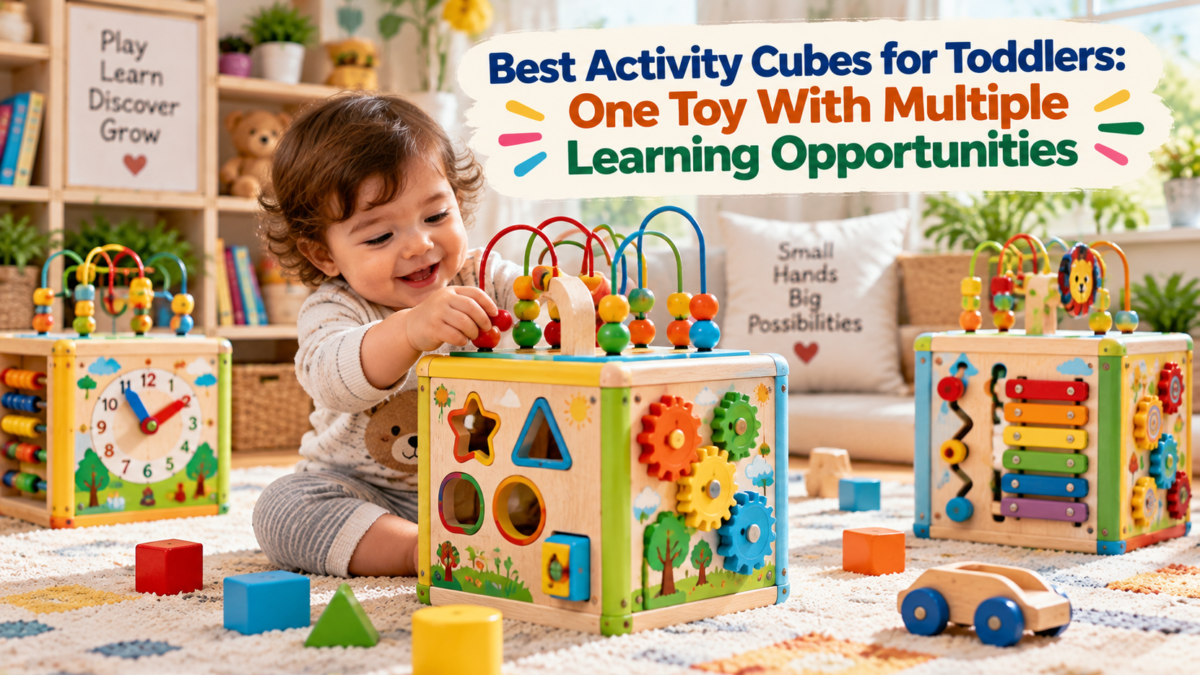
There is a moment of quiet, magnetic wonder that happens when a fourteen-month-old toddler approaches a solid wooden activity cube. Kneeling on a low play rug, their fingertips trace the smooth curve of a steel bead maze wire. They nudge a painted wooden sphere up an incline, watching with rapt attention as it loops through the air and slides downward under the tug of gravity. Moments later, their curiosity pulls them around the corner: they rotate a trio of interlocking gear cogs, peek behind a flip-board animal door and retrieve a wooden triangle from a shape-sorting chamber. Within a single square foot of floor space, the toddler conducts a comprehensive laboratory experiment in physics, spatial mechanics, and fine-motor control.
In an era dominated by electronic play stations that flash discordant LED sequences, emit shrill synthetic voices, and demand constant battery changes, it is easy for parents to believe that engagement requires digital bells and whistles. Yet, these automated novelties frequently backfire. When a toy sings, rolls, and narrates on its own, it turns the child into a passive spectator. The instant gratification of button-activated noise fragments attention spans and overstimulates developing nervous systems, often culminating in tears and sensory fatigue.
At CozyParents, we champion “intentional play” selecting durable, tactile, and thoughtfully paced resources that respect a child’s neurological development while preserving the visual tranquility of a mindful home. A well-designed wooden activity cube is the ultimate physical manifestation of this philosophy. By consolidating five or six distinct developmental stations into a singular, grounded footprint, it delivers an expansive playground of open-ended learning without turning your living room into a sea of plastic clutter. In this comprehensive guide, we explore the biomechanics and cognitive milestones supported by multi-sided activity cubes, share actionable frameworks for integrating them into a calm home ecosystem, and review seven exceptional, verified options available on Amazon US that treat your toddler as an authentic explorer of the physical world.
Developmental Foundations: The Multi-Dimensional Mechanics of Cube Play
To understand why activity cubes have remained a revered fixture in pediatric occupational therapy clinics and Montessori-inspired environments for decades, we must look at how early locomotion, hand mechanics and visual processing intersect. An activity cube is not merely a collection of distinct games; it is an integrated sensory-motor hub that invites children to move their bodies across three-dimensional space.
1. Dynamic Postural Transitions and Core Equilibrium
Most toddler toys are designed for a single bodily posture: either seated on the floor or standing upright. An activity cube breaks this mold by encouraging continuous, three-dimensional movement. To engage with the top bead maze, a pre-walker must pull up to stand, bearing weight through their feet and stabilizing their pelvis. To inspect the spinning gears on the side, they must lower themselves into a controlled deep squat or drop onto their knees. To explore the reverse panel, they must balance while cruising around the perimeter. This constant shifting between kneeling, squatting, standing, and lateral weight-bearing builds deep core stability, strengthens hip abductors and exercises the vestibular system’s dynamic balance mechanisms laying essential physiological foundations for unassisted walking and running.
2. Bilateral Integration and Isolated Finger Dexterity
Every side of a well-engineered activity cube presents a unique biomechanical challenge. Navigating a wooden bead along a convoluted wire requires finger isolation, forearm pronation and supination (rotating the wrist inward and outward), and continuous visual-motor tracking across the body’s midline. Sliding wooden track tokens exercises the intrinsic palmar muscles and the radial-digital grasp, while aligning geometric blocks with a shape-sorter cutout demands two-handed bilateral coordination one hand stabilizing the frame while the dominant hand pitches and rotates the shape into position. These physical micro-movements strengthen the palmar arches and thumb opposition, building the dynamic stability needed for future self-dressing, scissor use, and mature pencil grasp.
3. Spatial Topography, Object Permanence, and Causal Reasoning
Activity cubes introduce toddlers to topological geometry and cause-and-effect physics through tactile consequence rather than arbitrary electronic sounds. When a child drops a shape into a slot, it vanishes momentarily before clattering softly to the bottom, reinforcing the neurological concept of object permanence. When they spin a master gear, neighboring cogs turn in reciprocal directions, demonstrating mechanical transfer of energy. Because the cube is a physical polyhedron, children learn that an action taken on one plane can reveal an outcome on another. This physical exploration builds mental rotation capacities, spatial problem-solving, and a grounded internal locus of control.
The Product Roundup: 7 Intentional Activity Cubes for Toddlers
Selecting an activity cube that withstands vigorous daily play while complementing a peaceful nursery aesthetic requires prioritizing solid hardwoods, non-toxic water-based finishes, smooth counter-sunk hardware and stable non-tip architecture. Here are seven exceptional, verified choices available on Amazon US that align with the CozyParents philosophy.
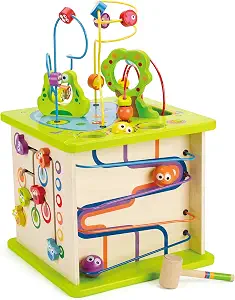
1. Hape Country Critters Wooden Activity Play Cube
- Description: A masterfully constructed heirloom activity center crafted from sustainable forest timber and non-toxic water-based paints, featuring five distinct animal-themed activity faces including a sprawling wire bead maze, a color-code tracking path, rotating honeycomb cog spinners, and rolling ball runs.
- Benefits for Child and Home: Hape represents the gold standard in developmental wooden toys. The Country Critters cube stands out for its substantial physical mass and wide, stable base, allowing cruising toddlers to pull themselves up to standing without the risk of the unit tipping forward onto the rug. The top bead maze features charming wooden bees and frogs that loop across heavy-gauge steel wires that never bend under toddler weight. Its warm, nature-inspired palette of forest greens, honey ambers, and natural wood grains adds an artisanal architectural presence to any living space.
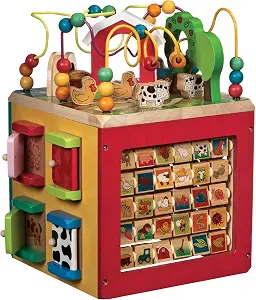
2. Battat Wooden Activity Cube – Discover Farm Animals Activity Center
- Description: A solid wood, five-sided farm-themed activity station featuring rounded beveled corners, smooth loop-de-loop bead tracks on top, spinning animal puzzle tiles, sliding track beads and peek-a-boo wooden barn doors with hidden livestock illustrations.
- Benefits for Child and Home: Battat excels at crafting durable, highly interactive play centers with exceptional ergonomic safety. The corners of this wooden cube are generously rounded and beveled, ensuring zero sharp edges if an unsteady toddler stumbles while cruising. The peek-a-boo barn doors feature sturdy internal hinges that withstand aggressive toddler pulling, while the illustrated rotating animal cubes encourage early taxonomic sorting and vocabulary building. Its solid weight keeps it securely grounded on low-pile carpets and hardwood floors alike.
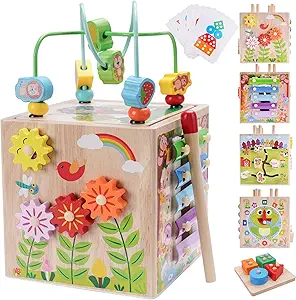
3. Tiny Land 8-in-1 Montessori Wooden Activity Cube
- Description: A thoughtfully designed, multi-functional Montessori-inspired activity cube crafted from premium beech and birch woods, featuring a removable and reversible top bead maze lid, an analog clock face, spinning gears, a shape sorter, a slide track maze, and a fully tuned baby xylophone.
- Benefits for Child and Home: Tiny Land brings clean Scandinavian minimalism to the traditional play cube. The standout feature is its inverted storage mechanism: the wire bead maze top can be lifted off, flipped upside down, and nested flush inside the interior cube body. This reduces the toy’s vertical profile by half, allowing it to slide effortlessly onto a low Montessori shelf or inside an open canvas storage basket when play ends. The tuned metal xylophone bars offer melodic, pleasant acoustic notes that nurture musical appreciation without electronic noise.
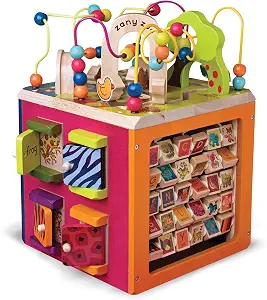
4. B. toys Wooden Activity Cube – Zany Zoo
- Description: A beloved, classic five-sided wooden activity center featuring illustrated animal spin tiles from A to Z, winding zig-zag track race paths, rotating loop-de-loop wooden tracks, and smooth illustrated wooden doors that conceal surprise animal artwork.
- Benefits for Child and Home: Zany Zoo is celebrated for its rich, hand-painted graphic illustrations and exceptional tactile variety. The alphabetical spin tiles introduce early phonemic and literacy exposure in a completely non-prescriptive, child-paced format. The zig-zag tracks require toddlers to guide wooden animal knobs down vertical paths, demanding graded finger release and arm coordination. Its substantial heirloom construction withstands multi-sibling use, while the soft, muted color scheme avoids visual chaos in family rooms.
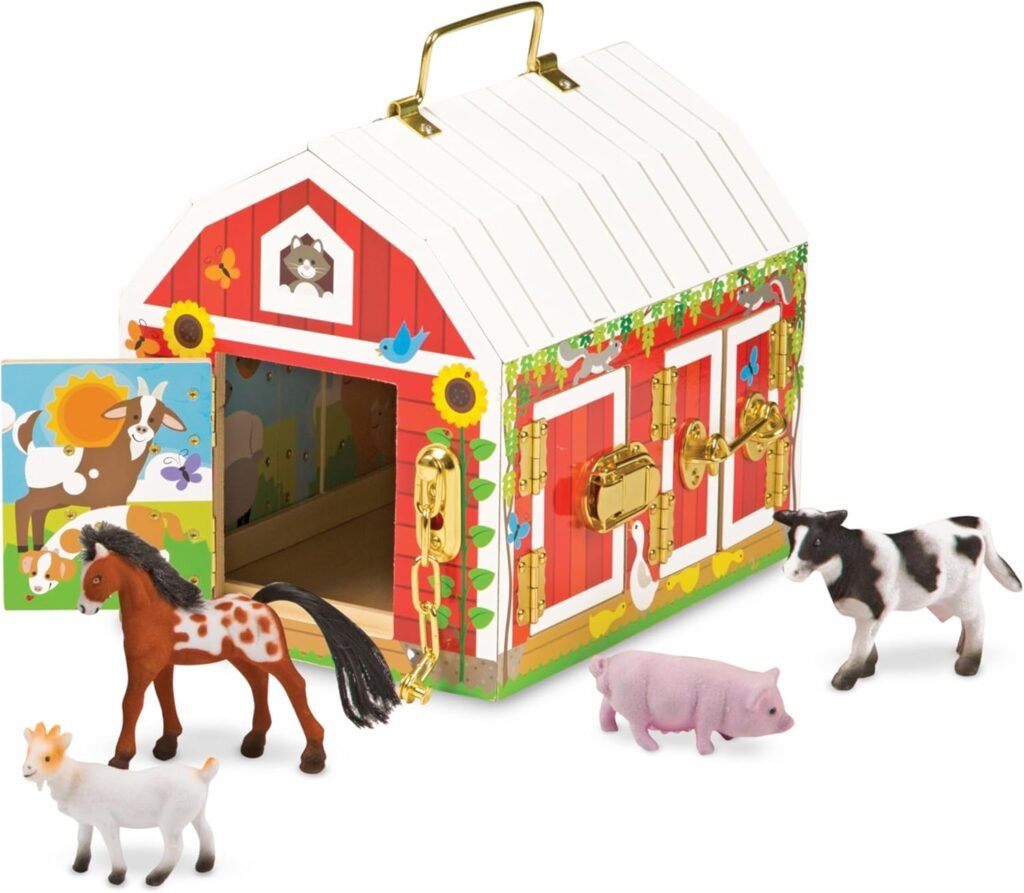
5. Melissa & Doug First Play Wooden Barn Activity Center
- Description: A charming, farmhouse-profile wooden play center featuring smooth wire bead tracks with chunky wooden tractor and sheep beads, sliding animal beads along guided wall tracks, and built-in shape-sorter slots with solid timber blocks.
- Benefits for Child and Home: Scaled specifically for young toddlers transitioning out of infancy (ages 12 to 24 months), this Melissa & Doug unit prioritizes oversized wooden components that fit comfortably within a developing palmar grasp. The barn silhouette adds imaginative storytelling value to physical dexterity play, allowing the child to treat the interior chamber as an animal stall. The smooth water-based lacquers wipe clean in seconds, and its narrow profile fits neatly against playroom walls.
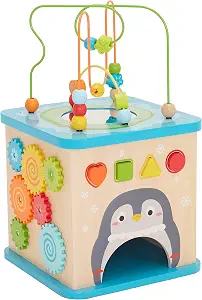
6. TOP BRIGHT 5-in-1 Toddler Wooden Activity Cube
- Description: A compact, high-precision activity cube crafted from natural hardwood and coated with non-toxic waterborne finishes, featuring an inverted bead maze lid, mechanical gear train, sliding numerical tokens, and an integrated geometric shape sorter.
- Benefits for Child and Home: An ideal solution for families living in smaller footprints or urban apartments where floor space is at a premium. The TOP BRIGHT cube delivers all the developmental benefits of a large play center within a compact 6×6-inch footprint. The removable top lid nests internally for seamless shelf storage, while the geometric blocks store securely inside the hollow belly of the cube, ensuring no loose parts scatter across the rug when playtime concludes.
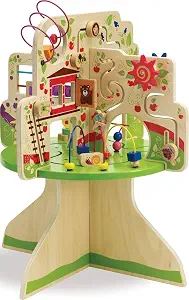
7. Manhattan Toy Tree Top Adventure Wooden Activity Center
- Description: An expansive, multi-tiered sculptural wooden activity tree featuring four quadrants of tactile play, complete with gliding tree frogs, springy smiling flowers, spinning animal dials, and six distinct tracks of winding wire bead mazes.
- Benefits for Child and Home: While diverging slightly from the traditional geometric cube, this multi-quadrant activity station operates on the exact same multi-sided developmental principles. Its 360-degree circular architecture allows two or three siblings or playdate peers to engage simultaneously from different angles without crowding one another, fostering social cooperation and parallel play. The hand-painted woodland aesthetic resembles an art piece from an upscale boutique, seamlessly integrating with high-design, intentional nurseries.
Practical Advisory: Building a Low-Friction Activity Cube Ecosystem
Curating a high-quality activity cube is only the beginning; how you place, rotate, and introduce it within your home determines whether it becomes an anchor of sustained concentration or a forgotten piece of floor furniture.
1. The 360-Degree Floating Perimeter Strategy
The most common placement mistake parents make is pushing a multi-sided activity cube flat against a wall or into a tight corner to keep the floor clear. Doing so instantly cuts off two to three sides of developmental engagement, restricting your child’s exploration to only the front face. Instead, “float” the cube near the center of a dedicated low-pile wool rug or play mat. Maintaining an open 360-degree perimeter invites your toddler to cruise, pivot, and crawl around the structure, turning stationary play into an active gross-motor circuit.
2. The Shape-Block Strewing and Containment Protocol
Activity cubes that include loose shape-sorting blocks frequently become a source of parental frustration when loose triangles and cylinders scatter under living room couches. Avoid storing the loose blocks inside the cube where they remain out of sight. Instead, place two or three matching shapes in a shallow, open wooden tray directly beside the cube on the floor. Presenting a small, intentional selection lowers cognitive friction, guides the toddler’s focus toward the sorting face, and makes returning the blocks to their tray an intuitive, self-correcting sorting game.
3. The Reversible-Lid Novelty Reset
If your chosen activity cube features a removable, reversible top lid (such as the Tiny Land or TOP BRIGHT models), use this architectural feature to manage household novelty and spatial order. When play concludes for the day, invert the lid into its flat storage mode so the wire tracks rest inside the cube. Leaving the cube in its streamlined, boxy form for several days creates visual quiet in your living space. When you invert the bead maze back to its upright position the following week, your toddler greets the toy with the heightened focus and excitement of a brand-new discovery.
Comparative Analysis: Premium Wooden Activity Cubes vs. Mass-Market Electronic Consoles
When choosing an activity center for their nursery, parents face a stark choice between durable, child-powered wooden cubes and cheap, battery-operated plastic consoles. Evaluating these choices across core operational dimensions shows why investing in solid craftsmanship produces a vastly superior developmental outcome.
Regarding kinematic agency and cognitive pacing, intentional wooden activity cubes move only in direct response to the toddler’s physical exertion. When a child slides a bead or spins a cog, they dictate the velocity, acceleration, and rhythm of the action, absorbing real-world cause and effect. In contrast, mass-market electronic plastic consoles—which blare loud synthetic tunes, flash harsh LED strobes, and recite scripted numbers at the push of a single button—force children into passive, repetitive button-mashing. This external stimulation disrupts intrinsic curiosity, short-circuits self-directed problem-solving, and encourages frantic, dopamine-seeking behavior.
In terms of physical stability and child safety, premium wooden cubes possess substantial physical mass (typically weighing between 8 and 15 pounds) with wide, low-gravity rectangular footprints. Cruising toddlers can confidently pull up on the wooden rails without the unit flipping over onto their feet. Mass-market plastic competitors are notoriously light, hollow, and top-heavy; when an unsteady ten-month-old attempts to pull themselves up on a flimsy plastic console, the entire unit frequently tilts and crashes to the floor, startling the infant and causing unnecessary bumps.
Looking at sensory regulation and household tranquility, intentional wooden play centers rely on natural acoustic resonance—such as the quiet clack of painted hardwood beads sliding on coated steel, the gentle wooden rumble of tumbling blocks, or the clean tone of a metal chime bar. These organic, low-frequency sounds ground an infant’s nervous system and preserve acoustic peace in the home. Electronic plastic cubes emit high-pitched, compressed digital audio through cheap speakers, elevating ambient household noise and triggering sensory fatigue in both children and caregivers.
From a functional storage and aesthetic standpoint, intentional wooden cubes are designed with spatial harmony in mind. They feature warm timber grains, hand-sanded beveled edges, and muted, nature-inspired palettes that integrate seamlessly with modern home decor and sit handsomely on low open shelves. Mass-market alternatives arrive in garish, fluorescent primary colorways made from cheap injection-molded plastics that clash with living areas and dominate room sightlines with visual clutter.
Finally, in terms of developmental longevity and multi-generational durability, high-grade wooden activity cubes endure through multiple children and developmental stages. A play center that begins as a pulling-to-stand anchor for an eight-month-old infant transitions into a fine-motor bead maze for a fifteen-month-old, later serves as an imaginative storytelling barn for a two-year-old, and eventually supports early alphabet and counting literacy for a preschooler. Fragile electronic plastic toys suffer rapid motor fatigue, broken battery terminals, and cracked plastic tabs, quickly ending up discarded in landfills once the child outgrows the novelty.
Conclusion: Crafting an Anchor of Calm Focus
Choosing an authentic, beautifully crafted wooden activity cube for your toddler is an investment in their physical confidence, their fine-motor dexterity, and their blossoming capacity for deep, self-directed concentration. By offering a single, grounded play center that celebrates tactile mechanics and spatial physics without the intrusion of electronic noise, you carve out a peaceful, purposeful sanctuary where foundational milestones can unfold at your child’s own natural pace.
At CozyParents, we believe every object in your home should serve a clear developmental purpose, invite joyful self-mastery, and support household serenity. When you sit on the floor beside your child, listen to the gentle click of wooden beads looping along steel tracks, and watch their little hands thoughtfully guide a gear into motion, you are witnessing far more than simple play—you are watching a young mind construct its understanding of the physical world.
We invite you to continue exploring CozyParents for mindful parenting frameworks, expert-backed gear roundups, and intentional strategies designed for your growing family. Does your toddler have a favorite side on their activity cube, or are you preparing to set up your first open-floor play station this season? Share your experiences in the comments below—we love learning how you curate peaceful, intentional spaces at home.