
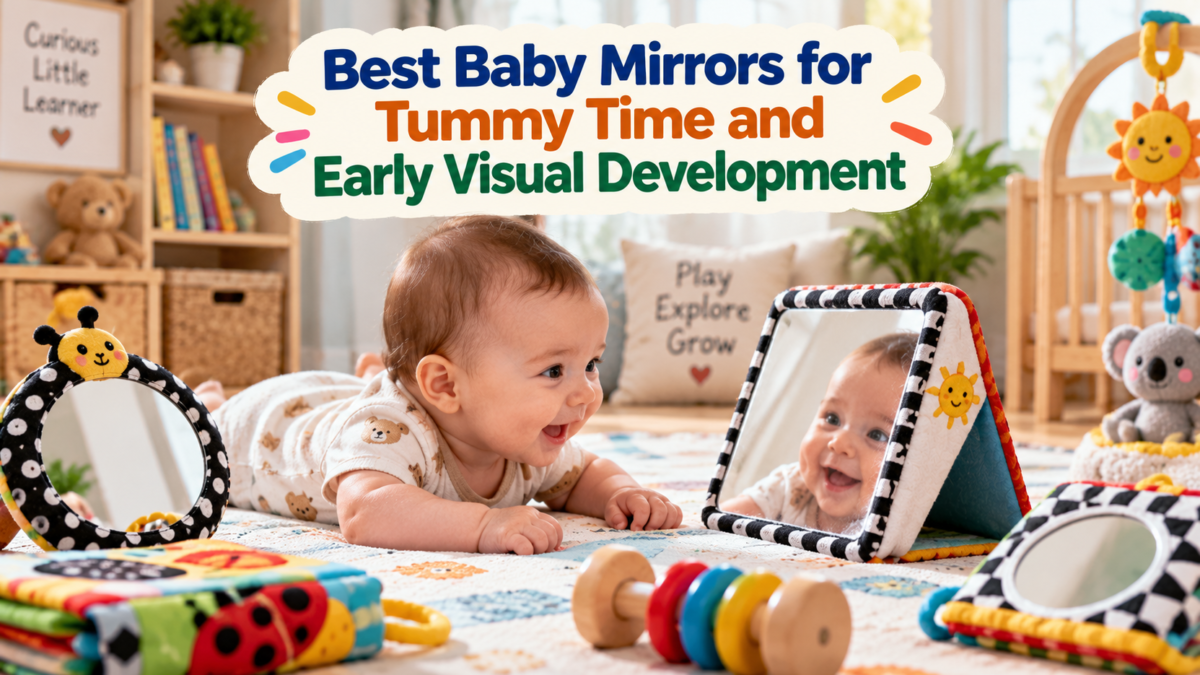
It’s a wonderful, sweet moment when a baby, barely balanced on their forearms, catches their reflection for the first time. Their eyes widen, their breath catches in silent fascination, and their shaky chin lifts off the mat by a fraction of an inch. For an adult, looking in a mirror is a normal part of grooming. But for a two-month-old baby, a reflective surface is a fluid playground of light, motion and social mimicry. In a world of baby gear that includes flashing battery-powered mats, mechanized vibrating swings and smartphones propped on nursery rugs to capture a fleeting infant’s attention, it’s easy to assume that digital stimulation is a must to make floor play bearable. But these artificial distractions short-circuit the very thing that tummy time is meant to develop: intrinsic motor effort, visual convergence and the calm neurological organization that comes from exploring physical reality.
For parents looking for tummy time helpers to calm down an infant who balks at the idea of their chest touching the floor, they often encounter flimsy plastic toys, funhouse-mirrored sheets that distort facial features and overstimulating novelty mats loaded with busy cartoon designs. Poorly made mirrors not only do not encourage patients to lift their heads but also give distorted images and are thrown away in a corner of nurseries.
At CozyParents, we believe that a baby’s play area should be a quiet sanctuary where the infant can focus on developing both physically and neurologically. We are all about “intentional play” sourcing durable, tactile, thoughtfully designed resources that honor a child’s developing nervous system and the esthetic calm of a mindful home. Come along with us as we discuss developmental milestones facilitated by infant mirror play, share practical tips for setting up a low-friction tummy time space, and review 7 best-rated, baby-safe mirrors on Amazon US that treat your baby as a true explorer of their own developing self.
Developmental Foundations: The Physical and Visual Mechanics of Mirrors
To understand why mirrors have such enduring developmental power in the fourth trimester and early infancy, we need to look at the interaction between a baby’s eyes, brain and postural muscles. Pediatric physical therapy, infant ophthalmology, early childhood neuroscience all validate that mirror play is more than just an adorable photo op. It is an integrated workout for visual acuity, neck extensor tone and social-emotional cognition.
1. Visual Acuity, Contrast Tracking, Accommodation Distance
Human newborns are born with legal blindness ( about 20/400 vision ). Their eyes have trouble coordinating, they have poor depth perception and can only focus on high-contrast objects held between eight and twelve inches from their faces the exact distance a parent’s face is when feeding them. The mirror at floor level provides a good focal distance. The mirror provides real-time visual feedback with high biological contrast, as the infant’s own eyes, mouth and hands move when the infant changes position. Babies follow their own moving limbs and expressions . They build extraocular muscles, practice binocular convergence ( both eyes working together ) and hone their skill at changing focal depths.
2. Cervical Extensor Tone, Motor Motivation and Weight Shifting
Tummy time is important to prevent positional plagiocephaly (flat head syndrome) and to develop the cervical extensor muscles to support the head upright. But it is hard physical work for an infant to hold an eight-pound head up against gravity. A baby looking at a blank rug will have no motivation to lift his heavy head and will often drop his face and cry. Mirror is an irresistibly visual anchor. Driven by an evolutionary curiosity about human facial anatomy, a baby will push down hard through their palms and forearms to lift their chest, keeping their neck extended for precious additional seconds to keep the “other baby” in sight. This prolonged muscular contraction develops the upper back, shoulders and spinal stabilizers needed for rolling, creeping and sitting up unaided.
3. Early Self-Awareness, Theory of Mind and Social Reciprocity
Long before infants can understand the abstract concept of “self” (typically developing around 18 months of age with the classic mirror self-recognition test), they experience social reciprocity through reflections. Babies start smiling socially at around two to three months old. An infant sees their own face in the mirror and smiles. They see a warm , smiling baby instantly smiling back. This triggers a positive neurochemical feedback loop. Also, when parents lie next to their baby and appear together in the reflective glass, the baby sees their shared spatial positioning which is the foundation for Theory of Mind, spatial mapping of the body and emotional security.
The Product Roundup: Seven Intentional Baby Mirrors for Tummy Time
Choose mirrors that offer clean, distortion-free optical clarity, and that are also totally shatterproof safe. Consider impact-resistant acrylic, durable multi-angle easel stands, non-toxic baby-safe fabrics and intentional sensory accents. Here are seven highly-rated options available on Amazon US that respect your baby’s development needs and are in line with the CozyParents philosophy.
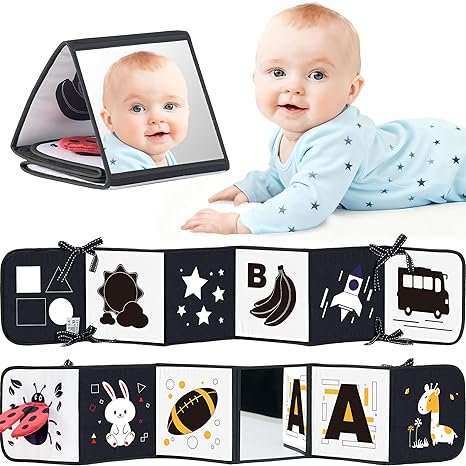
1. Infinno High Contrast Baby Book, Black and White, Tummy Time Mirror Toy
Description: Classic research-based infant development mirror with a large 9.5-inch baby-safe reflective side and high-contrast black and white graphics on the other side, adjustable fabric ribbons and a folding easel base.
Child & Home Benefits: The Wimmer-Ferguson series by Manhattan Toy is the benchmark for infant visual research. The reversible graphics are specifically designed with infant ocular biology in mind and are perfect for newborns 0-3 months needing bold geometric contrast, and the large, sharp acrylic mirror is great for older infants working on head lifts. Its soft fabric border folds completely flat, tucking nicely into a diaper bag or bookshelf slot so your living room stays clear of bulky plastic frames.
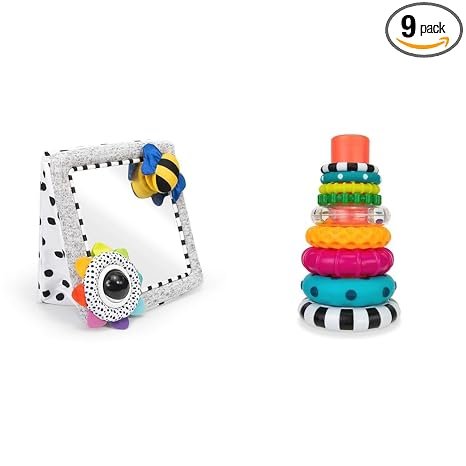
2. Sassy Floor Mirror: See Me Tummy Time
Description: Infant floor mirror with easel back, large shatter-resistant central viewing lens surrounded by soft padded textile frame, attached spinning tracker ball and textured high-contrast bumblebee.
Benefits for Child and Home: Sassy is great for combining physical developmental milestones with tactile cause and effect toys. The integrated high-contrast tracking ball provides babies with a clear focal target to bat at, encouraging early one-handed weight shifts during tummy time. The sturdy easel-back mechanism prevents the mirror from flopping forward on top of the play mat and the soft, fabric-encased edges make it totally safe if your infant rolls or tumbles against it.
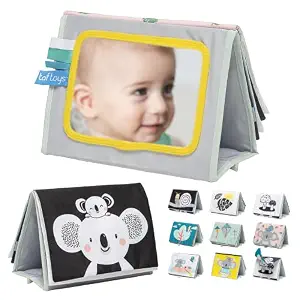
3. Taf Toys All Around Me Tummy-Time Soft Mirror Book
A multi-dimensional triangular prism activity toy with a large baby-safe mirror, fold-out high contrast black and white panels for early infancy, colorful developmental illustrations for later and crinkling peek-a-boo flaps.
Benefits for Child and Home: Taf Toys takes a progressive look at infant development. The mirror is housed in a free standing triangle prism to make the toy super stable so it won’t slip on thick carpet or cuddly play mats. Peek-a-boo felt flaps enable parents to share visual games with their infant, and subtle earthy accents and clean fabric construction preserve the playroom’s esthetic serenity.
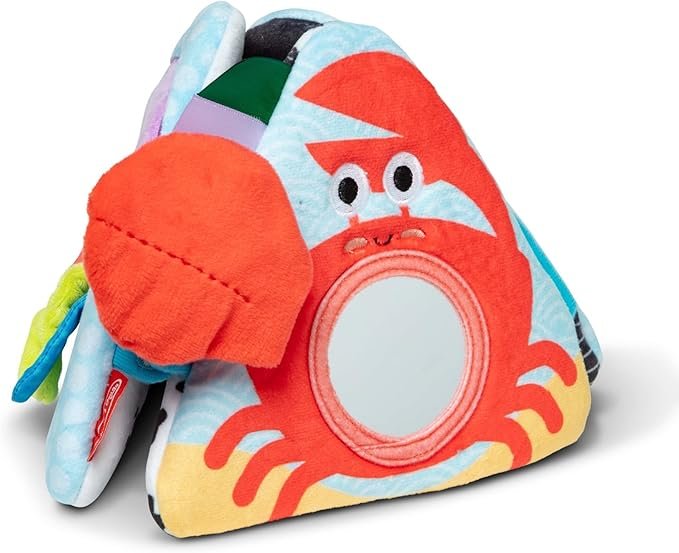
4. Melissa & Doug Ocean Tummy Time Triangle Baby Toy
Description: Fold-out large baby-safe mirror, high contrast ocean animal artwork, tactile crinkle fins and textured silicone teething ring on double-sided fabric activity triangle.
Child and Home Benefits: This free-standing triangular wedge is perfect for propped up babies on a nursing pillow or flat mat, offering an ideal 45 degree viewing angle. Made of high quality, long-lasting fabrics that are resistant to surface drool and milk spit-up, it cleans up in seconds with a damp cloth. Once the floor play is over, the entire triangle folds flat and is held in place with the safe hook-and-loop tabs, so it can be easily stored on a low nursery shelf.
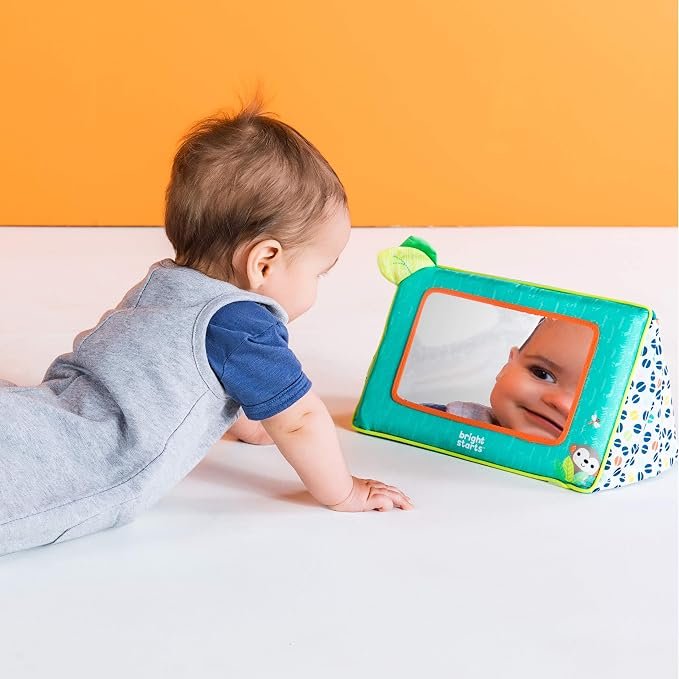
5. Bright Starts Sit & See Safari Floor Mirror
A lightweight travel-friendly floor mirror with a large, clear, reflective surface; durable, wipeable fabric border with soft crinkle leaves; and fold-flat easel backing.
Benefits for Child and Home: If you are looking for something simple and portable for your family this compact mirror offers exceptional functional value. The easel base is angled to give solid support on hard floors and rugs and positions the mirror at a four-month-old’s eye level as she practices forearm push-ups. It’s less than eight ounces and folds as flat as a notebook, so it’s an indispensable companion for keeping consistent tummy time routines while traveling or visiting grandparents.
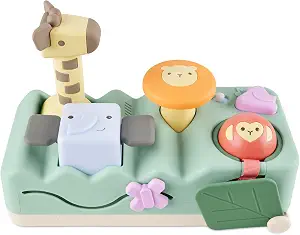
6. Skip Hop Explore & More Tummy Time Wobble Mirror
Description: A fun, contemporary sensory floor mirror with weighted, curved base that rocks and wobbles when batted, soft tactile animal ears and a high visibility distortion free mirror face.
Child and Home Benefits: Skip Hop combines kinetic play with the simple elegance of Scandinavian design. When your baby touches the mirror, their reflection rocks back and forth in a gentle wobbling motion which is fascinating to their visual tracking system and will encourage them to reach again and again. The weighted base keeps the unit from skittering away on hardwood floors and its muted, modern color palette blends seamlessly into design-conscious living spaces.

7. Itzy Ritzy Bitzy Sensory Tummy Time Floor Mirror
Description: A boutique style baby mirror with an esthetic appeal, made from textured ribbed cotton and soft natural linen and featuring a shatterproof reflective surface, gentle crinkle sensory ribbons and an internal chime bell.
Benefits for Child and Home: Itzy Ritzy shows that baby gear can be developmentally rigorous without garish primary colors. Luxurious natural linen border and subtle earth tones, this piece looks like a purposeful interior decor item on your living room rug. The soft low frequency internal chime rewards babies for kicking or reaching, encouraging whole body gross motor integration without loud and irritating electronic sound modules.
Practical Advisory The Low-Friction Tummy Time System
Choosing a good quality baby mirror is just the beginning, the placement, the setup, and presentation of it in your home will determine if your baby will happily focus on tummy time or fight it with tears.
1. The 45 Degree Horizon Alignment
The number one mistake parents make during tummy time is placing a mirror flat on the floor, right underneath the baby’s chin. If an infant has to look straight down, gravity pulls their face down into the mat and they tire quickly and cry. Instead, set your mirror up in a standing position ( 45 degrees ) about 8-12 inches in front of your baby ’s chest. This placement creates a definite visual horizon line. The infant has to actively recruit their cervical extensors and push up through their elbows to see the baby looking back at them making a hard chore into a rewarding visual discovery.
2. The Chest Bolster Bridge Plan
If your newborn has neck strength issues, or is one of those babies with reflux, lying flat out on a floor mat can be a deeply uncomfortable experience. Or roll up a small organic cotton swaddle blanket, or use a low nursing bolster under their armpits and chest to create an accessible “bridge.” Place the baby-safe mirror right on the floor in front of them. It takes away any mechanical pressure from their lower abdomen, frees their arms to reach forward and brings their gaze in direct alignment with their reflection. Their slight height instantly triples their tummy time tolerance.
3. The Ceremony of Common Reflection
Babies don’t want alone time, they want connection. Make mirror time a social ritual. Lie on your stomach next to your infant, both of you looking into the reflective surface. Tap the mirror gently, stick out your tongue, open your eyes wide, call their name. The familiar loving face of their parent reflected next to their own, builds deep psychological safety, calms an overstimulated nervous system and turns physical therapy into a joyful moment of family bonding.
Premium Intentional Mirrors Versus Mass-Market Mirrors: A Comparative Study
Parents choosing a tummy time mirror for their nursery are faced with a stark choice between well designed durable developmental mirrors, or cheap mass-market novelty toys. A comparison to core operational metrics reveals why quality is important.
Premium baby mirrors use thick, polished high grade acrylic or polycarbonate lenses that provide optical clarity and visual integrity for a true to life distortion-free reflection. Another matter altogether are cheap mass-market knock-offs, made from ultra-thin vacuum-metallized plastic films that warp and ripple within their frames, creating an unnerving funhouse-mirror distortion that confuses developing eyes and strains visual tracking.
Intentional mirrors are 100% shatterproof and impact-resistant. They are framed with heavy-gauge organic cottons, soft linens or food-grade silicone borders free of BPA, phthalates and lead for physical safety and structural durability. Cheap plastic novelties can have sharp, brittle injection-molded edges, exposed staples or flimsy glued-on decorative trims that can become a choking hazard if an infant puts it in his mouth.
Weighted triangular bases and secure easel stands or locking hook-and-loop tabs keep high-grade developmental mirrors upright on dense shag rugs or smooth hardwoods, while base stability and ergonomic positioning are taken into account. The disposable plastic competitors are notoriously light and top heavy. The lightest infant bat or kick sends them crashing flat ending play and frightening the baby.
Sensory and neurological: intentional mirrors prefer high-contrast monochromatic geometry, natural fabric textures, soft acoustic chimes to ground an infant’s nervous system. The mass-market alternatives tend to have blaring electronic chips, flashing LED sequences and screeching electronic melodies that overwhelm immature sensory filters, creating crying fits and cortisol spikes.
Finally, for developmental longevity, intentional floor mirrors grow with your child. A sturdy freestanding mirror begins as an infant visual tracking aid, grows into a seated self-awareness toy at seven months, and eventually becomes a creative prop for toddler dress-up and speech imitation games. The cheaper electronic substitutes provide only one stiff set of digital sounds that get old hat when your infant starts crawling.
Musings of Composure and Assurance
Investing in a real, baby safe mirror for your baby is an investment in their physical strength, their visual curiosity and their blossoming sense of self. You create tools that celebrate the subtle, natural happiness of physical optics and human connection, away from the distraction of electronic noise and you craft a tranquil, significant atmosphere where early milestones can happen elegantly.
At CozyParents, we believe that everything in your home should have a certain developmental purpose, encourage deeper connection between family members, and contribute to a peaceful household. When you lie down on the rug next to your baby, watching their eyes light up at their own reflection and seeing their chest rise with newfound strength, you are doing much more than practicing tummy time you are helping them find their place in the world.
Join us as we continue your journey with CozyParents, a place to explore mindful parenting frameworks, expert-backed gear roundups and intentional strategies for your growing family. Does your baby have a favorite tummy time position, or are you setting up your first nursery play mat this week? We’d love to hear about your experiences in the comments below we love hearing how you create peaceful, intentional spaces in your home.