
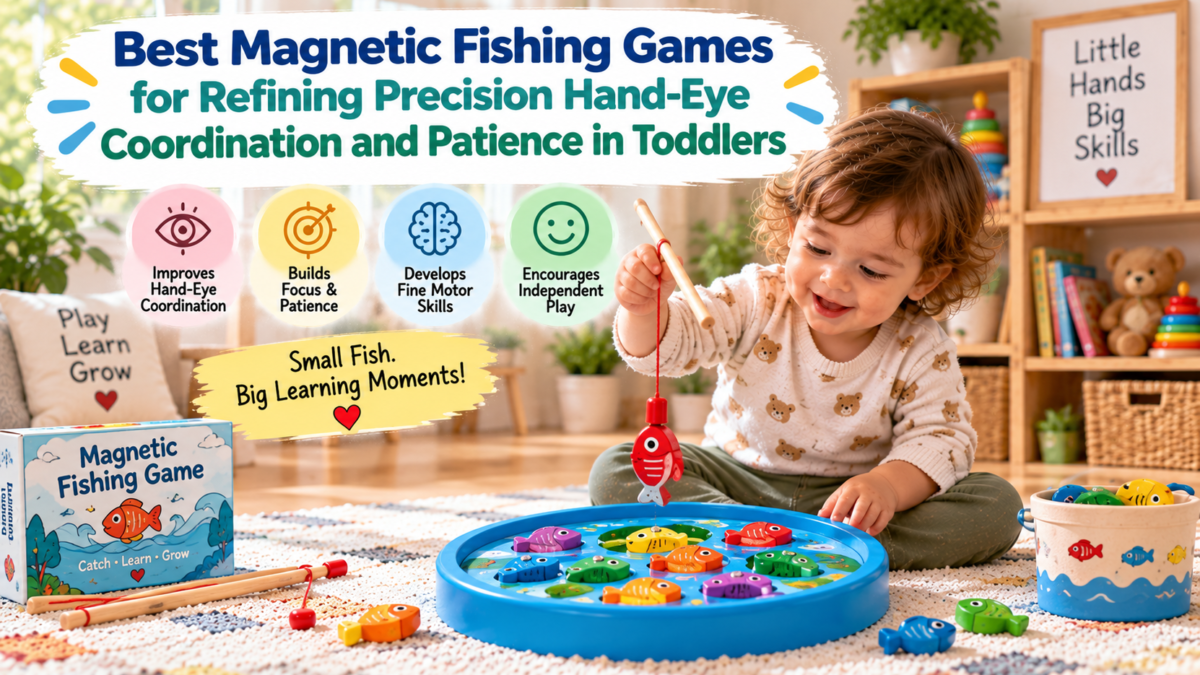
When a two year old holds a magnetic wooden lure over a tiny wooden pond there is a moment of stillness that is stunning. They breathe more slowly, their tongue sticks out between their lips in deep concentration and they go very still with their whole upper body. The magnetic bobber swings back and forth like a cotton cord pendulum. The child watches it, figures the swing, moves his wrist a fraction of a millimeter and waits.
And then click.
The steel rivet embedded in the mouth of a wooden trout is grazed by the magnetic lure. The toddler’s eyes gleam with pure, un-assisted triumph as they lift the prize high. That one slow catch and a simple wooden game does what dozens of flashy battery-powered toys can’t do: it puts the child into a state of deep, self-directed patience and micro-motor precision.
But today, walk down a commercial toy aisle and you will probably find motorized plastic fishing pools. These mechanical novelties have gaping plastic fish heads that spin on a motorized disk to the tune of a relentless, tinny carnival tune. A plastic cam opens and closes the mouth, forcing the child to frantic, high stress button-slapping. No subtlety, no ability to calculate kinetic momentum, no chance to learn the subtle rhythm of self-regulation. These toys don’t promote cool, collected concentration; they send toddlers into a sensory frenzy that ends in tossed fishing rods and broken plastic gears.
At CozyParents, we believe in “intentional play” which is the idea that the toys in our homes should be peaceful partners in our children’s neurological development. Magnetic fishing games, when made with honest physical physics and not electric motors, are classic, time-tested tools of early childhood. In this detailed guide, we will look at how magnetic fishing works developmentally, talk about realistic ways to increase the physical challenge as your child develops, and look at 7 tried and tested highly rated magnetic fishing games on Amazon US that transform living room floors into tranquil harbors of focus.
Body Mechanics of the Catch: Developmental Foundations
To understand why magnetic fishing games have such enduring educational and therapeutic value, we have to understand what’s going on in the brain and body of an infant or toddler while they’re playing the game. Pediatric occupational therapy, visual ophthalmology and early childhood neurology all agree that the manipulation of a suspended lure involves complex whole-body calibration.
1. Wrist Stabilization, Distal Control and Pendulum Problem
Moving a rigid stick or peg puzzle is a whole-arm gross motor control and the child pushes with the shoulder or elbow. But a magnetic fishing rod introduces what occupational therapists call the “pendulum problem.” The lure is attached to a flexible string by a magnet, and will swing wildly out of control with any sudden, jerky movement.
A toddler cannot use brute force to successfully hook a wooden fish. They shall:
- Stabilize their shoulder and elbow while isolating the subtle muscles of the wrist and fingers (distal control).
- Practice slowly and deliberately with dynamic force grading so your bobber remains steady.
- Modulate the pincer grip on the wooden rod handle, moving from a primitive whole-fist palmar grasp to a refined three-finger hold.
This physical self-restraint strengthens the deep transverse arches of the palm, trains finger isolation and develops the physical stamina necessary for holding a pencil, using scissors and self feeding with utensils.
2. Binocular Convergence and 3D Visual-Motor Mapping
Aligning two magnetic points in three dimensional space is a difficult visual challenge for an eighteen month or two year old. Depth perception continues to develop in humans through early childhood. Both eyes must work together as a team ( binocular convergence ) to guide the magnetic lure to a metal rivet on a flat wooden fish, focusing simultaneously on near-point targets while estimating distance and vertical clearance .
The toddler lifts and lowers the pole and his brain is doing trajectory and velocity calculations in real time. Depth requires a physical adjustment. They find that if they send the line down too fast it skims the surface and if they hold it too high, the magnetic field can’t bridge the distance.
3. Frustration Tolerance and Intrinsic Dopamine Loops
In a world of immediate digital gratification, patience is a muscle that needs intentional exercise. A toddler playing a manual magnetic fishing game will invariably miss the target a few times in a row. The string will go limp, the lure will tap the side of the fish but not catch or the fish will slide away across the rug.
This trial and error cycle is pure developmental gold. The materials are physical and quiet so the game does not flash a red light or yell ‘Try again!’ The feedback is totally neutral and self-correcting. The fish just waits on the floor until the child calms down their hands and tries again. When the magnetic connection finally clicks into place, the child gets a rich burst of intrinsic dopamine—the deep satisfaction of solving a physical problem through their own persistent effort.
7 Intentional Magnetic Fishing Games For Toddlers: The Product Roundup
Opting for magnetic fishing games that can withstand energetic play but still align with a peaceful nursery esthetic requires highlighting sturdy non-toxic hardwoods, securely sealed magnets, tough braided cotton strings, and smart self-contained storage.
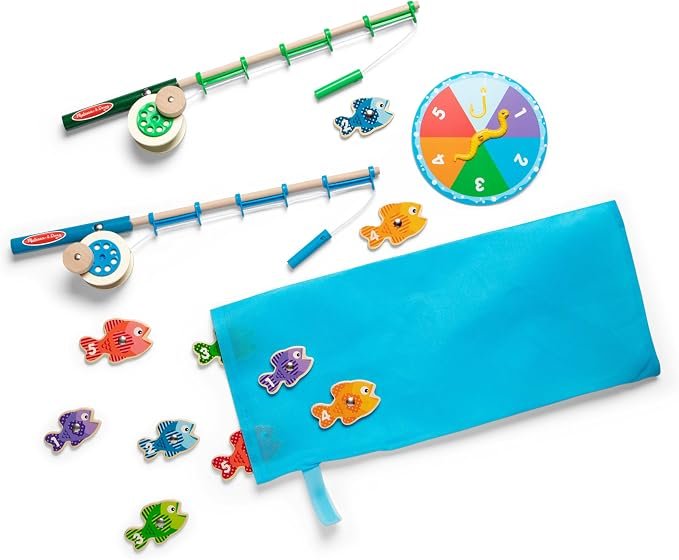
1. Melissa & Doug Catch & Count Wooden Magnetic Fishing Game
Description: Classic ten piece wooden fishing set includes two wooden rods with working wind-up reels, ten colorfully patterned wooden fish with embedded metal rivets and a wooden spinner and heavy-duty fabric storage and play bag.
Why It Works for Child & Home: Melissa & Doug is the gold standard for multi-stage game design that lasts. This set introduces working mechanical reels, uniquely. The younger toddlers can ignore the reel and use the fixed line to catch the fish and the older preschoolers can practice two-handed bilateral coordination, holding the pole steady with one hand while turning the hand crank with the other to reel their catch up. The back of the fish are numbered from 1 to 10 so this set is a natural bridge to early counting and sorting games. The entire set is flat-packed in a canvas bag, so it doesn’t leave any loose pieces in your living room.
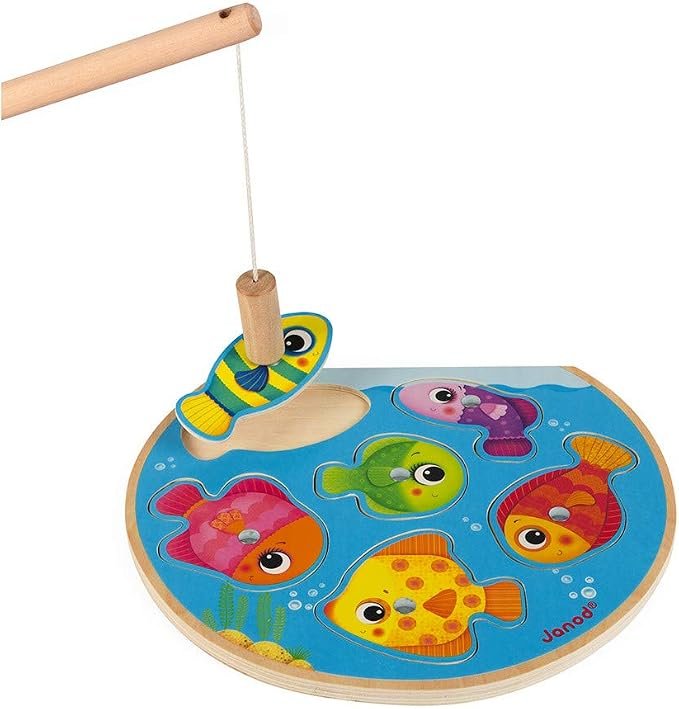
2. Janod 2-in-1 Speedy Fish Wooden Puzzle and Magnetic Game
Description: A delightful set of ten FSC-certified wooden sardines in bright patterns with secure metal rivets, two wooden fishing poles with magnetic fish-shaped lures, presented in an embossed retro-style metal sardine tin, created by the French.
Why it works for child and home: For families looking for visual whimsy without plastic clutter, Janod’s Sardine Game is a total win. Fish are painted with tasteful graphic scales and cheerful expressions using non-toxic, water-based paints. They shorten the poles for smaller toddler arms to keep the line from swaying too much. Once the play is over, all ten sardines and the two poles fit neatly inside the vintage-inspired sardine tin, making a beautiful decorative accent that looks handsome on an open Montessori shelf.
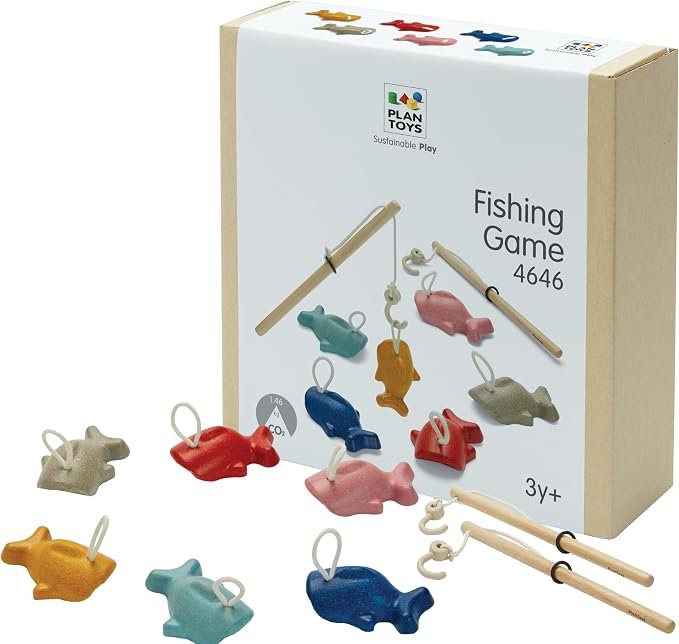
3. PlanToys Sustainable Wood Fishing Game
Six solid wood fish with wooden magnetic loops, two wooden fishing rods and a circular ocean-blue fabric pond are included in this environmentally friendly fishing game, made in Thailand from sustainable, chemical-free rubberwood and organic water-based pigments.
Child and Home Why It Works: PlanToys is known for its safe, round design. The fish in this set are not like the ones in games with exposed metal screws, but have smooth, hand sanded rings of wood embedded with magnets, for a warm, tactile feel safe for mouthing toddlers. The string length of the wooden sticks is adjustable so that the line can be shortened for the beginner and lengthened when motor skills develop. The soft fabric pond provides a spatial play area on the floor and also doubles as a neat cinch bag for storing.
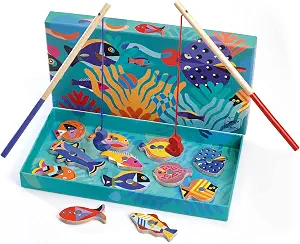
4. Djeco Colors / Graphic Magnetic Fishing Game – Wooden
Description: A twelve piece wooden fishing game, with whimsical illustrations of tropical marine creatures and recessed magnetic rivets for safety, two wooden rods with magnetic lures, all presented in an illustrated box that doubles as the ocean seabed.
Why it works for child and home: Djeco brings sophisticated European illustration to early childhood play. Thick wooden sea creatures including playful octopuses, seahorses, and starfish are finished with silky matte lacquers that eliminate harsh glare under indoor lighting. The heavy-board packaging is durable and serves as the “aquarium” during play, keeping the creatures in within four raised cardboard walls so they don’t slide away on slick hardwood floors.
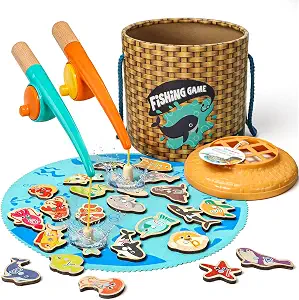
5. TOP BRIGHT Magnetic Wooden Fishing Game for Kids
Description: A multi-purpose developmental toy consisting of 26 colorful wooden fish puzzle pieces with letters and numbers printed on them, two magnetic rods with retractable cord lines and a double sided fabric storage mat.
Why It Works for Child and Home: TOP BRIGHT mixes early alphabet exposure with kinetic coordination. There are twenty-six fish in a wide range, so several children or parents can have a go at once without running out of targets. Retractable rods help keep strings from getting tangled in storage bins. The double-sided play mat has a tranquil ocean scene on one side and a numerical sorting chart on the other to help toddlers practice early taxonomic grouping.
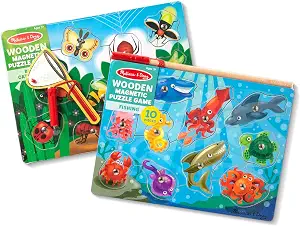
6. Melissa & Doug Deluxe Wooden Bug Catching Puzzle Game with Magnets
Ten magnetic wooden garden critters (butterflies, bees, ladybugs and caterpillars) sitting in recessed board wells and a sturdy wooden magnetic “net” wand. A dual purpose wooden inset puzzle.
Why It Works for Child and Home: For toddlers who get frustrated easily by swinging cords, this puzzle format is the perfect introduction. The magnetic net is not hung by a loose string but is attached to the end of a stout wooden dowel wand. This gives eighteen-month-olds stiff, direct leverage to shoot for and raise the pieces. If they catch a bug, replacing the critter in its recessed slot exercises shape-recognition, spatial-rotation, and flawless self-correction.
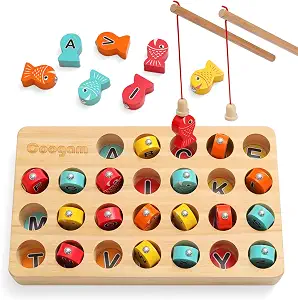
7. Coogam Alphabet Wooden Magnetic Fishing Game
Description: A small wooden table game with a round solid wood pond base with twenty-six drilled holes, twenty-six mini wooden fish with uppercase letters and two solid wood magnetic rods.
How It Works for Child and Home: The genius of this game is the two-way motor challenge. Catching a fish in the recessed pond hole requires precision, but putting the fish back into its narrow vertical well requires delicate finger alignment and vertical release. This two-step loop demands acute spatial awareness and keeps older toddlers (ages 2.5 to 4) in sustained, quiet focus for long periods of time.
Practical Advice: Creating a Low-Friction Fishing Ecosystem
Introducing a magnetic fishing game to your home calls for thoughtful presentation and a gradual increase in difficulty. No easy edges, long strings tangle, little wooden fish go under sofas and toddlers get overwhelmed.
1. The “Tether Shortening” Scaffold Protocol
The length of the fishing line is directly related to the physical challenge of the game. A twelve-inch length of string is a long piece that will swing in big, uncontrollable arcs and can set off a tantrum in a toddler who has not yet learned to control his or her wrist.
Stage 1 (18-24 Months) : Wrap the string around the wooden rod a few times and secure with a small elastic band so that there are only a couple of inches of line dangling from the end. That minimizes the pendulum swing, giving the toddler instant success, and building physical confidence.
Stage 2 (24-36 Months) : Once their hand-eye coordination is up to par, slowly unwrap an inch of string every few weeks to show them how to adjust to a longer, slower pendulum arc.
2. Establish Firm Limits for Your “Pond” with Play Mats
Wooden fish have flat, smooth bases that slide across slick hardwood floors when tapped by a magnetic rod, sending the child in pursuit of fleeing targets in frustration. Always anchor the game in a well-defined boundary:
- Use a circular wool felt mat, a blue organic cotton play cloth, or a shallow woven seagrass basket for the pond.
- The felt or canvas texture provides natural friction to keep the wooden fish in place as the magnetic tip hovers above.
- Creating a defined physical space teaches children where the game is to be played and keeps the wayward wooden pieces from flying around the living room.
3. The Catch-and-Sort Tray Habit
Don’t let your caught fish pile up on the floor in a jumbled heap. Set a small shallow wooden tray or a sorting bowl with two compartments next to your toddler:
With your free hand, help your child to gently unhook each fish and lay it flat in the tray, before casting their line again.
This two handed release reinforces the bilateral integration (one hand holding the rod, the other hand gripping the fish to break the magnetic bond).
The fish that are caught are stored in a special tray, and the math ritual at the end of the session is to count the catch.
Four Soothing Play Rituals to Enhance Focus
During the chaotic moments of the day, a toddler’s eye will naturally gravitate toward magnetic fishing games. Here are four simple rituals that can help you bring calm to your routine:
1. The After-noon Reset
When the witching hour comes in the late afternoon and your toddler is restless or overtired, don’t reach for the screens. Dim the main overhead lights in the room. Lay a soft blue play cloth on the floor and put four wooden fish in the middle. Sit with them, holding a second rod and say nothing. This rhythmic, delicate visual-motor work will naturally bring down their heart rate, slow their breathing and help ground the high energy emotional states.
2. The Color-Match “Catch and Drop”
Make the game an active and purposeful sorting activity. Line up three small bowls of color on the rug. Red, yellow, and blue. Encourage your toddler to catch a fish, balance it on the end of the magnetic line, carry it across the rug and drop it in its matching bowl without dropping it. It blends fine-motor precision with slow, deliberate gross-motor walking, transforming physical energy into focused coordination.
3. The Auction of the Number & Pattern
For older toddlers and preschoolers (2.5 to 4 years), weave simple math storytelling with numbered or patterned fish. Ask: “Can you catch a creature with spots?” or “Can you find the fish that has the number two on its belly?” Asking for something specific requires the child to visually scan the field, filter out distracting patterns and exercise selective visual attention.
4. The Bedtime “Tucking In” Ritual
Make the fishing game a gentle segue to bedtime. Before heading to the bath, ask your toddler to catch each fish individually and “tuck it to sleep” in its wooden box or tin container. Sing a lullaby Slow and soft For every creature Taken and put to rest. This predictable, unhurried routine of winding down is a clear cognitive signal that the day’s active play is over and the restful evening hours have begun.
Praise the Patient Explorer
Choosing a good magnetic fishing game for your toddler is more than simply keeping them occupied. It is about investing in their developing skills of patience, concentration and quiet self-control. You provide simple tools that respond to the honest mechanics of gravity and magnetism, without the intrusion of electronic noise and you create a peaceful and purposeful haven in which physical milestones can unfold gracefully.
At CozyParents, we believe everything in your home should have a clear developmental purpose, invite meaningful connection, and support serenity in the household. Sitting on the floor next to your child, listening to the soft click of the magnets on wood, watching their little hands brace themselves for the catch, you are witnessing much more than a game. You are witnessing a young mind discovering the quiet power of concentration.
We hope you’ll stay tuned to CozyParents for mindful parenting frameworks, expert-backed roundups of gear, and intentional strategies for your growing family. Does your toddler love magnetic games? Or are you getting ready to set up your first low-shelf fishing station this week? Share your experiences in the comments below, we love hearing about the ways you create peaceful and intentional spaces in your home.