
Enter a busy family living room on a rainy late afternoon and you are very likely to see a striking architectural experiment. Your couch cushions have been ripped off the base, three heavy dining chairs have been set up in a defensive perimeter and every spare throw blanket in the house has been strung across the gaps, weighted down with thick stacks of board books.
Your toddler is deep inside this dark, cavernous structure. They are in their own little world, encircled by an assortment of plastic animal figurines, a half-eaten snack cup and a pile of picture books. This strong desire to construct little, self-contained hiding places is not simply an accidental phase or a stubborn attempt to mess up your furniture. The fort is an important psychological milestone in early childhood development.
A toddler’s day is spent navigating a huge world built entirely for adult proportions. They’re out of control, everything’s too high, too loud.
Physical boundaries immediately provide a sense of container security when a small child crawls into a scaled-down fabric fort. It blankets them in spatial comfort, it downregulates an overstimulated nervous system and it gives them complete sovereignty over their sensory environment.
But not every play tent sold commercially is so successful at nurturing this deep developmental emphasis. Cheap synthetic pop-up structures from thin nylon fabrics tend to trap heat, creating a stuffy interior that quickly sends toddlers back outside.
Cheap plastic frames also bend easily, even from a small amount of pressure, causing walls to unexpectedly cave in. This puts a halt to the child’s imagination and creates a constant storage headache for parents.
Let’s put aside the flashy, loud commercial novelties and talk strictly organic breathable materials, rock-solid structural stability and open-ended design architectures readily available on Amazon. Setting up your own special, low-stimulation cosy spot will give you hours of self-directed play that can easily evolve from simple toddler hiding games to elaborate preschool narrative epics.
At Cozy Parents, we review childhood tools through the lenses of spatial minimalism, child-led exploration, and authentic milestone integration. We believe your home should be a sanctuary of intention where your child’s attention span can naturally grow longer and deeper without dependence on screens.
If you’re ready to discover more expert-approved blueprints for building a calm, clutter-free home ecosystem, go to Cozy Parents to get simple, therapist-supported playroom tips for real family life.
The Geometry of Small Spaces: Early Sensory Security
For a young toddler, say eighteen months old, a play tent is first and foremost a trusty sensory decompression chamber. All day long their brains are sorting huge inputs of language, motor planning and emotional shifts.
The visual and auditory noise of the home can be overwhelming and stepping inside a physical boundary allows their optical nerve to rest. This blocks out surrounding distractions and shifts their brain waves back to a balanced baseline.
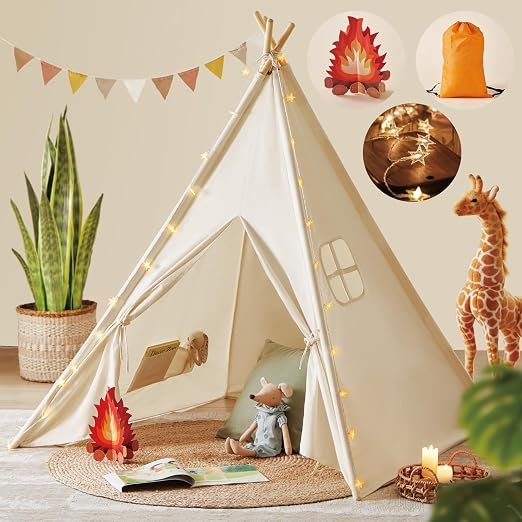
★ Tiny Land Heavy Duty Canvas Teepee Tent is a spectacular canvas gold standard for this early structural sanctuary. Available on Amazon, it is made from an ultra-thick unbleached cotton canvas wrapped around high density pine wood support poles, avoiding cheap, static inducing synthetic nylons.
The heavy fabric is a spectacular acoustic filter, dimming the surrounding room noise, whilst remaining fully breathable through an integrated canvas window flap.
When a young toddler crawls in, their hands feel the rich natural texture of the fabric, not smooth, artificial plastics. The tactile feedback is satisfying, creating deep sensory integration with no screen needed.
The toddler is the only author of the space because the interior floor space is totally open and unprinted. It’s a quiet reading nook, a bear cave, a place for their wooden blocks to live.
As their spatial coordination improves, adding soft boundaries that allow movement through narrow openings greatly increases their task persistence.
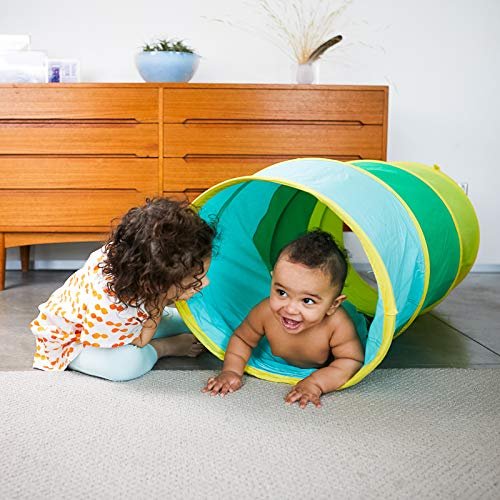
★ The Lovevery Organic Cotton Play Tunnel is a beautiful, structured crawl-through tunnel made of 100% breathable organic cotton canvas.
Younger toddlers will spend long, focused periods simply passing toys from one end of the tunnel to the other, practicing object permanence and motor planning as they move through the flexible fabric channel.
They’re always crawling, stabilising their core muscles and cross-coordinating their arms and legs. This develops their vestibular alignment and shoulder stability and lays the physical foundation for advanced balance.
Small-World Architecture
Once your child is beyond the age of three, their play takes a massive cognitive leap. They stop using the tent as a static place to hide and start to treat it as an active, structural setting for abstract narrative mapping.
The cosy space becomes a sensory decompression zone, a bustling village market, a deep-space navigation capsule or a veterinary clinic where they process social emotions and expand their active vocabulary.
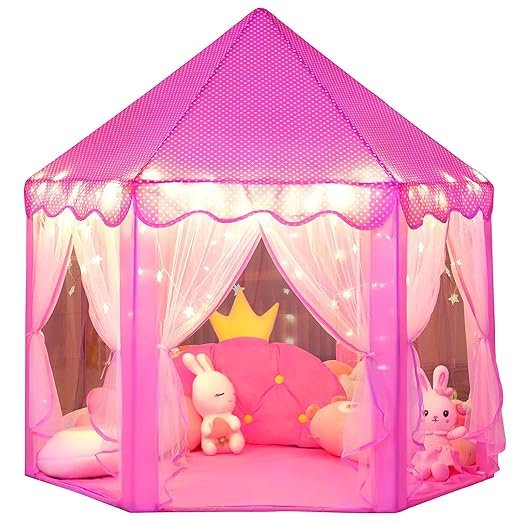
★ The Wilwolfer Large Wooden Play House Tent has a spectacular cabin-style architectural design on Amazon that beautifully bridges this developmental transition. It has a solid, interlocking pine wood frame and is covered in heavy canvas cotton. It makes a very stable mini-house background that can anchor hours of complex dramatic play without tipping or shifting.
Preschoolers also enjoy setting up the interior seating, serving abstract meals through the fabric doors and setting strict rules about who is allowed in the family.
In this dramatic stage the complexity of their cognitive problem solving is directly determined by the style of the tent’s openings. By choosing structures with multi-functional doorways and clear sightlines, they can flex their imaginations far beyond pre-themed cartoon tents that lock them into a single television script.
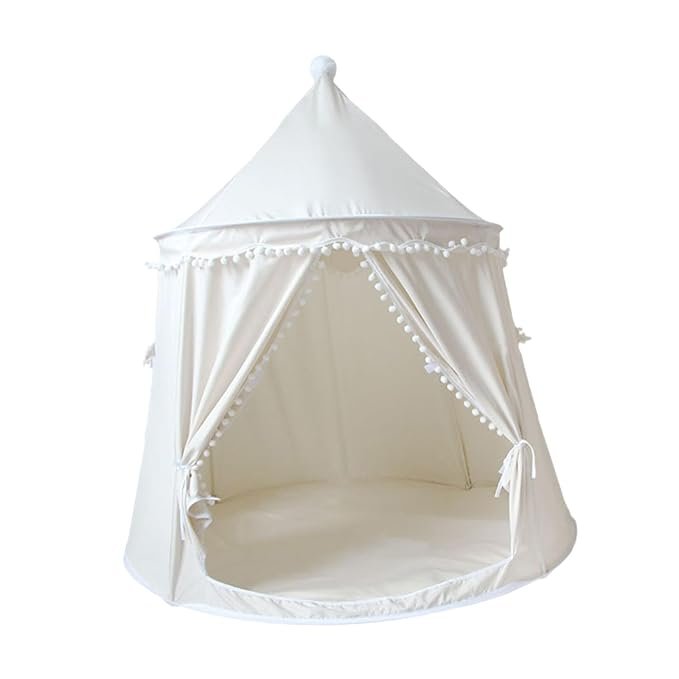
★ FoxPrint Princess Castle Pop Up Play Tent revamps active pretend play with a high-tensile spring steel frame, highly responsive, that pops up in less than thirty seconds on your patio or rug.
The castle building has mesh window panels that allow air to flow freely but also allow preschoolers to keep visual tracking of the wider room.
The graphics are simple and iconic on the outside, so the child’s brain has to work to fill in the blanks of the story, turning the fabric cone into a mediaeval castle, a high-tech radar tower or a secret laboratory. This abstract thinking directly feeds their early mathematical logic and linguistic readiness. For more ideas on how to use independent play sanctuaries to hit developmental speech milestones naturally, you can also check out the parent resource databases at our website.
Collaborative Clubhouse Work Space
True play value means a tight structure can easily expand to accommodate collaborative, multi-child playdates or cooperative sibling interaction. This allows two or three kids to be in the same enclosed footprint without bumping into each other, learning to share physical boundaries, delegate narrative roles and communicate intent.

★ Pacific Play Tents Super Duper 4-Person Dome Tent is a remedy for the space squeeze of multiple-kid play with a roomy, 58-inch square floor plan easily located on Amazon. Within this giant interior volume, there are dual zippered mesh doors and reinforced pole pockets for older preschoolers to work collaboratively inside.
One child can be responsible for setting up the “supplies” in the corner, another can be the entry security gatekeeper and a third can direct the imaginary flight path.
This complex cooperative game builds executive functioning at a high level as children must hold in their minds a multi-step plan, verbally state their own physical boundaries and be flexible when a peer changes the storyline.
Alternative geometric tracking shapes provide a nice behavioural anchor when they want to move from large collaborative clubhouses to quiet, deeply grounding motor routines.

★ The Playhut Classic Cube and Tunnel Combo Set is a spectacular, modular addition to any backyard patio or open playroom layout. Each cube module and its crawl-through tubes are connected with simple loop fasteners and the structural flexibility is extensive enough to reconfigure into winding obstacle courses.
This activity is a natural way to calm an overexcited nervous system after a long day at school. Preschoolers enjoy the opportunity to fine-tune their speed as they manoeuvre through intersecting fabric channels, plan secret supply drops for friends and develop their sense of position and direction.
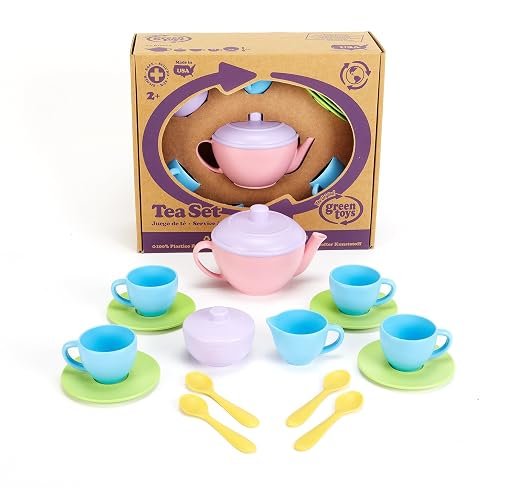
★ Green Toys Green Eats Eco-Friendly Tea Set. Complete your custom tent ecosystem with the easy-to-sanitize snack accessory with this durable dining set which is made entirely in the USA of recycled plastic milk jugs with no external coatings, paints or metal parts to rust and can be set right inside the canvas walls for realistic cooking role-play. It can be tossed in the top rack of the dishwasher at night for an extremely low-maintenance companion for hospitality in everyday living rooms.
Reclaiming the Quiet Corners of Growth
Opting out of flashing plastic electronic gadgets and instead decking your home out with a high-value, sustainable play tent is a beautiful investment in your child’s developing autonomy. You trade the chaotic, over-stimulating noise of modern digital media for the calm, purposeful focus of a child mastering their inner world through the choice of simple lines, breathable non-toxic fabrics and open-ended accessories.
Evaluate your current living room arrangement today, clear the single-purpose distractions that perform all the cognitive heavy lifting for the child, and step back, letting your independent little explorer find their own formula for rock-solid confidence in their very own cosy sanctuary.
You don’t have to figure out these early childhood growth stages alone or wonder which developmental materials really support your family’s day-to-day peace. Keep us close as your trusted digital village for a steady stream of expert child development frameworks, practical playroom layout audits and honest product reviews.