
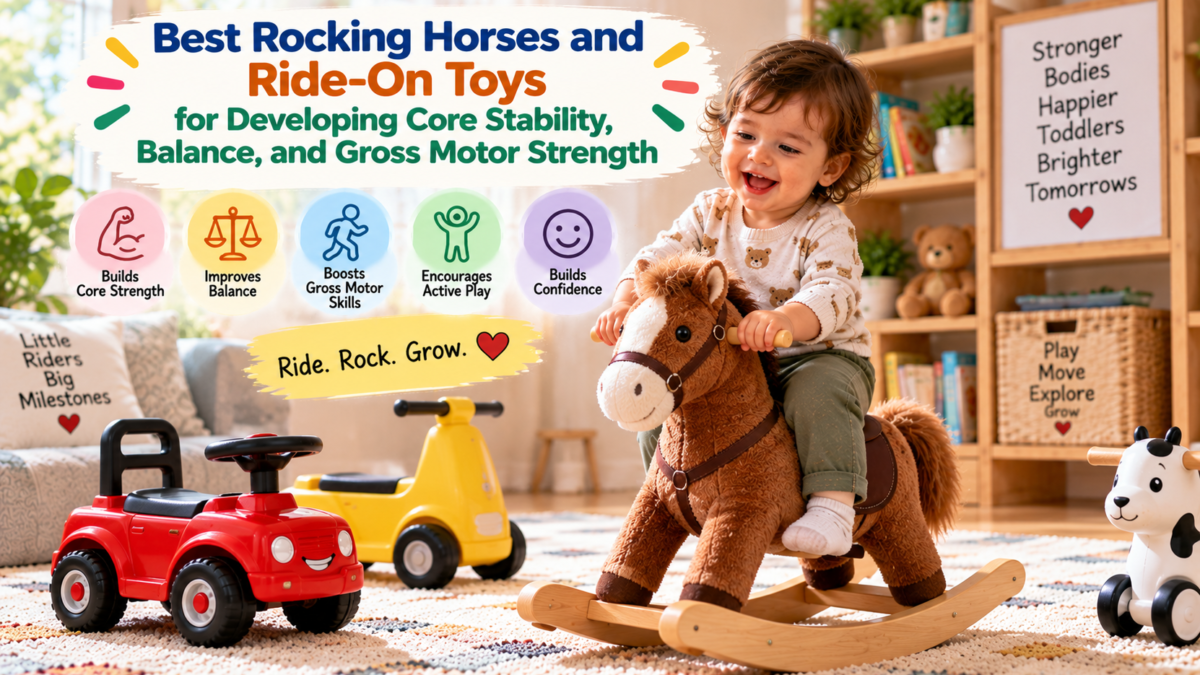
There is a remarkable change of posture when an eighteen-month-old gets on a solid wooden rocking-horse. Their hands grip the smooth birch grips, their feet find the foot pegs and their eyes kindle with anticipatory focus. They begin that first conscious push, transferring weight from heel to toe, employing deep muscles in the lower back, swaying through the arc of the rocker, and their entire being is caught in an intuitive kinetic loop. Back, forward. Deceleration, acceleration. In this simple act of self-directed movement the child is not merely play-acting; he is calibrating his internal gyroscope.
But walk into any big-box toy aisle today and you’ll discover a glut of battery-powered ride-ons. These robotic cars have motorized foot pedals, fake dashboard touchscreens and pre-recorded engine revving coming through tiny plastic speakers. The child presses down on a pedal and an electric motor does all the work. No weight shifting. No balance calibration. No gross-motor exertion. With automated ride-ons, toddlers become passive passengers in their own playrooms, rather than building physical confidence and vestibular mastery.
At CozyParents we love the idea of “intentional play” – the idea that the physical objects in our houses should be peaceful, lasting partners in the physical and cognitive development of our children. The child-powered rocking horse and manual ride-on toys are full embodiments of this philosophy. They are purely physics-driven: kinetic momentum, core leverage and spatial balance. They create high-impact gross-motor development without the noise and clutter of battery-powered novelties. This comprehensive resource explores the neurology and muscular mechanics of rocking and riding, provides practical frameworks for incorporating active gross-motor toys into a peaceful home and reviews seven tried and true, highly-rated options on Amazon US that make your toddler a capable adventurer of physical movement.
Developmental Mechanics: The Rock and Ride of Musculoskeletal Mechanics
To understand why manual rocking and riding toys are still developmentally so valuable we must consider how the nervous system of the infant and toddler processes vestibular sensation, core postural control and dynamic balance. Pediatric physical therapy and occupational neurology have shown that physical rocking and self-propulsion provide a full body workout that static toys cannot.
1. Balance & Spatial Orientation Vestibular Calibration
The vestibular system is the main balance center in the human body . It is located in the fluid filled semicircular canals of the inner ear . It detects head position, velocity and gravity variations. The fluid within the inner ear is in a constant state of flux when a toddler swings back and forth on a curved runner or leans into a turn on a multi-directional caster ride-on.
- This movement provides the brain with rich vestibular stimulation helping it to:
- Create a stable internal mid line and a map of the pull of gravity in 3D space.
- Combine visual inputs with balance mechanisms (vestibulo-ocular reflex) allowing the child to keep their vision on a target even when their body is moving.
- A natural neurological reset. Rhythmic, predictable back-and-forth rocking activates the parasympathetic nervous system, calming an overstimulated or emotionally dysregulated toddler.
2. Deep Core Stability and Pelvic Co-Contraction
The child has to constantly micro-adjust their deep trunk stabilizers on the active rocker or ride-on, unlike with passive seating or motorized carts. A toddler must engage their transverse abdominis, rectus abdominis and spinal erectors simultaneously to avoid falling forward or sliding over the back .
Furthermore, dynamic pelvic stabilization is required when mounting, dismounting and pushing off the floor. As the child kicks feet alternately against the floor for forward movement they are developing strength in their hip abductors and gluteal muscles. This deep core stability is the bedrock of the strength necessary for confident walking, running, jumping and eventually sitting for long periods at a classroom desk.
3. Bilateral Reciprocal Coordination and Motor Planning
Self-propelled ride-on toys involve complex contralateral movement patterns. A toddler needs to push a vehicle forward and steer it.
- Kick reciprocate the legs, or spring forward with equal push-off of both feet.
- Use both arms to steady their upper body while making minor steering adjustments with the handlebars.
- Real-time motor planning: estimate spatial clearance, predict obstacles in the living room and compute braking distance before collision with furniture.
Such cross-body coordination requires rapid communication between the brain’s left and right hemispheres through the corpus callosum, establishing vital neurological track work that will be needed later for physical milestones like pedaling a bicycle, swimming and gross-motor sports agility.
Product Roundup: 7 Thoughtful Rocking Horses & Ride-On Toys
When selecting gross-motor gear that will hold up to vigorous daily riding, but also fit into a serene family living space, look for sustainable hardwoods, non-toxic waterborne finishes, floor-safe non-marking casters, and stable, tip-resistant architecture. Here are seven of the best, verified options on Amazon US that align with the CozyParents philosophy.
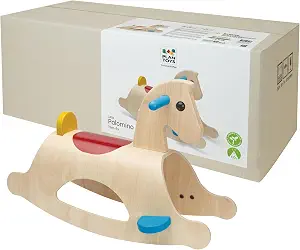
1. PlanToys Classic Wooden Palomino Rocking Horse
Description: Minimalist heirloom-quality rocking horse hand crafted in Thailand from sustainable, chemical-free, kiln-dried rubberwood finished with safe organic water-based dyes with built-in foot pegs, ergonomic handlebar grips and gently contoured saddle.
Why It Works for Child and Home: PlanToys is the world leader in the engineering of environmentally-friendly toys. The Palomino has a deliberately shallow, calculated rocker curve to prevent dangerous tipping forward or backward, giving cautious eighteen-month-olds the confidence to get on and rock on their own. Its warm satin-smooth rubberwood grain and understated esthetic meld seamlessly into contemporary living spaces. Solid wood base absorbs kinetic energy, no squeaking or scratching of hardwood floors.
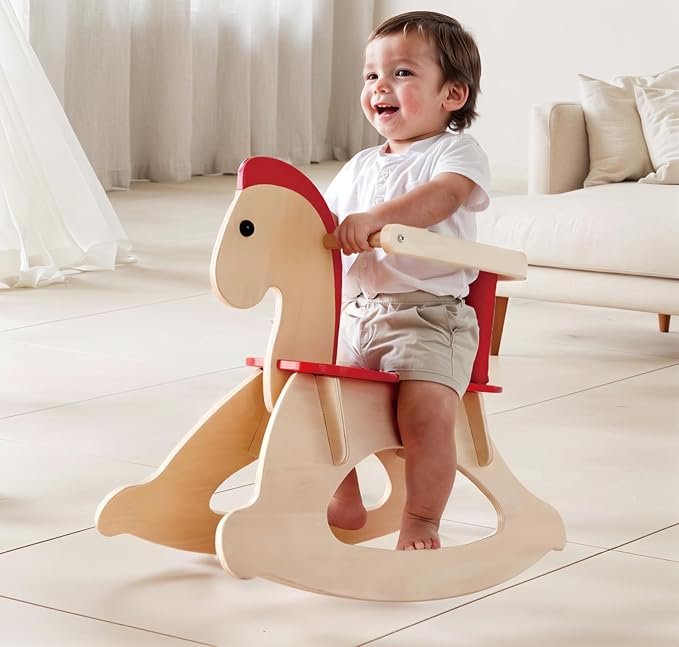
2. Hape Rock & Ride Rocking Horse made of wood
Description: A rocking horse made of FSC-certified birch and maple that grows with your child. It features a removable curved backrest guardrail that can be adjusted as your toddler’s core stability develops.
Why It Works for Child and Home: With brilliant mechanical simplicity, Hape works through the age transition dilemma. The curved safety backrest surrounds the seat for younger toddlers (10 to 18 months) who are still developing seated balance, providing secure lateral support to prevent them from sliding. If your child is 2 years old and has good trunk control, the backrest is removed with simple hardware and the unit becomes a classic, open-seat rocker. Its natural wood finish and neutral accents look beautiful in any nursery.
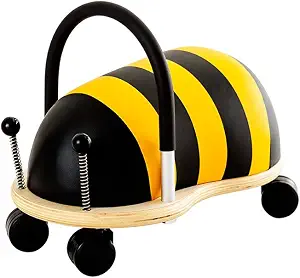
3. Wheely Bug Ride-On Prince Lionheart (Small)
Award-winning multi-directional rolling ride-on toy with padded easy-to-wipe polyurethane foam seat on contoured plantation-grown renewable plywood base with heavy-duty 360 degree non-marking casters and aluminum handle.
Why It Works for Child and Home: Multi-directional casters let your toddler spin, glide sideways, pivot and reverse with zero steering friction, unlike traditional ride-ons that go in rigid straight lines. This 360 degree freedom challenges the hip abductors and ankle stabilizers in all planes of motion. The padded seat is lined with a soft sponge, providing comforting proprioceptive pressure, and the silent, floor-friendly caster wheels roll over hardwood floors without leaving scuff marks or rattling the floorboards.
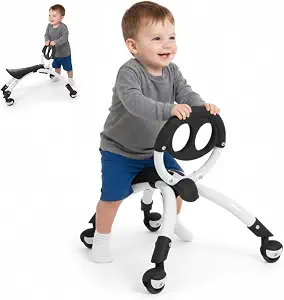
4. YBIKE Pewi Walking Buddy & Multi-Directional Ride-On
Description: Lightweight developmental hybrid with tubular aluminum frame, ergonomic low slung molded seat, multi grip handlebar rail and four 360 degree non marking rubberized caster wheels.
Why It Works for Child and Home: The YBIKE Pewi is a great bridge tool from early walking to confident riding (9 to 36 months). First they use the wide surrounding handle frame as a stable push-walker until they can sit comfortably. When balance improves they sit straddling the low seat and use it as a foot-powered scoot bike. The broad multi-directional wheel base prevents tipping during erratic weight shifts and the entire unit weighs only four pounds so toddlers can carry and maneuver their vehicle independently.
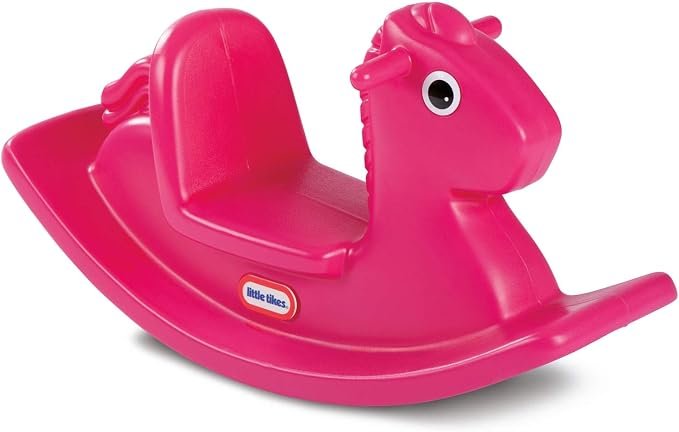
5. Little Tikes Classic Rocking Horse Blue/Pink
A virtually indestructible, monolithic rocking horse made in the USA from smooth, high-density non-toxic polyethylene, with a high contoured backrest, easy-grip molded handles and a low-profile, wide-stance rocking base.
Why It Works for Child and Home: This classic rocker, plastic but with decades of proven ergonomic stability. Its one-piece, seamless construction means no screws to loosen, no joints to trap dirt, no seams to split. Size for young toddlers (12 to 36 months). Light enough for a toddler to drag from room to room Totally weatherproof for patio use Cleans in thirty seconds with a damp cloth and Castile soap
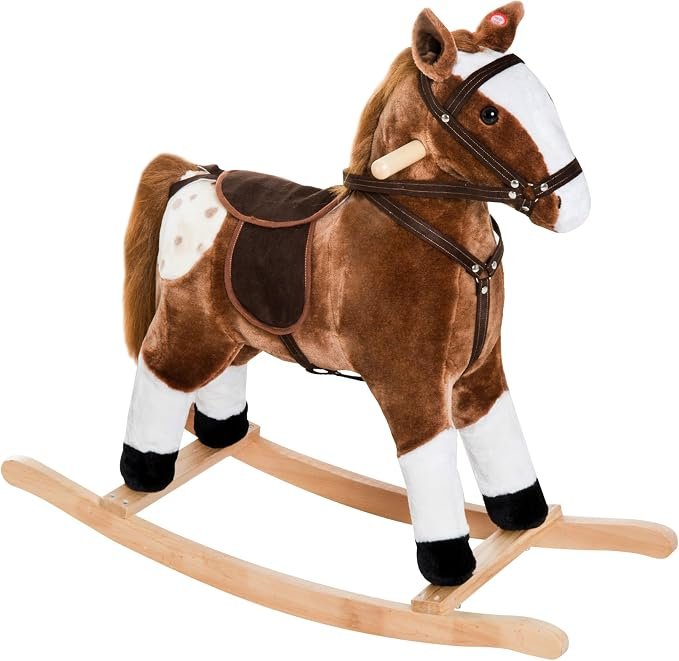
6. Qaba Kids Rocking Horse Plush for Boys Girls with Realistic Sounds Brown
Description: Classic French designed solid wood rocking horse with non-toxic water based stains, anti-tip safety rocker base, integrated footrests and a removable wooden perimeter safety ring.
Why It Works for Child and Home: European toy design with exceptional woodworking. The Caramel horse has a protective wooden hoop that surrounds the seat for beginning riders (ages 12 to 24 months) that unbolts easily once the rider outgrows the need for boundaries. The curved rockers have wooden end stops built into them which mechanically limit the rocking angle, so no matter how enthusiastic the rider, it’s impossible to tip the horse forward.
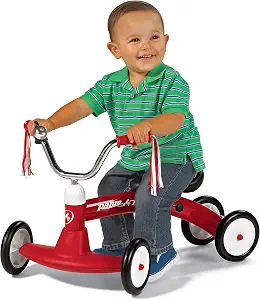
7. Radio Flier Scoot About Classic Metal Ride On
A vintage style design toddler ride on 4 wheels with a solid steel frame, real chrome handlebars with an ergonomic steering lock, an adjustable padded saddle seat and wide front rolling wheels with an integrated front bumper.
Why It Works for Child and Home: The Scoot About is made of solid steel, so it has a grounded, stable center of gravity, so it won’t wobble or tip over when the child is mounting it. The wide front wheel track gives plenty of room for a toddler to kick their feet forward without banging their ankles on the frame. The integrated steering damper keeps the bars from turning past a safe angle, preventing jackknife tip-overs when you’re cruising the living room at high speed.
Practical Advisory: A Low-Friction Riding Ecosystem
When you bring large gross-motor toys into your home you need to be intentional about physical boundaries and space planning. Without defined parameters a ride-on can become quickly an empowering physical tool to a collision hazard for baseboards and furniture.
1. Establish the “Flight Path” and Landing Runway
Ride on toys require unobstructed kinetic runways to offer their full developmental benefit. If your child is stopping every 3 feet to dodge coffee table corners or carpet transitions, they cannot get a sustained reciprocal kicking stride.
Clear an open loop around your living room or hallway removing loose baskets and floor cushions.
If you have hardwood floors, designate a “rocking station” for wooden rocking horses by laying down a low-pile wool runner or a large felt play rug, which will prevent the base from sliding across the room as your child rocks.
For rolling ride-ons, set physical boundaries such as gated stair doors and “no-ride zones” for kitchen prep areas to keep adult work areas free of ride-ons.
2. The “One Active Anchor” Gross-Motor Rotation Routine
Large active toys dominate sightlines in living rooms and take up valuable floor space. Never ever ever have two ride-ons and a rocking horse all out on the rug at the same time. Multiple large vehicles = visual chaos and frenetic, unfocused toy switching.
Place one gross-motor tool (such as the wooden rocking horse) in your active living space for three weeks.
Store the wheeled ride-on in a closet, utility nook or garage in a hall.
And swapping the rocking horse for the rolling ride-on at the end of the month, your toddler greets the vehicle with the renewed energy and intense curiosity of a new discovery, keeping gross-motor play deeply engaging without cluttering your floor.
3. Sensory grounding as barefoot propulsion
When the indoor weather allows, encourage your toddler to rock and ride totally barefoot. The soles of human feet have over 200,000 sensory nerve endings that provide immediate tactile information to the brain on friction, balance and surface resistance.
When toddlers ride barefoot they can flex their toes, grip the floor and push off using the heads of their metatarsals, instead of passively sliding around inside slippery socks.
Direct contact with the floor helps to strengthen the plantar arches, stabilize the ankles and avoid slipping when dismounting on smooth floors.
Gross-Motor Calming Rituals for Daily Rhythms
Rocking and riding equipment can be powerful tools for managing behavior and daily transitions. Here are four simple ways to make these things part of your family routine:
1. The Afternoon Vestibular Reset
When that late afternoon witching hour hits and your toddler starts to get irritable, whiny or overstimulated from a full day, don’t turn on the television. Dim the overhead lights in the room, play some soft acoustic music and lead them to their wooden rocking horse. Sit on the rug near me. The rhythmic, predictable back-and-forth sway stimulates the parasympathetic nervous system, lowers cortisol, slows the breath and supports an overstimulated nervous system in returning to a grounded baseline.
2. The “Delivery Route” obstacle course
Turn active riding into a purposeful cognitive mission. Put three small wooden baskets or canvas bins in the corners of the room, each with a colored cloth marking it. Give your tot an object (like a wooden block or soft toy) and say: ‘Special delivery for the blue station!’ Maneuvering their ride-on around rugs and furniture to deliver the cargo taps into their endless physical energy to coordinate multi-step motor planning.
3. The Parade for Animal Rescue
Provide opportunities for symbolic play with plush ride-on animals. Let your child load a favorite stuffed animal onto the back of their ride-on or hold it while rocking, narrating an imaginary rescue mission across the mountains. It combines high-energy gross-motor activity with tender imaginative empathy. It expands vocabulary and emotional expression.
4. The “Pasture” Tucking-In Routine at Bedtime
Ending big motor play before evening wind-down prevents bedtime stalling. Before bath time, have your toddler “feed” his rocking horse a pretend wooden carrot and lead it to its “pasture” (a corner of the playroom or a folded blanket). Say goodnight to the horse, together. This predictable ritual gives a tangible cognitive clue that energetic daytime riding is over and restful nighttime stillness has begun.
Rejoicing in the Freedom of Movement Independently
A real, beautifully made rocking horse or manual ride-on toy is an investment in your child’s confidence in their own physicality, their curiosity about space, and a lifelong love of moving. You give yourself well-designed, straightforward tools that respond to the honest mechanics of gravity and muscle, rather than electric switches and you create a peaceful sanctuary where gross-motor milestones happen with joy and grace.
At CozyParents, we believe that every item in your home should have a clear developmental purpose, foster mindful connection and contribute to household serenity. You sit on the floor and hear the soft, rhythmic swish of runners on the rug and see the little hands of your child bracing for the ride and you are not just watching play you are watching a young human being learn the exhilarating power of its own balance.
Keep exploring CozyParents for mindful parenting frameworks, expert-backed gear roundups, and intentional strategies designed for your growing family. Does your child love the rhythmic calm of a rocking horse or are they zooming around on a caster ride on this season? We would love to hear about your experiences creating peaceful, intentional spaces at home in the comments below.