


There is a quiet, meditative stillness that descends on a preschooler when he or she finally manages to thread a piece of flexible cotton lace through a tiny wooden aperture. To an adult, stringing beads or lacing a card is a normal pedestrian manual task. But to a four-year-old, it is an absolute triumph of fine-motor planning, bilateral coordination and sheer concentration. However, when parents enter the world of the modern commercial toy market, they are often confronted with a dizzying array of plastic gadgets, flashing digital screens and loud, battery-powered games that promise to accelerate dexterity. These noisy novelties flash and chime and they often shatter a child’s attention span, turning what should be a peaceful, focused exercise in tactile discovery into a frantic quest for a digital reward.
At CozyParents, we believe a child’s playroom should be a sanctuary for focus, independent thinking and purposeful work. We believe in ‘intentional play’ choosing resources that are durable, touchable and well thought out to respect the developing nervous system of the child and the visual harmony of the home. In this comprehensive guide, we will explore the specific developmental milestones that are supported by lacing and threading toys, explore how to design a low-friction play ecosystem, and review 7 great threading products available on Amazon US that respect your child’s growing mind while preserving the esthetic peace of your home.
The Fine-Motor Mechanics of Threading
To understand the lasting educational potency of lacing and threading toys across generations, we need to look at how a young brain and hand interact with the physical world. Occupational therapy and child development principles tell us that fine-motor dexterity is not a static academic drill. It is a dynamic, multi-sensory experience based on motor planning, spatial awareness and neurological control.
1. Bilateral Integration & Eye-Hand Coordination
Lacing and threading materials require advanced bilateral coordination; the ability to use both sides of the body together, in controlled and complementary ways. One hand has to hold the wooden board, bead or card steady and the other has to guide, pitch and push the lace through the hole you want. Requires advanced hand-eye coordination and spatial calculation. As babies develop into toddlers, they move from awkwardly grasping with their entire fist to a careful, deliberate three-finger pincer grasp. Good quality threading toys offer just the right amount of physical resistance and tactile feedback to build up these little hand muscles without frustration.
2. Pre-writing Precision & Pincer Control
“The fine motor movements of threading a lace, or stringing a bead, directly strengthen the neural pathways and the muscle strength for future independence with writing.” The stiff tip of a cotton lace, when pinched by a child or the turning of a tiny wooden bead to line up its inside channel, sets and exercises the very finger muscles that will one day hold a pencil. This repeated physical contact refines wrist rotation and finger isolation and turns clumsy hand movements into confident, deliberate control that directly translates to academic readiness.
3. Keeping Attention & Emotional Control
One of the most interesting psychological benefits of a traditional lacing toy is that it has a built-in unhurried feedback loop. Threading takes patience, planning in order, and fixing mistakes. If a child misses a hole or twists the string, they have to stop, think about what they did wrong and take the lace out to try again. It builds deep emotional resilience, frustration tolerance, and executive function. Children learn to trust their own analytical abilities, developing deep self-reliance and emotional regulation in complex tasks rather than relying on a parent or an electronic device to correct them.
Seven Purposeful Lacing & Threading Toys for Preschoolers
When choosing lacing and threading toys, look for long-lasting, natural non-toxic materials and simple design that fits smoothly with a child’s developing mental and physical skills.
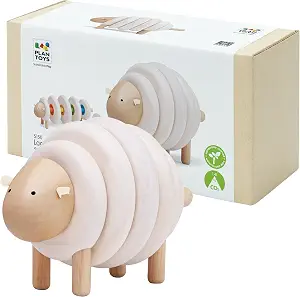
1. PlanToys Lacing Sheep Wood Solid
Description: A beautiful, sustainably made rubberwood lacing toy shaped like a sweet sheep, with organic cotton threading cords and smooth, ergonomic threading holes for little hands.
Benefits: This classic lacing toy eliminates the guesswork of age-appropriate selection by being perfectly aligned with a preschooler’s emerging need for bilateral coordination and concentration. The nursery esthetic is rooted in its natural rubberwood construction, and the simple design doesn’t overload the senses. Its parts are compact and store nicely on an open shelf, keeping the floor free of clutter.
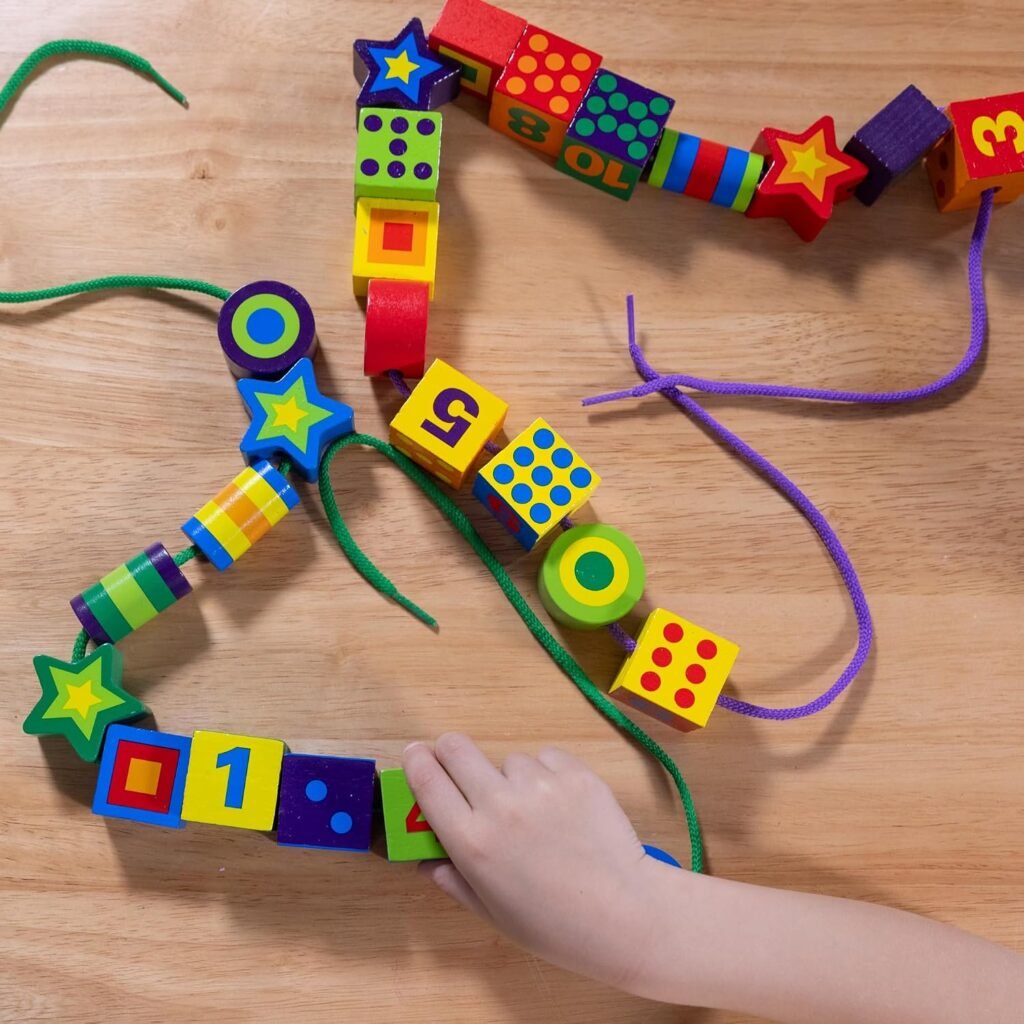
2. Melissa and Doug Deluxe Wooden Lacing Beads in a Box
Almost thirty brightly painted solid wooden beads in a variety of geometric shapes and colors, with two strong child-safe laces, all in a compartmentalized wooden storage box.
Benefits: This is a classic early childhood development staple. The wooden beads are nice and big, so they are especially easy for little fingers to grasp and thread, and the variety of shapes and colors is great for early patterning and sorting practice. The wooden storage box helps teach kids to clean up after themselves and keeps the pieces nicely corralled.
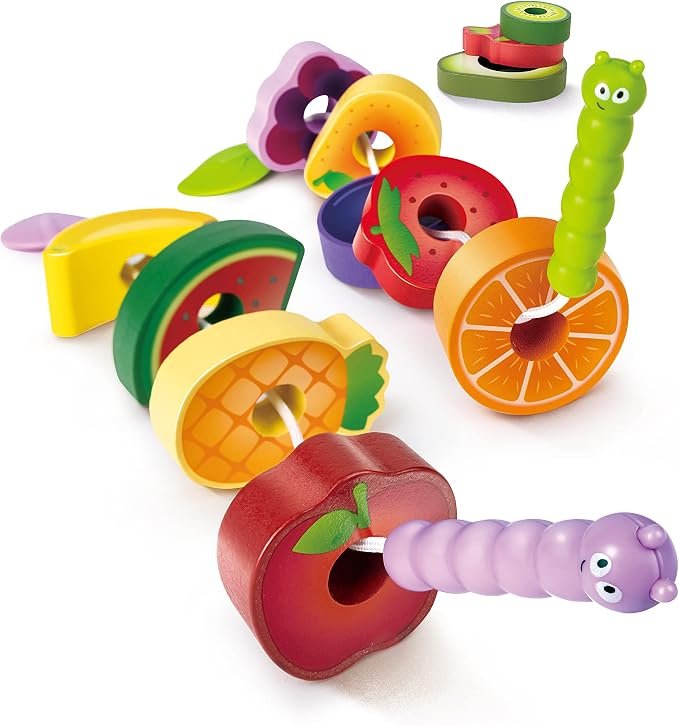
3. Hape Caterpillar Fruit Feast Playset
Description: Internationally acclaimed open-ended Waldorf toy made from solid linden wood, finished with non-toxic water-based color stains to allow the natural beauty of the wood grain to shine through.
Benefits: The supreme longevity toy, this goes easily from a simple sorting exercise to a complex patterning and threading challenge. It does not have any particular electronic function and therefore grows with the child through several stages of development. The smooth wooden circles fit nicely inside a small natural cotton storage bag, taking up minimal space in a minimalist playroom.
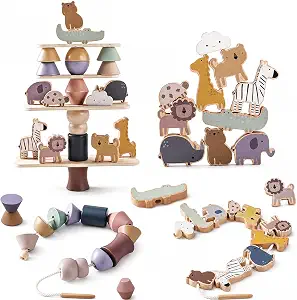
4. Wooden Animals Threading Toys Lacing Beads for Toddlers
Description: These simple tree, mushroom and animal shapes are hand made from solid linden wood with precision drilled threading channels and finished only with natural flaxseed oil and no chemical paints or varnishes.
Benefits: No artificial colors. Calming naturalistic play environment. Organic wood scent provides grounding sensory connection inside. The unusual, irregular shapes present advanced spatial challenges requiring finer motor calculation and patience than standard uniform blocks.
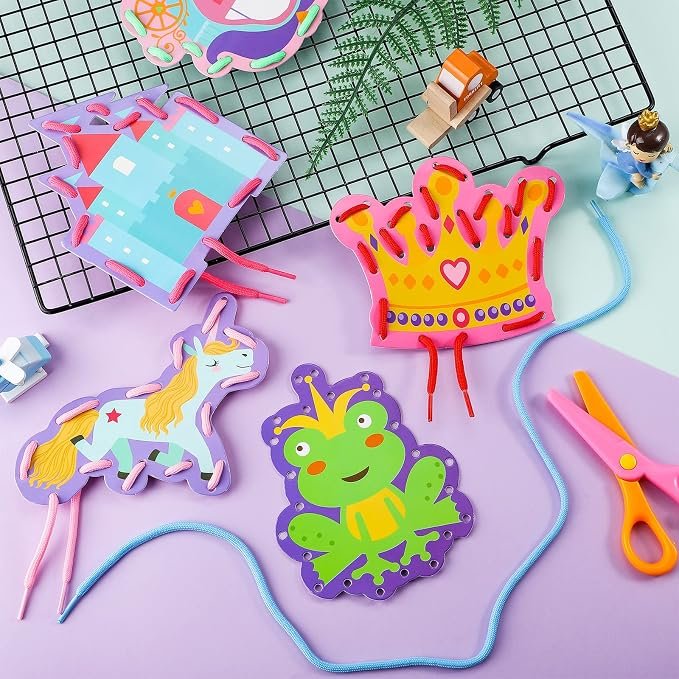
5. Zonon 8 Pcs Kids Sewing Cards 8 Patterns Lacing Cards
Lacing Cards Kits: package includes 8 pieces princess theme lacing cards in 8 different patterns, including princess and castle for girls and boys, with bright colors and cute deigns that will draw your attention and make your educational game more interesting
Benefits: Tracing sewing cards are equipped with 8 different colors laces for easy and fast hanging, and you can use them for beautiful and interesting house decoration with these laces
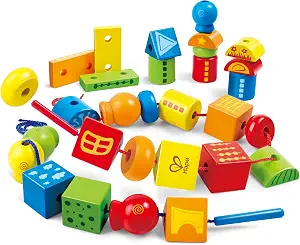
6. Hape Educational Match-and-Thread Wooden Toy
A multi-dimensional wooden threading puzzle made from Baltic birch, finished with child-safe, water-based paints. It combines sorting blocks with sequential lacing cards.
Benefits: Created for children 36 months and older, it tackles several developmental areas at once: color identification, sequential planning and fine-motor accuracy. Being solid wood, it will take enthusiastic daily handling, but will remain screen-free and quiet to play.
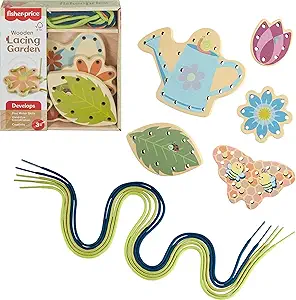
Beautifully illustrated with charming garden motifs, heavy-duty FSC-certified recycled cardstock lacing boards, paired with soft organic cotton laces tipped for easy grasping.
Benefits: These artistic lacing cards offer a gentle, nature-inspired introduction to threading, free of plastic overstimulation. The cardstock is thick and durable for repeated use, and the matte finish helps prevent harsh glare under indoor lighting so young eyes are protected during long creative sessions.
Practical Advisory Building a Low-Friction Threading Ecosystem
Collecting lacing and threading toys is only half the battle; how you arrange and introduce them into your living space is what determines how well your home maintains its peace and order.
1. The Progressive Complexity Strategy
If you bring a complicated multi-hole lacing board or tiny beads to a young toddler, they can become frustrated and overwhelmed immediately. Try incremental simplification instead. For younger children, begin with one large wooden animal with oversized holes, and thick, rigid-tipped lace. When your child has mastered this concept easily, move on to smaller beads or multi-path threading cards. It will also build confidence, guard attention span, prevent frustration and promote steady cognitive growth.
2. Low-Shelf Accessibility & Categorized Placement
Store your child’s lacing tools on low, open wooden shelves above deep toy chests or high closets. When the toys are visible and within the child’s reach, they can choose what they want to play with and, most importantly, how they want to put it away when they are finished. It improves executive functioning, fosters a strong sense of personal autonomy, and instills respect for the home environment.
3. Pick a “Less is More” Rotation Approach
Paradoxically, the overabundance of fine-motor and threading toys available at one time can inhibit engagement by way of choice fatigue. Keep one set of laces out and in rotation, and store the rest in a closet or storage bin. Change your pick every four weeks. The familiar toy reappearing after a month away inspires the intense curiosity of a brand new discovery, giving the toy a longer life without cluttering up your living space.
Comparison: Premium Intentional Threading Toys vs. Mass-Market Options
When shopping for lacing and threading toys for preschoolers parents are often faced with the choice of a quality sustainable product or cheaply mass produced plastic product. Walking through these choices along specific dimensions shows why intentional gear is a vital investment in your family.
Durability: the premium sustainable wooden lacing boards and thick multi-ply cardstock are made to last for multi-generation life that can easily hold the heavy pulling, bending and active manipulation of early childhood. Conversely, mass-market plastic or flimsy paper threading toys are prone to fraying strings, cracking plastic rims and fading, often ending up broken and in landfills within months.
Intentional toys are built with minimal spatial harmony in mind, in terms of functional storage and home integration, with compact wooden boxes, natural cotton pouches and neutral esthetics that blend seamlessly into home decor. Cheap plastic alternatives tend to be awkward, bulky shapes, and chaotic primary color schemes that dominate the sight lines of the room, creating unavoidable visual clutter.
In high-grade toys, ergonomics and safety are key. They are created with non-toxic, water-based finishes, organic cotton cords, and smooth, rounded edges that are easy on a child’s sensitive skin and developing immune system. Cheap knock-offs may contain untested chemical plasticizers, raveled synthetic strings, or brittle plastics that break apart under pressure.
From a sensory point of view, natural wood, organic cotton and matte finishes provide grounding, organic textures and natural scent profiles which calm a child’s nervous system. The shiny, cold surfaces of synthetic plastics and electronic novelty toys, and the loud, high-pitched artificial sounds can overload the sensory processing abilities of the young child’s brain.
Finally, in a developmental and therapeutic sense, purposeful lacing tools tend to be open-ended – growing in creativity as the child moves from a toddler exploring basic hand-eye coordination, to a preschooler creating intricate patterns and narrative play. Cheap novelty toys have a pre-programmed function that gives a short hit of dopamine and then the child loses interest quickly.
The Power of Deliberate Play Over Time
Lacing and threading toys for your preschooler is an act of profound environmental and psychological stewardship. By choosing items that match your child’s developmental stage, you give them exactly what they need to develop keen two-sided coordination, strong fine-motor control, and mental clarity all without the distracting noise of modern commercialism.
We believe everything in your home should have a purpose, or nurture growth, or bring a moment of peace. By curating a thoughtful, sustainable collection of developmental toys, you’re not just tidying your living room, you’re teaching your child how to focus, how to wonder and how to be present with the world around them.
Keep checking CozyParents for all things minimalist parenting, expert curated gear roundups and intentional approaches to help restore calm to your family’s everyday flow. Are you doing a toy rotation at home right now or planning to do a play space purge this week for your child? We love hearing about how you create peaceful, intentional environments for your growing family so tell us in the comments.