

Few toys generate instant exhilaration like a remote control car skittering over the living room rug or bouncing over patio tiles. For a toddler, the pleasure of pushing a button and having a machine reply across the room is a lesson in agency, spatial tracking and mechanical cause-and-effect.
Driving an RC vehicle is a great way to combine physical play with technology, get kids outdoors, design obstacle courses and explore real-world physics.
But the remote control vehicle market is rife with annoying mismatches between a child’s motor development and a car’s technical parameters. You can find them on toy store shelves and digital shopfronts, brittle plastic supercars that shatter into hallway baseboards on their inaugural run or high-speed hobby buggies whose twitchy pistol-grip throttles send cars screaming into walls at thirty miles per hour before a five-year-old can even blink. When an RC car is too fast, too delicate, or controlled by a complicated controller, enthusiasm quickly transforms into tears, scuffed plasterboard and abandoned gadgets in the back of the closet.
A remote control car for a real novice should meet a youngster exactly where their visual spatial ability and fine motor reflexes are now. At Cozy Parents we grade kids’ play tech for developmental hand-eye coordination, physical impact resilience, non-toxic materials and clutter-conscious living. We believe that children’s devices should be sturdy, easy to use and able to take enthusiastic bumps without taking over your home with disposable plastic garbage.
Cozy Parents provides grounded tools for tranquil family life of the everyday sort. If you’re ready to craft an intentional, low-stress play environment supported by professional buying frameworks, practical routines and minimalist gadget recommendations!
Motor Milestones & Matching Electronics To The Age
Driving a radio-controlled car involves tracking the car visually while mentally rotating its position in space (the left and right steering are reversed when the car is coming toward you) and calibrating the fine motor movements of your thumbs.
When assessing an RC car during the early childhood and elementary phases, child development experts and toy engineers consider four basic criteria:
1. Controller Geometry and Input Ergonomics
The transmitter is the primary interaction between child and vehicle. The standard multi-channel joystick is just a cognitive overload for toddlers and preschoolers (ages 2 to 4). Little kids need simple two button steering wheel remotes (one big button forward, one reverse-and-turn). As fine motor finger isolation and bilateral coordination begin to develop around ages five to seven years, kids can be successfully upgraded to dual-stick controllers or basic pistol-grip transmitters with proportional steering wheels.
2. Calibrated Speed Limits and Fragile Acceleration
The #1 adversary of success for beginners is Speed. High velocity = high impact energy. The indoor toddler is naturally limited to speeds of three to five miles an hour, so that developing eyes can watch trajectory without running into the legs of furniture. For school-age beginners venturing outside, search for transmitters with throttle-rate adjustment switches (such as 50% / 75% / 100% speed limiters) that allow parents to cap maximum speed until steering muscle memory develops.
3. Armour that’s Safe for Furniture and Absorbs Impact
A beginner doesn’t go around barriers, he runs into them. Cars manufactured from brittle plastic polystyrene shatter on collision. Beginner models are better with high-elasticity PVC shells and flexible thermo-plastic bumpers, soft silicone chassis armour or big foam tires. These shock-absorbing materials bounce off walls, baseboards and ankles without leaving scuff marks or damaging internal gearboxes.
4. Battery Safety and Charging Access
RC toys have always been notorious for chewing through a dozen-pack of disposable alkaline batteries. Prioritise vehicles with internal, screw-secured rechargeable lithium-ion or nickel-metal hydride (NiMH) battery packs that may be charged by ubiquitous USB connections for sustainable household management and child safety. Only use a special screwdriver to unlock the battery compartments, to keep loose cells away from curious young fingers.
Beginner-Friendly RC Cars
To assist you discover an agile, durable, and age-calibrated remote control car, we have reviewed seven outstanding beginner-friendly models that are now trending on Amazon US.
All of these choices offer good impact resistance, intuitive controls and reliable engineering designed for early drivers.
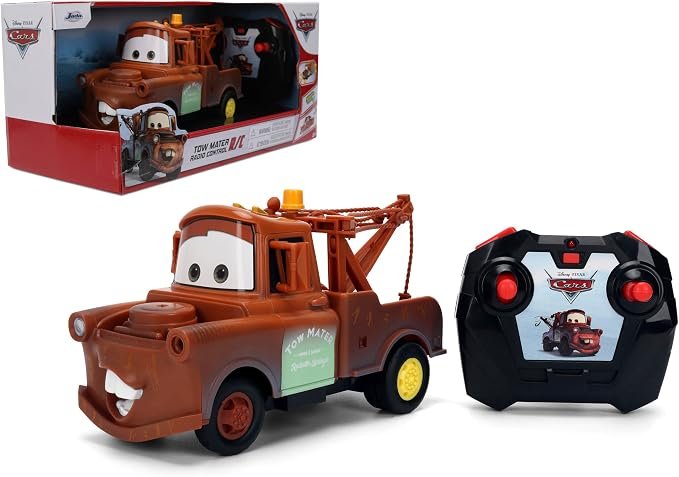
1. Jada Disney Pixar Cars (Ages 18 months – 4 years)
This the gold standard of early introduction, specifically designed for toddlers beginning their very first drive. It’s built of high-density, non-toxic ABS plastic that takes repeated drops down stairs and collisions with furniture and shaped with smooth, rounded contours and no harsh plastic edges.
The main engineering innovation is a steering-wheel-shaped remote control with just two big, colour-coded buttons: one moves the car straight forward and the other reverses and spins the car in a circle. This straightforward arrangement helps infants grasp cause and effect navigation without feeling irritated with complex steering arcs. It’s an enjoyable, low-frustration first step into radio control, with happy horn noises, flashing headlights and a removable cartoon driver figure.
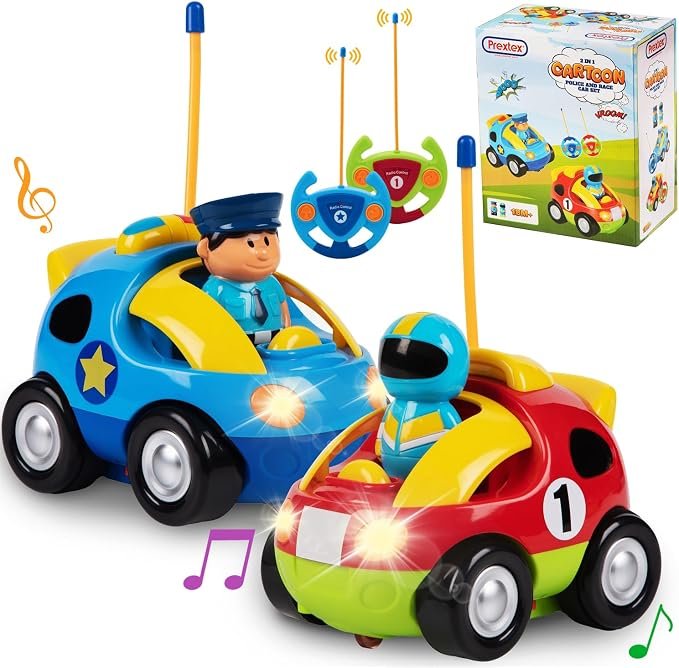
2. Prextex Cartoon R/C Police Car & Race Car 2-Pack (Ages 2 to 5)
If you have brothers and sisters or friends that want to race together, then the Prextex 2-Pack is an extremely good deal and quite durable. The kit has two different cars, a police car and a race car, each with its own hefty two-button transmitter shaped like a wheel and tuned to separate radio frequencies so both cars may be driven at the same time without interfering with each other.
The cars move at a slow, predictable strolling pace that makes indoor play safe for furniture in the living room and toddler toes. The removable police and race driver action figures fit nicely in the cockpits, providing fun pretend play and mechanical steering practice. It’s a work horse, a parent-friendly, accessible vehicle for shared toddler play, built to endure high-impact bumps into the thresholds of hallways.
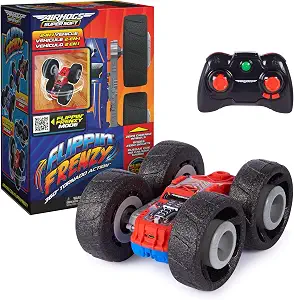
3. Air Hogs Super Soft Flippin’ Frenzy (Ages 4 & Up)
Driving indoors may cause nervousness over dented plasterboard and scuffed hardwood floors. The Air Hogs Flippin’ Frenzy gets around this structural issue by encasing the whole vehicle chassis in two giant super soft EVA foam tires. These light, non-marking foam wheels are essentially one long cushion so the car may smash into painted baseboards, glass patio doors and furniture at full tilt and do minimal harm.
The car comes with a revolutionary 2-in-1 reversible chassis. If it meets a wall front first it just flips itself upside down and continues to drive as a totally other colour car. Little kids can conduct 360-degree spins, flips and acrobatics indoors with the push of easy buttons using a dual-stick 2.4 GHz controller and the lightweight, USB-rechargeable internal battery makes maintenance simple and battery-free.
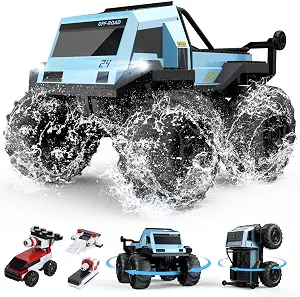
4. DEERC 360° Rotating Stunt RC Car (For Ages 4 to 8)
The DEERC Stunt Car overcomes the frustration of “getting stuck” that kids experience with typical steering courses. The dual-sided vehicle has twin engine four-wheel drive and flexible, grooved rubber tires that allow it to go forward, reverse, spin in situ and flip 180 degrees over obstacles.
If a novice driver smashes headlong into a closed door or trips over a rug edge, no adult assistance is required to flip the car back over. It just keeps on driving on its upside down side. Includes a 2.4 GHz remote with anti-interference technology for up to 150 ft. of control. Bright LED lamps for cruising the driveway at nite. It includes two modular rechargeable battery packs for an extended driving time and turns unexpected crashes into exhilarating acrobatic manoeuvres.
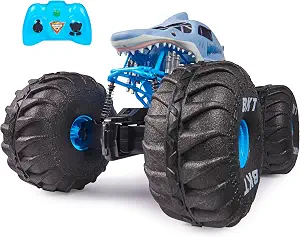
5. Monster Jam Official Megalodon All-Terrain RC Truck
Monster Jam Megalodon 1:24 scale replica delivers monster truck thrills to backyards, designed for beginner off-road exploring. Inspired by the legendary shark truck, its light injection-molded body is mounted on giant custom BKT-style rubber tires that roll over thick lawn grass, gravel driveways and scattered playground mulch with ease.
The controller is a twin joystick configuration that is intuitive and developed specifically for smaller hands, it has responsive forward-reverse and left-right turning without complicated trim knobs. Powered by a reliable 2.4 GHz radio band, it also allows young drivers to arrange outdoor backyard races with friends. The truck has tough high-clearance wheel shape that keeps it from bottoming out on outside obstacles, so it makes a great outdoor confidence-builder.
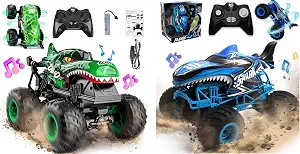
6. BEZGAR 1:18 Monster Truck Toys & 1:16 Remote Control Monster Truck (6-10 Years)
BEZGAR Monster Truck Toys is a tough and affordable stepping stone for students in elementary school who are ready to want a hobby-style vehicle that has the look and feel of a real trail truck. The aluminium alloy body shell and independent spring suspension on all four wheels give it a genuine mechanical robustness against outdoor curb hits.
The truck includes a proportional pistol-grip transmitter that helps older novices learn throttle control with a trigger and steering by turning wheels. The front chassis is protected by a strengthened heavy duty nylon bumper that directs collisions away from the front axle steering hubs. On tarmac and dirt trails, it’s good for speeds up to twelve to fifteen miles per hour and has some real off-road capability in a rugged beginning chassis.
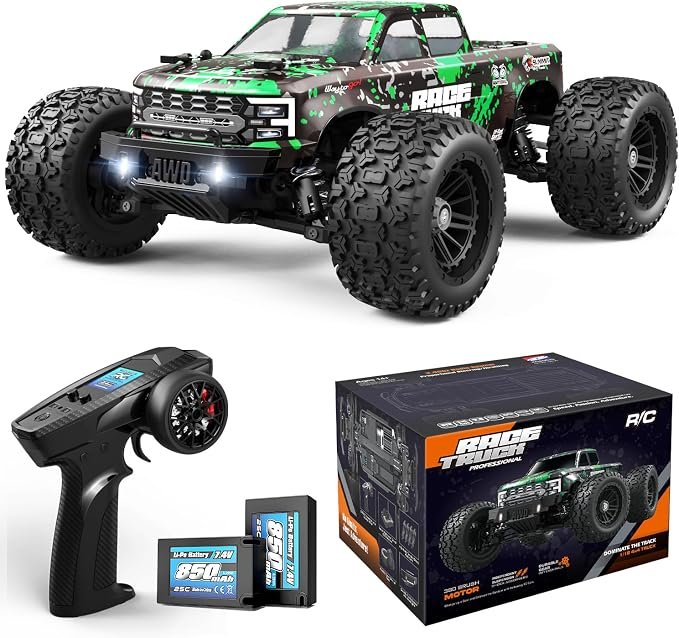
7. HAIBOXING 18859E 1:18 4WD Off-Road Buggy (Ages 8+)
The HAIBOXING 18859E is a great in-between for toy store RC and true hobby-grade RC for older novices and pre-teens who are ready for serious outside performance. Features of this 4×4 off-road truck include waterproof electronics, metal coil shocks with oil, metal planetary differentials and a high-torque 380 brushed motor capable of reaching twenty miles per hour.
Importantly for beginners, its ergonomic 2.4 GHz transmitter includes a dedicated dial, the “Speed Switch.” Parents can adjust the top speed down to 50% for inside hallway practice or driveway navigation and unlock full 100% throttle power after the child exhibits spatial control on open grass or dirt tracks. Supported by an open parts replacement ecosystem and teaches older kids mechanical maintenance, wheel servicing and hand-eye dexterity that persist for years.
Navigating Home Without Clutter in the Living Room
Bringing remote control cars into your home is bringing moving equipment, charging connections and remote transmitters that can easily scatter about living rooms.
To keep play running smoothly and with minimum friction, develop these four realistic household systems:
1. Set Clear “Track Boundaries”
Setting up clear physical driving zones before firing up an RC car. Select an open corridor or the carpeted edge of the living room for indoor toddler play, with the caveat that bedrooms with fragile furniture and kitchens with hot ovens are off-limits. For faster outdoor buggies, confine high-speed runs to open parks, paved cul-de-sacs or backyard lawns to safeguard home inside trim.
2. Create a ‘Pit Stop’ Charging Station
Immediate visual noise is created by loose charging cords, wandering transmitters and all . Designate a far shelf in your playroom, garage or mudroom as the official “Pit Stop.” Build a modest, child-resistant multi-port USB charging station where the cars and controllers must be parked and plugged in right after use. This means the vehicles stay charged at all times and the remotes never get lost.
3. Create Temporary Obstacle Courses Without Screens
Instead than having the youngsters drive cars back and forth into walls blindly, use that energy for spatial problem solving. Suggest them create obstacle courses with cardboard boxes, painter’s tape lines on the rug, paper cups or sofa cushions. A winding course teaches fine motor throttle modulation and spatial anticipation much better than flat out straight line hammering.
4. Rigorously Perform a “Post-Outdoor Wipe Down” Ritual
Outdoor rubber RC tires pick up dirt, grass clippings and pavement grit which then gets dragged onto your indoor carpeting. Keep a sharp bristle utility brush and a microfibre rag beside your entryway door too. Teach your youngster to spin the tires and brush off mud and dust before bringing their vehicle inside so floors inside stay clean.
Building Concentration & Spatial Awareness
A remote control car is so much more than a sprightly plastic toy. It is an enchanting, screen-free training ground where the kids learn hand-eye coordination, push physical limits and feel the joy of mechanical mastery. The correct car respects your child’s developing motor reflexes, absorbs exuberant accidents with grace and adds pleasant outdoor activity into your family’s daily routine.
Choosing controllers suited to the child’s age, drivetrains calibrated for speed, impact-absorbing materials and a tidy charging station means you’re investing in an exciting play equipment that fosters increasing confidence without cluttering your home.
This week, take some time to evaluate your play areas, find the proper vehicle to suit your child’s level of coordination and enjoy the shared laughter of navigating a miniature car about the floor together.
You will never have to sort out the kids’ gear choices or play area arrangement alone. Cozy Parents is your go-to source for honest product reviews, deliberate growth frameworks and easy home ideas that help you parent with intention and groundedness.