
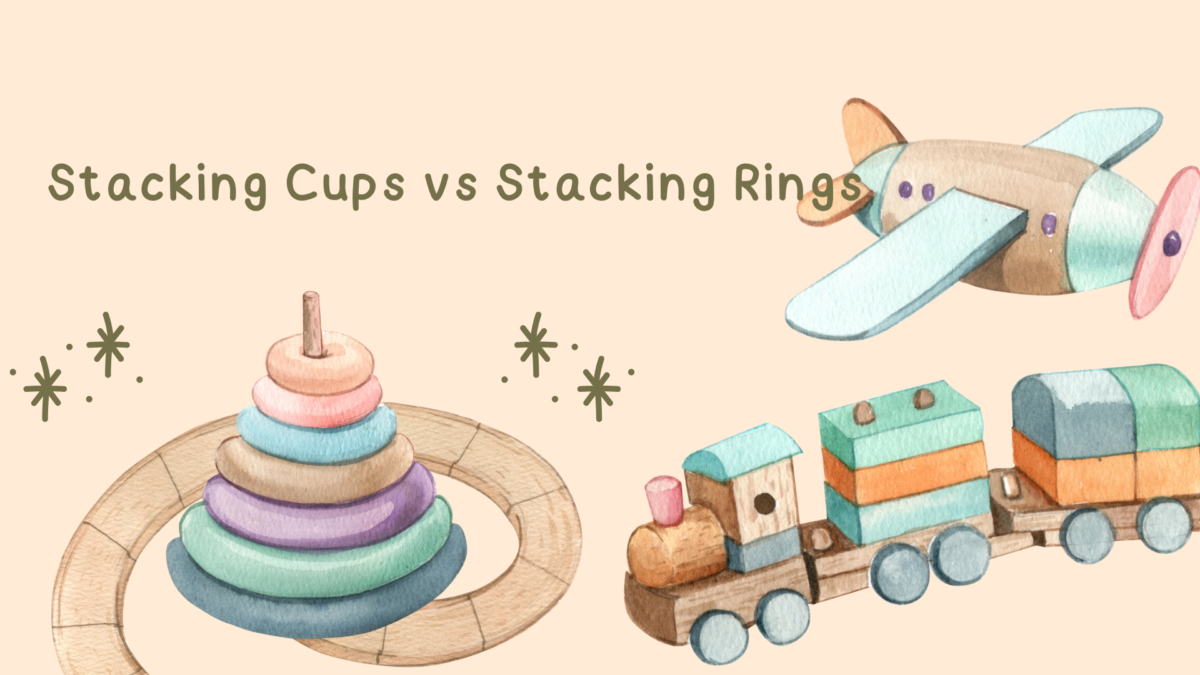
Go to any nursery, paediatric office or neighbourhood playgroup and you’ll be sure to find them sitting on the rug, a bright set of plastic nesting cups and a classic pyramid stack of coloured rings. These two staples of early childhood have anchored playrooms for generations. They are so ubiquitous, most parents buy them on autopilot, as if they were simple, interchangeable tools to keep a baby sitting occupied.
Both toys involve building vertically so it is easy to assume that they provide the same developmental value. You give the baby the pieces, he puts them in place, the tower falls over eventually and the cycle starts again.
However, the stacking cups and stacking rings have totally different physical architectures under the simple facades. They test your baby’s growing brain, motor planning and spatial logic in completely different ways.
The choice between them is not merely a matter of aesthetics. It’s the kind of neural pathways your child will develop during floor time.
Let’s cut through the marketing hype and examine the cognitive science, fine motor demands and long-term household lifespan of these nursery workhorses. We’ll help you figure out which stacker truly belongs in your intentional, clutter-free home ecosystem.
We approach early childhood play spaces from the lens of spatial clarity, developmental purpose and absolute toy longevity at Cozy Parents. We want to help you create a home that values deep child focus over commercial clutter.
If you’re looking for more clear, evidence-based guides to help you navigate early childhood milestones without getting lost in plastic noise, then head over to Cozy Parents to get connected with practical parenting toolkits built for real family life.
The Fine Motor Duel: Architecture of Grasp and Dynamics of Release
To understand the difference between these two things, we have to look closely at the physical interaction of a baby’s hand with the objects. The first year of life is a time when a baby’s brain is rapidly learning how to coordinate the micro-muscles of the fingers and wrists, progressing from clumsy whole-hand palmar grasps to the hyper-precise pincer grip.
“Stacking rings are typically circular and hollow. This form factor is very forgiving for an infant just learning how to coordinate their hands. A six-month-old can easily slide their entire hand or several fingers through the middle hole of a ring to lift it, using basic hook reflexes, not sophisticated muscle control.”
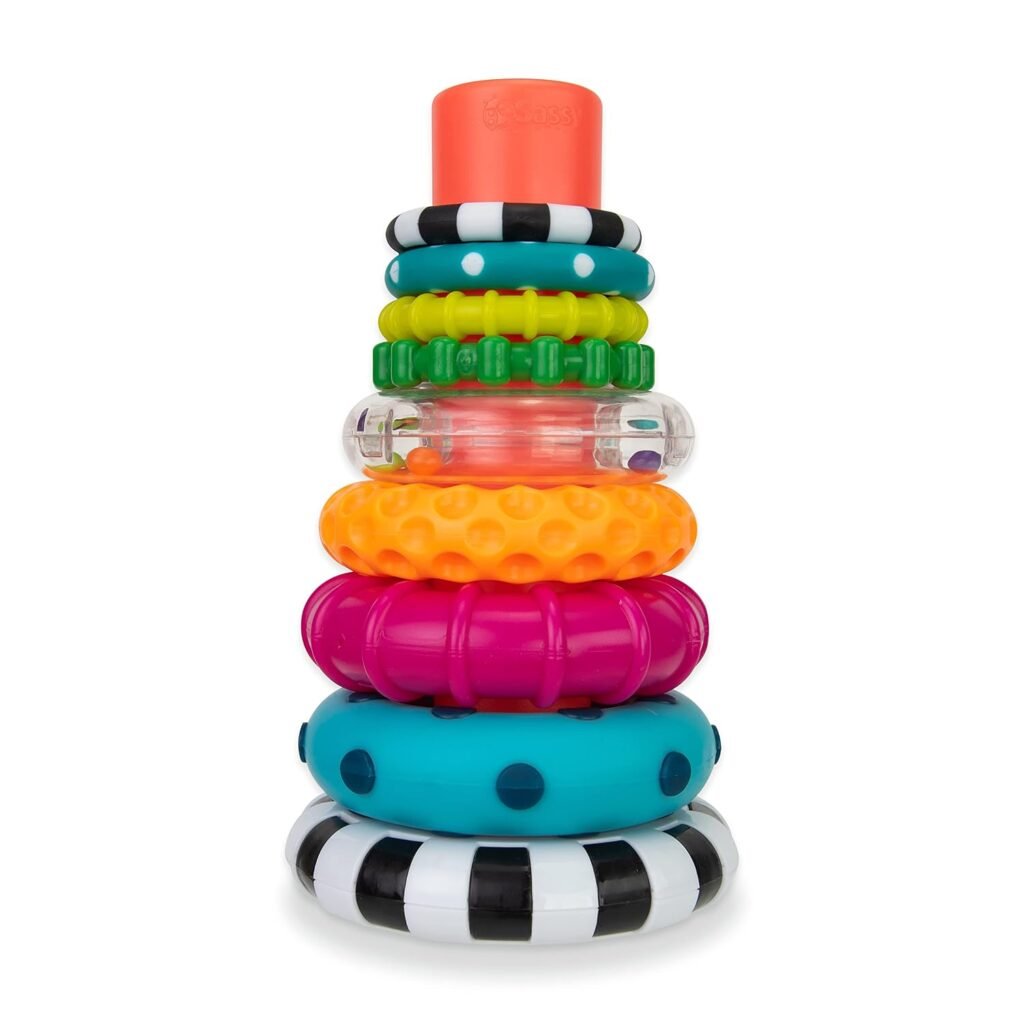
★ Sassy Stacks of Circles Stacking Ring Set makes great use of this early physical baseline. This smartly designed stacker, sold on Amazon, features chunky, dual-textured rings that are super easy for a baby to grab on to. Since the center opening diameter of each ring is the same, a baby can stack them on the straight post in any mathematical sequence without the tower collapsing.
This design removes the early barrier of sorting by size, allowing the infant to focus on the core mechanics of intentional grasp, lift and release.
Stacking cups, however, are a much more significant physical barrier. A cup is a solid 3D volume but it does not have an open center hole. There is no simple loop-grip for your baby to use to lift it off the floor. They have to forcefully open their fingers and spread them wide, grip the outer smooth surface of the cube with their palm and hold it with continuous, steady inward pressure.
Also, stacking requires a very sophisticated “release dynamic” of a cup. A ring can be dropped loosely over a central post but a cup has to be turned over entirely and balanced carefully, edge to edge, on top of the lower cup. If the alignment is out by a couple of millimetres, the tower topples over immediately. This structural feedback demands that your baby works on intense finger isolation and graded muscular control every time they try to build.
The Cone Scaffolding vs Absolute Gravity Spatial Brain Matchup
These two toys, besides the physical muscular workout, grow totally different profiles of spatial mapping, depth perception and early mathematical logic.
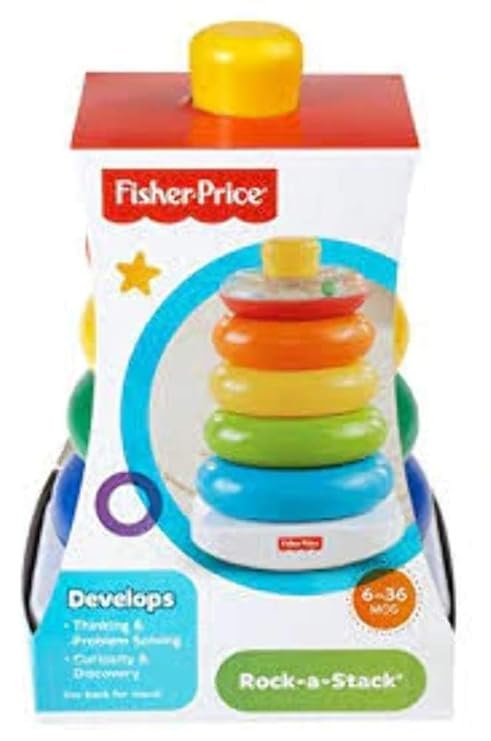
The conventional set of stacking rings is heavily reliant on a built-in guide, the central post. This post is like a cheat code for the baby’s external spatial awareness. When the baby can place the center hole of the ring in line with the top of the pole, the physics of the toy kicks in, sliding the piece down into a secure spot.
★ The Fisher-Price Rock-a-Stack has a traditional conical post design and adds an absolute sequence rule. The pole is much wider at the base than at the tip , so the smallest rings physically can not slide all the way to the bottom .
This mechanical constraint is an instant, self-correcting lesson in the gradation of size. If the child tries to put the pieces out of order they get immediate physical feedback on how to visually calculate the difference between bigger and smaller
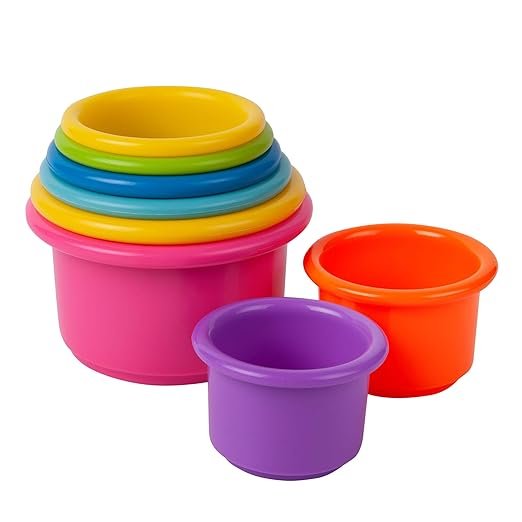
There is no structural guide rail on the stacking cups. No central peg for aligning the shapes. No hidden channel to hold the pieces in place. No physical safety net.
★ The First Years Stack & Count Cups are a perfect example of the brilliant, minimalist complexity of this open-ended format on Amazon. Your child is left to his own devices with a set of eight brightly coloured, numbered cups and the raw laws of absolute gravity and balance.
If the baby wants to build a vertical tower, she must use her eyes to locate the exact center of the bottom cup, hold her hand right over it and let the top cup fall with perfect stillness.
If a baby tries to stack a large cup on a small one in a set of nesting cups, the big piece will not just sit there awkwardly, it will slide all the way down to the floor, engulfing the smaller cup within its volume. This generates a whole new spatial conception: nesting.
Cups teach a child about internal volume, hollow spaces and containment and allow them to see how big three dimensional objects can magically disappear inside each other for neat storage. The lifestyle tips at Cozy Parents can offer you a clear and stress-free way to go if you want to get a better handle on how to set up your playroom layouts so that your child can play independently in spatial play for longer periods without needing you to be present all the time.
Shift in Material: An Oral & Textural Exploration
For a six to twelve month old baby the mouth is not only the source of nourishment, it is the main way of collecting information about the world. Oral exploration is an important sensory developmental milestone, with super-sensitive nerve endings in the lips and tongue interpreting density, temperature and structural contours.
Hard cold traditional hard plastic toys do not make it through this sensory period as they are hard and cold and can hurt sensitive gums that are teething if chewed on too hard.
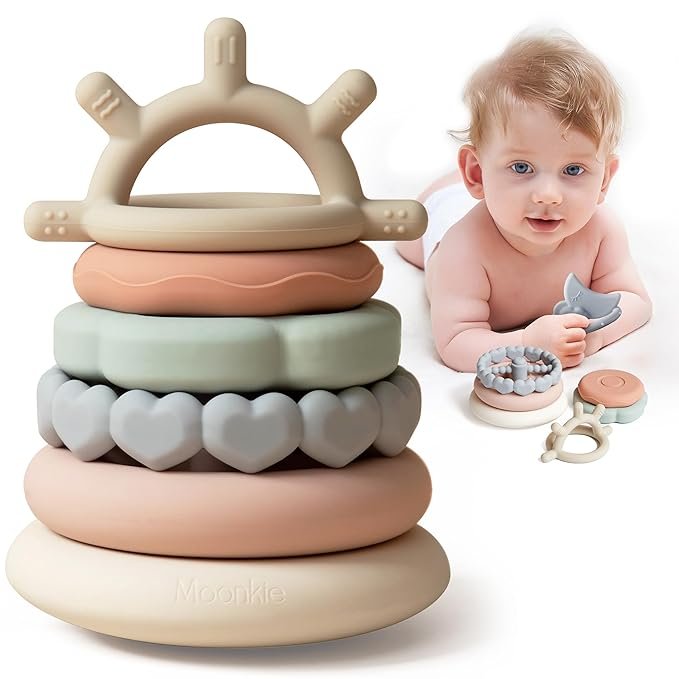
★ Moonkie Stacks of Circles Silicone Stacking Rings beautifully addresses this oral comfort challenge on Amazon by moving the traditional pyramid design into 100% food-grade, BPA-free silicone. Each ring is textured differently from smooth ridges to raised geometric bumps for a spectacular, multi-textured teething set, long before your baby is ready to stack them.
When swatted, the weighted, wobbly base corrects itself, keeping younger infants fully engaged during tummy time.
And then when you take that same soft, chewable formula and put it in cup format, the material opens up a whole new world of household utility.
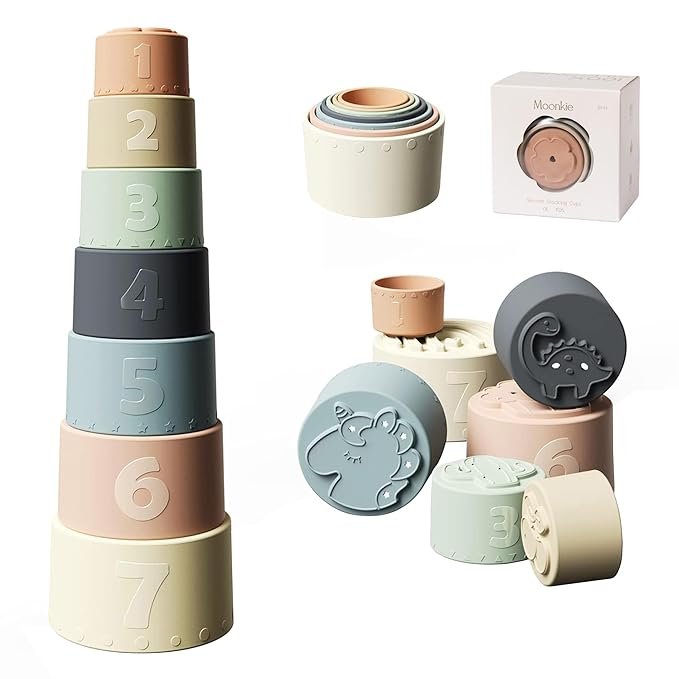
★ Moonkie Silicone Stacking Cups Set Features 7 pastel squishy silicone cups that can be dropped on tile floors, sat on or stepped on, never cracking or chipping or making a loud sound.
Silicone handles temperature changes like a champ, so these cups can be boiled for sanitising, stuffed in a diaper bag for restaurant distraction or used as safe soothing teethers for long car rides.
The Longevity Audit: Play Lifespan & Open Ended Versatility
When we determine the value of a toy, we need to determine its household lifespan: how many months or years will this item actually stay in active rotation before it becomes permanent closet clutter? This is where the structural separation between these two formats becomes painfully obvious.
In essence, a traditional set of stacking rings is one utility puzzle. It has one main script: you put the rings on the post and you take them off.
When a child has learned this physical sequence at eighteen months, the developmental challenge of the toy is zero. The rings are not easy to use for other games they do not hold liquids, they do not roll easily and they do not fit well into other pretend play. The set soon becomes too small.
The cups, in contrast, have a wonderful second life of endless possibilities well into the preschool years. A cup is a simple, multi-purpose container, so its uses will change as your child’s intelligence develops.
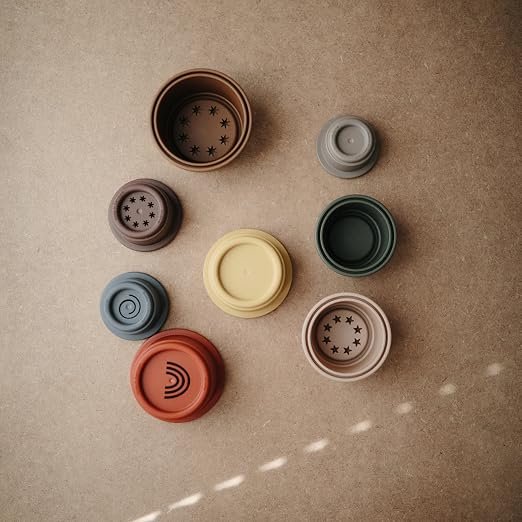
★ The Mushie Stacking Cups Toy is a beautiful Danish design available on Amazon with integrated bottom drain holes stamped in beautiful geometric star and cloud shapes.
As your child reaches toddler milestones and grows beyond simple vertical tower building, these cups transition smoothly into the bathtub or backyard sandbox.
They become water strainers, sand castle moulds and basic tools for exploring fluid mechanics and volume distribution.
By three, those same cups have transformed again, into fake coffee mugs for their stuffed animals, color-sorting bins for arts and crafts, or abstract containment units for loose playground stones. For more tips on how to integrate these early language and sorting milestones into your home life, explore the parent resource databases at our website.
The Last Word
Both toys offer timeless value for a developing infant but stacking cups are the clear winner for parents looking for a toy that will last and offer developmental complexity. Stacking rings are a wonderful, forgiving jump-off point for the early grasp and release mechanics of the first year of life.
But cups require more hand-eye coordination, challenge the brain with stacking and nesting logic, and have a brilliant, multi-purpose lifespan that grows from baby floor play to complex toddler water and pretend adventures.
Test your child’s current confidence in fine motor skills, pick out a quality set made with non-toxic materials, and step back and watch your little builder master the physical laws of their world, layer by layer.
You don’t have to go through these early childhood growth stages alone. Remember we are there for a continuous stream of expert baby care advice, honest product reviews and warm peer validation is always kept in your bookmarks as your trusted digital village.