
Walk into a busy family living room on any weekday morning and you’re sure to see a classic developmental workout. Your toddler is hunched over a heavy wooden board, little fingers clamped around a small plastic or wooden knob. They pick up a piece of cut-out colour, turning their wrist ninety degrees, trying to get it to fit snugly into a matching indentation on the board.
The piece falls flat with a satisfying wooden thud, your child gasps with pride and immediately reaches for the next slot. This type of focused floor work is not just a way to distract you for fifteen minutes of quiet time. Peg puzzles are a total force to be reckoned with mechanically in cognitive development in early childhood.
In their first two years, toddlers learn to master macroscopic movements such as crawling, walking and pushing large carts. When they sit down with a puzzle board, all they think about are micro-movements: visual spatial tracking, fine motor grip calibration, and advanced problem solving logic.
But not every puzzle collection can keep you entertained for long or protect early learning milestones. Family play spaces are often full of cheap options with poorly glued pegs that break off easily, jagged wooden borders that create splinters or paper graphics that peel away under normal toddler drool.
A warped puzzle piece from manufacturing causes the toddler to experience extreme friction and quickly lose confidence, leading to sudden behavioural meltdowns.
Forget the hyper-stimulating digital screen apps and think of the real, heirloom-quality peg puzzles that are readily available on Amazon. Invest in these robust, beautifully illustrated wooden workhorses and give your little learner the ultimate platform to master shapes, categorise animals and map everyday objects all on their own terms.
At Cozy Parents, we assess childhood tools from the perspectives of neuro-affirming autonomy, physical milestone safety and clutter-controlled minimalism. We believe your home should be a peaceful, low-stress ecosystem where your child’s concentration can deepen naturally.
If you want to learn other expert-tested blueprints for creating an intentional, stress-free home, then visit Cozy Parents to connect with practical, therapist-backed playroom strategies designed for real family living.
Engine of the Pincer Grip: Fine Motor Mechanics
For a young toddler, about eighteen months old, a peg puzzle is a physical strength coordinator, above all else. Before their brains have fully decoded that a triangle has three distinct sides or that a cow says “moo,” their fingers must figure out how to pluck a small three-dimensional object off a flat surface and hold it steady against gravity.
The classic thin puzzle piece with no knobs forces a toddler to scoop with an awkward flat hand, often frustrating them when their fingernails cannot get under the wood. A fat, upright peg neatly sidesteps this dilemma, providing an organic gym handle for their fingers.
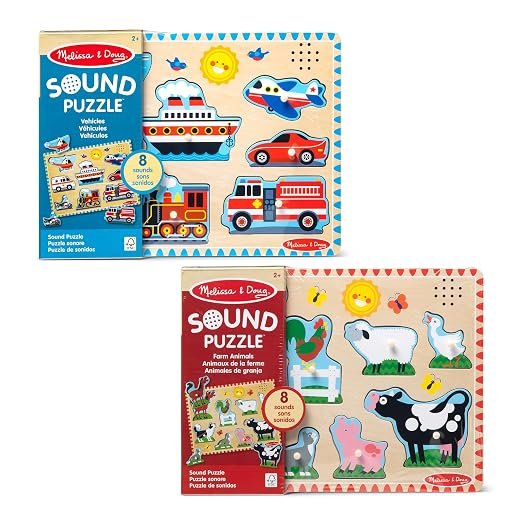
For this early muscular tracking, ★ The Melissa & Doug Classic Wooden Peg Puzzle Set is a spectacular gold standard canvas. You can find this pack on Amazon. It contains dedicated boards on geometric shapes, colourful numbers and primary colours. Each solid piece of wood capped with a high-tensile plastic knob, securely anchored and just the right size for a toddler’s small hand.
When a toddler repeatedly pinches that tiny knob between his thumb and index finger, he’s performing a basic biological manoeuvre called the pincer grasp. That specific grip strength is the same physical coordination they will need later in childhood to safely feed themselves with a spoon, button their winter coats, and smoothly control a pencil at a school desk.
Since each cutout slot has a full-color illustration underneath the piece itself, your child gets instant visual confirmation the second they pull the block out. Their spatial tracking gets better and better . Adding puzzles with slightly bigger knobs and different palm pressures really extends their task persistence .
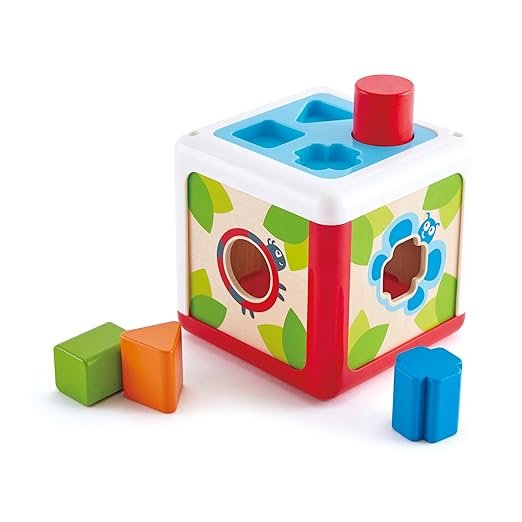
★ The Hape Wooden Chunky Shape Sorter Peg Puzzle features a super thick and heavy duty geometric layout with extra large wooden pegs.
Younger toddlers will have had long focused stretches just feeling the smooth rounded edges of the circles, squares and triangles, exploring the physical weight of the solid timber and being completely screen free.
This finger tracing of 3D edges helps their visual cortex make the connection between 2D abstract representations and actual physical structures, which is the neurological basis to reading math later on.
Small-World Classification of Animals and Objects
Your child’s play takes a giant leap in cognition after age two. They move beyond the basic physical mechanics of moving pegs and dig into language processing and sorting logic.
The puzzle board changes from a motor dashboard to an interactive dictionary where they can classify species, name household tools, and build a massive vocabulary of action verbs.
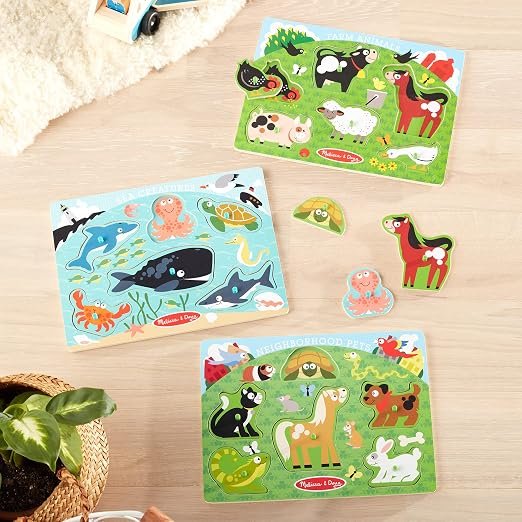
★ Melissa & Doug Farm Animals Wooden Peg Puzzle is a great Amazon find with spectacular, high-traction farm layout that bridges this language transition beautifully. It features eight familiar farmyard animals like horse, pig, sheep and cow it offers a clear visual canvas that supports hours of independent sorting play.
The toddlers like to match the real animal to the correct place it belongs on the pasture background, sort the animals by size and make real animal sound waves.
The style of the underlying puzzle art directly controls the complexity of their cognitive problem solving, at this stage of representation. Their imagination can sort concepts much faster by picking illustrations with clean, iconic shapes than with hyper-busy, chaotic cartoon boards that overload the optical nerve.
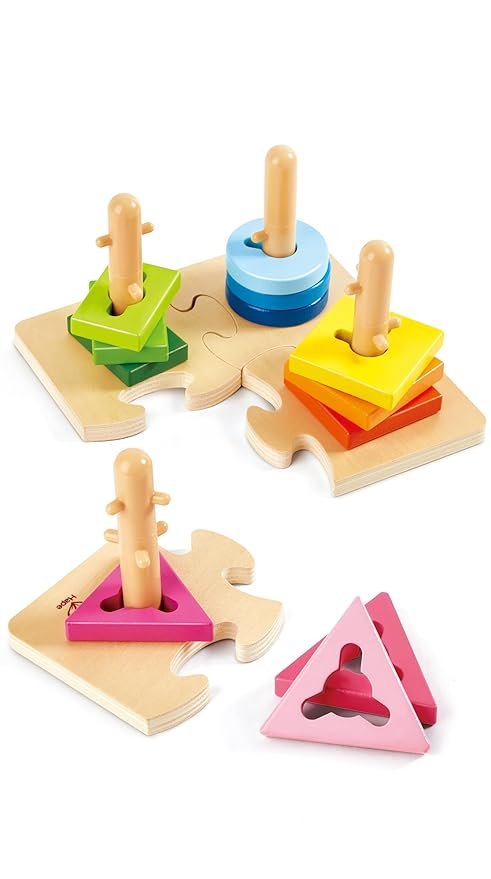
★ On Amazon, The Hape Master Bedroom Wooden Peg Puzzle re-imagines hands-on object recognition with a highly authentic, minimalist interior design.
The puzzle includes everyday objects such as a small bed, wardrobe, lamp and soft rug, enabling toddlers to practice matching abstract wooden blocks to real objects in their own bedrooms.
The design is peaceful and focused, so the child’s brain has to work to understand the functional utility of each household tool. This distinct mental processing boosts their working memory, verbal tracking and routine predictability. For more strategic tips on how to naturally expand your child’s daily speech milestones using spatial puzzles, you can check out the vast parent resource databases at our wesbite.
Strategic Engineering: Advanced Spatial Rotation
The real play value is that a puzzle board can scale up seamlessly to match your toddler’s exploding intelligence, without a hardware update. This means that the toy has a natural self-correcting mechanism that rewards deep task persistence and visual analysis.
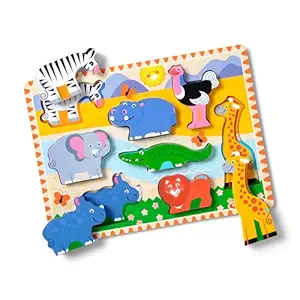
★ Melissa & Doug Pets Wooden Peg Puzzle overcomes the problem of spatial alignment with detailed, uneven animal outlines like a cat’s tail or rabbit’s long ears. Older toddlers have to practice micro-rotations due to this advanced layout.
They can’t just drop the piece from above; they have to carefully tilt their wrists, slide the piece sideways against the wooden border, and wiggle the block until it slips neatly into place.
This independent trial and error creates deep psychological resilience. Your child learns that if a piece doesn’t fit the first time, they don’t have to throw it away in frustration, they just need to assess the mechanical gap, spin the shape and try a new angle.
Freestanding block combinations are a great behavioural anchor when they want to take a quick break from horizontal floor boards and practice vertical balance logic.
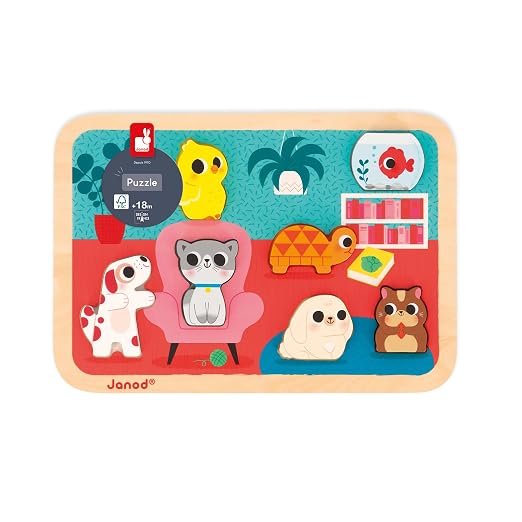
★ Janod Chunky Wooden Forest Animals Puzzle is a great multi-functional addition to any playroom shelf. This creative 2-in-1 hybrid set is available now on Amazon and comes with extra-thick, solid-wood characters that can be used as traditional flat puzzle pieces or freestanding wooden toy figures.
The preschoolers love to balance the thick wooden foxes, bears and deer carefully upright on top of each other to build tall forest towers, lay out imaginary wilderness safaris across the rug and practice delicate hand alignment. This multi-layered utility keeps the set in active rotation for years.
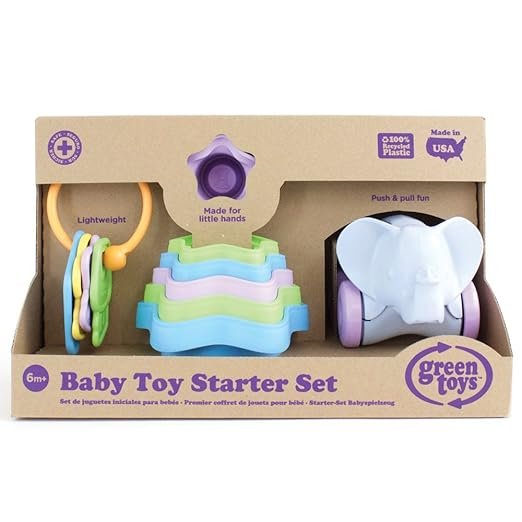
★ The Green Toys Eco-Friendly First Baby Puzzle is the perfect, easy-to-sanitize piece to complete your toddler’s personalised sorting station.
Made in the USA from 100% recycled plastic milk jugs, no external paints, screws or coatings. This four-piece star and frog set is tough enough to be submerged directly in real sensory water tables or outdoor sandboxes and can be tossed directly into the top rack of the dishwasher at night, making it an incredibly low-maintenance companion for real everyday playtime labour.
Reclaiming the Focus Layer by Layer
It’s a beautiful investment in your child’s developing autonomy to skip cheap synthetic flashing gadgets and fill your home layout with high-value, wooden peg puzzles. The sturdy wooden pegs, the eco-friendly non-toxic materials, the high-contrast self-correcting illustrations, all replace the frantic overstimulating noise of modern digital media with the calm, focused purpose of a child mastering their world piece by piece.
Audit your playroom shelving today, clear away the single-utility electronic distractions that do all the cognitive thinking for the child, and step back to let your independent little problem-solver forge his own path to unshakeable spatial confidence.
You will never have to go through these early childhood parenting shifts alone or wonder what developmental gear really drives your family’s daily peace. Stay connected with Cozy Parents to receive the best child development frameworks from experts, playroom layout audits and genuine product reviews.