
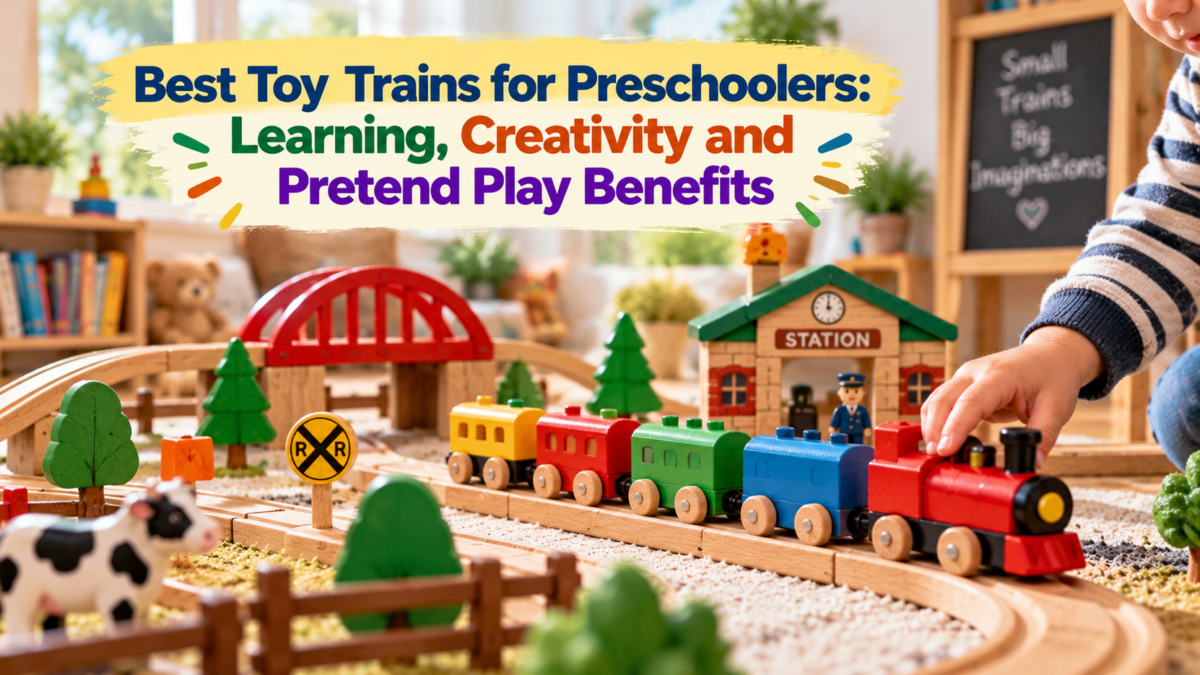
A preschooler pushes a wooden locomotive on two grooved tracks, connects its magnetic coupling to a trailing coal car, and hears the soft rhythmic click-clack of wheels as they round a gentle curve. The child is under an intense, silent enchantment. Watch any four-year-old kneel on a rug for an hour, carefully aligning wooden switches, troubleshooting a bridge that keeps collapsing under its own weight, staging an urgent delivery of imaginary timber to a woodland depot. It’s engineering and symbolic storytelling in perfect harmony. In a world of motorized locomotives zipping along fixed tracks, remote-controlled trains that blare out jarring digital horns and battery-powered flashing novelties that do all the moving and sounding for you, it’s easy to assume that all preschoolers want is digital automation. But these mechanical shortcuts tend to bypass the very things train play is meant to encourage: spatial self-regulation, structural physics and creative self-authorship.
Parents who are looking for train sets to satisfy this domestic obsession are often faced with cheap, flimsy plastic track kits that snap under pressure, battery-guzzling engines that keep derailing, and single-purpose licensed sets that preclude play other than a single pre-determined script. Snap-together plastic sets are flimsy and do not support peaceful, focused play. They frustrate developing hands and quickly languish in messy storage bins.
We think a family playroom should be a quiet sanctuary for focused, self-directed expression. We believe in intentional play, thoughtfully curating durable, tactile, and well-designed resources that honor the developing nervous system of the child and the visual calm of a peaceful, uncluttered home. In this all-in-one manual, we’ll review developmental milestones preschool train play supports, provide practical tips for establishing a low-friction railroad ecosystem, then review seven top-rated, verified train sets and accessories on Amazon US that treat your preschooler as a real engineer of their own miniature world.
Developmental Underpinnings: Cognitive and Kinetic Dynamics of Railroad Play
To be able to understand how train sets are important to young children’s development in the long term, we need to think about how a young preschool brain understands physical physics, three-dimensional geometry and sequential storytelling. “It’s not just a cute pastime to build and run a railway,” says the American Occupational Therapy Association, citing pediatric occupational therapy, spatial development research and early childhood psychology. “It’s a full-body workout for spatial reasoning, fine-motor calibration and executive function.”
1. Track Geometry, Track Closing and Spatial Geometry
Unlike simple vertical block stacking, a preschooler building a functional train track has to deal with topology mathematics. To work continuously, a railroad circuit must physically close. If the curve goes the wrong way, the train will run off into the rug, and two male track ends won’t connect without an adapter piece. From three to five years of age, children have a huge cognitive leap in mental rotation. When children think about using a long straight or a tight curve or a switch track to bring their engine back to the station, they are manipulating shapes mentally and projecting trajectories. This practical experimentation with geometric constraints is the foundation for subsequent mathematical competence and structural reasoning.
2. Fine Motor Grasping, Magnetic Polarity and Kinetic Modulation
Running a preschool train takes subtle fine-motor calibration. A child learning to match magnetic connectors to couple two train cars receives an early tactile lesson in physics and polarity (learning why turning a carriage around causes it to repel as opposed to stick). Driving a five-car wooden train over a raised suspension bridge needs bilateral integration and fine-tuned pressure modulation. Push too hard on the child and the bridge wobbles and the cars uncouple; push too fast and centrifugal force derails the train on the downhill bend. This never-ending feedback loop of touch and proprioception hones the child’s palm arches, finger isolation and hand-eye coordination.
3. Executive Function, Causal Sequencing and Narrative World Building
Preschoolers are natural storytellers who externalize their understanding of societal routines through physical objects. A train layout is an entire living ecosystem: cargo is picked up at the crane, goes through the tunnel, is offloaded at the depot and cleared at the railroad crossing. This sequence develops executive function and narrative scaffolding. Toddlers describe their play in terms of function, using words like “arrived,” “cleared,” “switch,” “heavy load” and “delay.” Children coordinate departures and arrivals, which gives them the opportunity to practice emotional self-regulation, to explore social roles and to turn abstract concepts into concrete, repeatable rituals.
The Product Roundup: 7 Nice Toy Trains and Train Sets for Preschoolers
Look out for train sets that can take some energetic play from your preschooler, and make your space feel in balance. Look for sturdy beechwood or rubberwood (FSC certified) with reliable magnetic couplers, non-toxic water-based finishes and universal compatibility across brands. Here are seven great, highly-rated options on Amazon US that respect your child’s developmental capabilities and align with the CozyParents ethos.
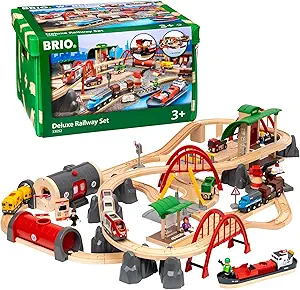
1. BRIO World 33052 Deluxe Railroad Set
A sprawling, heirloom-quality master railroad system with 87 pieces including passenger and freight trains, wooden tracks, bridges, cranes, stations and cargo containers, all stored in a sturdy green plastic storage tub with a latching lid.
Benefits: Since 1958, BRIO has been the global benchmark for wooden railroads. The tracks are made from FSC-certified European beechwood and are satin-smooth with precision-milled interlocking joints that slide together without sticking. The working drawbridge and mechanical magnetic crane add a little bit of realistic cause-and-effect physics. The storage tub, included, is roomy but keeps the entire 87-piece world in one footprint, maintaining living room serenity when the workday ends.
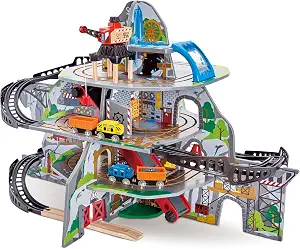
2. Hape Railroad Mighty Mountain Mine Wooden Train Set
Description: Vertical multi-level railroad playset made of sustainable timber and safe bioplastics with spiral mountain track, functional conveyor belt, rotating cargo crane, repair station and obstacle bridge with wooden freight locomotive and carts.
Benefits: Vertical play is an ideal spatial activity for preschoolers, encouraging children to stand, crouch and stretch their bodies as they follow their train down through the mountain. The integrated track design means the spiral mountain is always stable, so there’s no more hassle of loose bridge supports falling over on deep rugs. Its warm, earth-hued palette feels like a deliberate piece of playroom architecture rather than a pile of artificial clutter.

3. Melissa & Doug Wooden Railroad Set (130 Pcs)
Description: Wooden railroad system with 100 solid wood track sections & supports and more than 30 train accessories including six-piece freight train, passenger train, flatbed truck, roundhouse engine shed & suspension bridge.
For families aiming for maximum building versatility, this set provides unparalleled track geometry. Preschoolers can make complex multi-loop circuits and raised tracks with curved, straight, switch and ramp pieces. The solid wood pieces are heavy, giving satisfying proprioceptive grounding for little hands. All tracks and rolling stock are of the universal 1.57 inch gage, so this set fits perfectly with other major wooden railroad brands.

4. 39-Piece Wooden Train Set with Play Bridge by Tiny Land
Description: A curated entry level wooden train set made from superior beech wood, featuring traditional straight and curved tracks, a raised red arched bridge, wooden passenger carriages with magnetic couplers and tiny wooden accessories.
Benefits to Child and Home: A great starter set for families new to wooden railroads . The small 39-piece count allows a child to learn basic oval and figure-eight loops without being inundated with hundreds of loose parts. The tracks which are hand-sanded out of beech wood have a warm, organic, hand feel that removes the cold slickness of plastic and the whole thing sets up nicely on a small nursery rug or low coffee table.
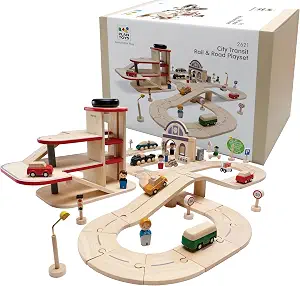
5. PlanToys Road and Rail Transit Set (Rubberwood Solid)
A transit set sustainably produced from chemical-free kiln-dried rubberwood and non-toxic water-based organic dyes, with dual-sided reversible tracks (one side for trains, the other for wheeled cars) and modern rubberwood transit carriages.
Child & Home Benefits: Circular, eco-conscious craftsmanship from PlanToys is known worldwide. The natural wood grain has a velvety matte finish that offers an uncompromising sensory alternative to glossy lacquers. The reversible track design links road vehicles and rail cars, enabling kids to build integrated multi-modal transit systems. The muted earth tones are Scandinavian inspired and work well in serene living spaces.

6. BRIO World 33097 Cargo Railroad Deluxe Set, 54 Pieces
Description: A dedicated industrial themed wooden train set focusing on kinetic cargo handling. Includes battery assisted and manual freight engines, flatcars with removable magnetic cargo crates, two trackside cranes, a container truck and an elevated bridge system.
Child and Home Benefits: This set is a master class in fine-motor tool manipulation. The mechanical dial cranes require preschoolers to isolate their fingers and turn tiny knobs to lift magnetic cargo crates off wagons and lower them right on waiting transport trucks. The sturdy lidded storage box makes cleanup an intuitive, self-correcting sorting game with no small cargo pieces lost under living room couches.
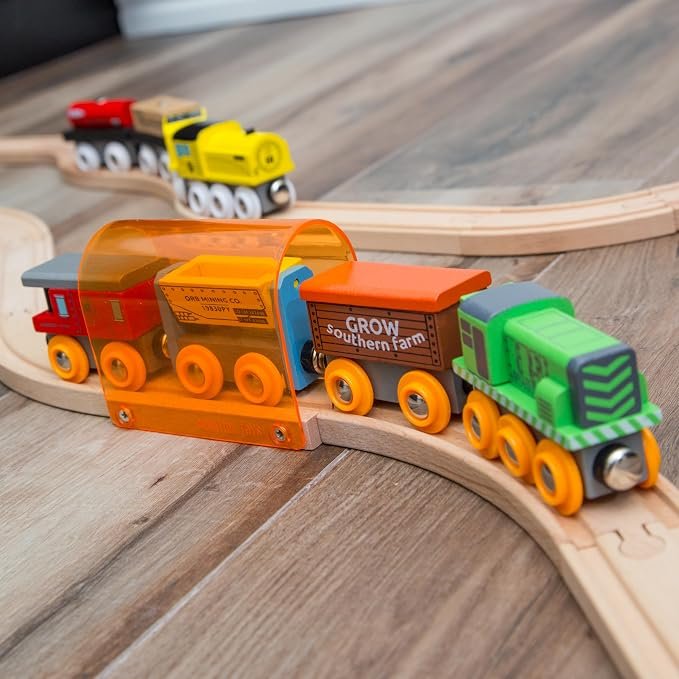
7. Orbrium Toys 56-Piece Wooden Train Track Expansion Set with Tunnel
Description: Solid dense beech wood dedicated universal wooden track expansion pack including a wide variety of short straight pieces, sweeping curves, curved switch tracks, male-male and female-female track adaptors and a tunnel.
Benefits for Child and Home: As a preschooler’s architectural ambition progresses, he’s likely to encounter structural dead-ends where two track pieces just won’t connect. No more track frustration! This pack contains the geometric adaptors and directional switches required to complete the track without parents needing to purchase duplicate trains or commercial accessories. The solid beech tracks are manufactured in one piece without glued plastic pegs so they will last years of heavy stepping and enthusiastic redesigns.
Practical Advisory: How to Build a Low-Friction Railroad Ecosystem
The challenge of owning beautiful wooden train tracks does not end with their curation; it continues with how you organize, store and display them in your home. These decisions will determine if your collection will remain a source of architectural inspiration or devolve into a jumbled mess of wood shavings and floor clutter.
1. The “Track Anchor” and the Rug Boundary Strategy
Toddlers get pretty frustrated when the train tracks keep shifting and derailing on slick hardwood floors. Place your railroad play on a low-pile wool rug, a large canvas drop cloth or a flat wooden play table. The soft surface prevents wooden track connectors from sliding apart as locomotives rumble by muffles the acoustic clatter of tumbling carriages, and offers a distinct physical boundary where the railroad zone begins and ends.
2. Practice Sorting by Category in a Drawer or Bin
Don’t stuff a hundred track pieces, engines, bridges and trees into one big toy box. When they can’t find a simple curved piece to make a loop, they dump the whole bin out and instant overwhelm. Instead, use three or four shallow wooden crates or open canvas bins on a low Montessori shelf:
Bin 1: Straight and bridges.
Bin 2: Curved parts and switch tracks.
Bin 3: Trains on the move and magnetic coaches.
4. Bin: Landscape accessories (trees, signs, figures).
Visual classification of tracks enables preschoolers to discover the exact structural geometry they need. This encourages systematic planning and makes cleanup an intuitive and self-correcting exercise.
3. Accept the invitation to “Track Strewing”
Sometimes preschoolers may walk past a whole tub of wooden tracks and have no idea how to start a complicated build. Take a leaf out of the philosophy of “strewing”: before your child is awake or comes back from preschool, set up a simple oval track with one raised bridge and put a single engine and two carriages at the station. This kind of soft, slow visual cue lowers the threshold, triggers intrinsic narrative curiosity, and invites the child to lift the locomotive and begin to extend the railroad without any adult intervention.
Comparative Study: High-end Wooden Railroads Vs Mass-market Motorized Plastics
When shopping for train sets for your home, parents are faced with a clear choice: heirloom-quality, sustainable wooden systems or cheap, disposable, mass-market plastic playsets. When you look at the choices across the core operational measures, you see why investing in solid wood makes for a profoundly better play experience.
High-end solid beech and rubberwood decks, in terms of durability and longevity, easily outlive generations of drops, heavy footfalls and enthusiastic toddler demolition. The tracks are milled from a single piece of hardwood with integrated connector nubs that can’t break off. Cheap mass-produced plastic train tracks have thin brittle injection-molded tabs that break under the weight of a single toddler step, rendering entire sets useless within weeks.
Purposeful wooden railroads are meant to complement living spaces for functional storage and home integration. They’re designed with warm, organic timber shades, tactile matte finishes, and standard geometries that pack flat into low wooden crates or canvas bins. Mass-market alternatives are found in large, single-use blister packaging and are reliant on loud, fluorescent neon colorways that dominate room sightlines and contribute to household visual clutter.
From an ergonomic and physical feedback point of view, high-grade wooden trains are weighted to their scale, offering grounded tactile resistance that trains hand strength and spatial control. Plastic novelties for the mass market are notoriously hollow and feather-light, offering no tactile feedback and falling off tracks in an ungainly way, leading to preschooler frustration and erratic throwing.
Intentional sets are created with an emphasis on hygiene, safety and chemical integrity, using non-toxic, child-safe water-based lacquers, organic beeswax or chemical-free kiln-dried hardwoods that include no BPA, phthalates or PVC. The cheap, mass-market kits have strong chemical plasticizer odors, unverified, corroding battery parts, and tiny glued-on parts that are hazards for detachment.
Finally, in terms of developmental and therapeutic value, simple wooden trains are an open-ended, non-prescriptive tool for self-directed engineering. They don’t tell the train where to go, or sing annoying digital songs at the press of a button. They respect your child’s creative self-authorship, allowing them to build their own paths, solve complex circuit physics and feel the quiet pride of bringing their own miniature world to life.
Building Calm and Confidence
To choose a true wooden railroad for your preschooler is to invest in their structural reasoning, their fine-motor dexterity and their imaginative autonomy. By providing tools that celebrate the simple, mechanical beauty of physical physics without the distraction of digital noise, you carve out a calm, purposeful space where their focus can flourish.
At CozyParents we believe every item in your home should serve a distinct developmental purpose, foster real family bonding and contribute to the peaceful environment in your home. When you sit on the rug with your child, hear the soft rumble of wooden wheels on timber tracks, and watch them carefully set a switch to let a freight train pass, you are doing much more than playing with toys you are helping them lay the tracks for lifelong confidence.
Visit CozyParents for intentional family frameworks, expert-approved gear roundups, and mindful parenting strategies for your growing family. Is your preschooler constructing a favorite track layout again and again? Or are you designing your first low shelf railroad setup? We’d love to hear how you go about creating peaceful and intentional spaces in your homes, so please share your experiences in the comments below.